Archives for 0

Too Much, Too Fast = Burnout

Do not let anyone guilt you into doing more than you (or your kids) can handle. Burnout comes from too much, too fast. Just because another family is studying Latin, Greek, and Hebrew in Kindergarten, it does not mean that you should, too. It also does not mean that the other family will actually learn anything from it, or continue it to mastery. They may be well on their way to being the next family to give up homeschooling and re-enroll in public school.

The “right way to homeschool” is the way that is comfortable and relaxed and fits your family’s lifestyle. Do not take this business too seriously — make it enjoyable. Homeschooling already far exceeds the standard set by government schools, and Homeschool Burnout is caused by trying to do too much, too soon, to other people’s standards.

Begin by teaching your beginning student to read and count. The simplest methods are often the best: Alpha-Phonics teaches reading just as well as the $200 programs, but for 1/10 of the price. If you find you need flashcards or other manipulatives, make some yourself with your student’s help, or shop your local thrift store and see what goodies can be found there. The Getty-Dubay Italic Handwriting Series was my favorite for very simple-but-elegant penmanship that, incidentally, converts later to cursive with few changes and little difficulty. Pick up a set of Cuisenaire Rods and introduce Miquon Math at 1st grade. If you already have some simple storybooks and a library card, you are now well equipped for the first few years of homeschooling. History, science, geography, health — all those can wait until 4th grade when your student has a confident grasp on reading and is ready for some broader subject matter and a wider look at the world.

Language Arts is a catch-all phrase for reading, phonics, spelling, handwriting, grammar, and composition. My advice is: you know what your child is interested in, and you know what your child is capable of. If little Melissa wants to write stories, by all means let her, even if it means she dictates while you act as scribe. If Scotty gets bored stiff doing workbook pages for spelling or phonics, dig out your old Scrabble game and let him form this week’s words with the letter tiles. “Thinking outside the box” may be a modern cliche, but it definitely applies to homeschooling. Playing with letters/sounds, forming those letters/sounds into words, and grouping the words into sentences is how we all learned to talk. Now it is how your student will learn to read.

Classic Literature Is Not Necessarily Good Literature

Yes, Johnny IS reading, but WHAT is he reading? Decide if the subject matter is something you want your student to devote hours and hours to before you assign the book. Many selections being sold today as “must have” children’s books are not anything I would want to have in my home. Contemporary children’s authors seem to think sibling rivalry is to be encouraged, unacceptable behavior is heroic, and deplorable grammar is an effective method of identifying with the reader.

I recently read an advertisement for a children’s museum exhibit featuring a popular cartoon character. The theme of the exhibit was “Reading is Cool.” I happen to disagree. Reading, as an isolated activity, is not necessarily cool. The subject matter could make the reading into a very “uncool” activity. We should be teaching our children not only the skill of reading, but also teaching them the much more important skill of selecting quality reading matter: is this book a good model of grammar usage, or does the author continually “break the rules” in an effort to grab an audience? Is the subject matter worthy of my time, or do the characters run contrary to my family’s standards and values?

Additionally, just because a story has been around for decades does not make it worthy of your time. Many “classics” (as described by literary critics) merely focus on subject matter that no one else had yet dared to tackle, e.g. The Scarlet Letter/adultery. Before taking a recommendation from anyone, know what their standards are. The same standards-screening principle applies to movies, videos, computer games/software, etc. as well as books. Occasionally, I felt the need to read a book myself to determine its worthiness before allowing my student to read it. Not only was it a great use of my time, but it also gave us a wider scope in discussing the book later — plus the student was able to see a parent devouring a book, something all too rare in today’s video-saturated world.

Give Credit Where Credit Is Due

List credit on your student’s high school transcript for non-traditional classes. It may not be a “recognized” curriculum title, but if it is a learned skill that they have developed, it proves they have the ability to teach themselves.

For example, if the student has devoted considerable time to an independent project (stamp-collecting, designing/making beaded bracelets, training horses, digital photo-editing, etc), think up a course title and write an appropriate description for it, listing any reference books as “texts used.” Include out-of-classroom work as well, such as seminars attended, etc. The “course descriptions” page of their transcript will provide the complete explanation. (If you are interested in how to write a transcript, see Transcript Writing.)

Listening to CSN radio (or to your pastor’s Sunday teaching) counts as Bible class; just because you have always listened to it, and would listen to it anyway, does not mean it should be overlooked as a “credit” course. The same applies to AWANAs, Sunday School, Royal Rangers, or similar structured classes your students attend.

Mastery vs. Perfection

There is a difference. Mastery focuses on the big picture and ignores insignificant details. Perfection gets sidetracked on minute details, while often missing the bigger picture entirely.

In our homeschool we strive for mastery by trying to learn the concepts offered. I only give one grade, it is 100%, and you get to keep trying until you have achieved it. The point of going over a lesson more than once is to ensure that the concepts have been grasped. This does not mean that the student is force-fed the same lesson over and over in the same way until the skull gives way and accepts the information. Instead, I try to explain and illustrate the lesson in as many different ways as possible, until the little light bulb above the student’s head finally comes on. This also means that I, as the teacher, fully have to understand the concept being taught, so that I can effectively pass it on to my students. Sometimes that has meant that I studied the math book ahead of time and taught myself the lesson first, before I was capable of passing on the information. (Saxon‘s Advanced Math was a continual race as I hurried to keep problem sets done ahead of my son, knowing that if he ever hit a snag, I did not want him to have to wait while I learned the past 30 lessons in order to understand this one.)

Perfection would recopy math problems until each digit was perfectly identical to all others of its type. Perfection would wear holes into the paper erasing seemingly minor imperfections, and then desire to recopy the entire paper because the holes were unacceptable. Perfection would never finish a single assignment, because true perfection can never be attained this side of heaven.

Please, Parents, in all your efforts to raise well-behaved, highly motivated, excellent children, please do not inflict them with the curse of perfectionism. Allow your children to leave a project “as is” rather than stressing out over unimportant details. Help them to notice things in real life that are not perfect, but function just as well in spite of their imperfections. Encourage your children to do their best, while at the same time reinforcing the concept that their best is what is desired, not someone else’s best. If we are each doing our own best, we can be pleased with our efforts and have no reason to feel disappointed or ashamed of our achievements.

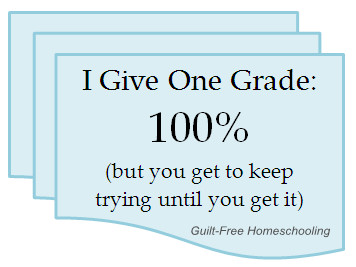
I Give One Grade: 100% — But You Get to Keep Trying Until You Get It

A lesson learned is a lesson learned. We will not move on until you know it, but also we will move on as soon as you have learned it. If you know to start a sentence with a capital letter and put a period at the end, you probably do not need to do that for all 6 pages in the workbook!

If the child has learned the lesson, does it really matter how he/she learned it? It is the final results we are after: learning is learning no matter how long it takes. Did you read The Chronicles of Narnia or C.S. Lewis’ rough drafts of them? Did you wear the dress with the collar put on backwards, or did you fix it first? Did you give away batches of burned cookies for Christmas gifts or bake new ones? I give only one “grade” in our homeschool: it’s 100%, and you get to keep trying until you have made it. That does not always mean re-writing the math problems until they are perfect; it means we go over the concept until you have understanding. (Some kids need to write it, others just need to understand it.)

A public middle-school teacher (acting as the supervising teacher) recommended that a homeschool family not list any grade lower than an “A” on their transcripts or other official records. Her reasons: “The work your children are doing is far above the level of what their counterparts are doing in public school. Also, you are finishing every book — we never finish a book. Therefore, your children would be considered ‘A’ students in public school.”

In Mary Pride’s book Schoolproof, she relates a story of how her father (who taught philosophy) asked her what grade she would give to a student who had earned an “F” on his first test, a “D” on the second, a “C” on the next, then a “B”, and an “A” on the final exam. Young Mary thought carefully, and then replied that she would average a “C” for the course. She tells that her father shook his head and told her that she was wrong. The student had earned an “A” for the course, because he finally had mastered the material.

Name This Figure, or Are There Really Any Wrong Answers?

Math book shows a hexagon and says: Name this figure. Student’s answer reads: Bob.

Mom gives the following illustration to show “3 lefts make a right”: Picture in your mind that you are going out the front door. Go down the steps to the front sidewalk and turn left. Now walk three paces and turn left again. Walk four more steps and turn left again. Now, which direction are you facing? Student answers: Forward!

Does the sun rise in the east? No, the earth turns to reveal the sun.

These are a few real-life examples from our homeschool of how there are really no wrong answers. It may not be what is listed in the answer key, and it may not be the answer you were expecting, but it may not be wrong either! Two plus two is still four, not six, but with less-concrete subjects we may need to take those answers with a grain of salt. Government schools were originally formed with the intent of producing a “working class” of compliant non-thinkers who would obey without question. I prefer to encourage creative minds to think for themselves and look at things in new ways.

Knowing How to Find the Answer Is the Same as Knowing the Answer

Where in real life are you required to have the answer to every problem or question on the tip of your tongue at a moment’s notice? Even doctors and lawyers must do research and use reference materials: they are not required to know everything at all times. Contrariwise, a worker (at any kind of job/career) who has no idea where to begin looking for an answer to his problem will not have a very promising future. Therefore, teaching our children how to use reference materials and how to do problem solving are the greatest skills we can impart.

I taught some history/geography classes in our homeschool co-op group that were run game show-style. The students were given lists of facts ahead of time that they would need to know in order to answer random questions, but they were also told that they would be allowed to refer to those lists during the game. I gave them brief instructions on how to read through the material and highlight keywords. It was fascinating to see how these middle-school-age scholars took to the concept! When they showed up two weeks later to play the game, their notes were appropriately marked up, they dived into the stack of papers with enthusiasm when a question was put to their team, and they knew exactly where to find a remarkable amount of facts in a surprisingly short period of time.

Verified by MonsterInsights