Archives for 0

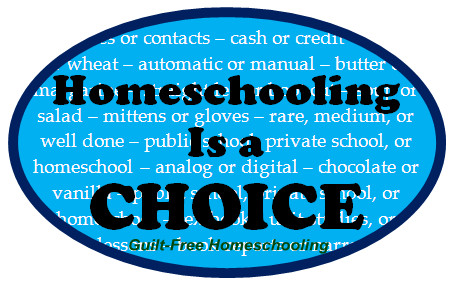
Homeschooling Is a Choice

Our lives are filled with choices:
— glasses or contacts
— milk chocolate or dark chocolate
— cash or credit
— white or wheat
— automatic or manual
— butter or margarine
— straight leg or boot cut
— soup or salad
— analog or digital
— chocolate or vanilla
— mittens or gloves
— rare, medium, or well done
— public school, private school, or homeschool

When we first began questioning acquaintances about their choice to homeschool, they all were very reluctant to divulge anything. We persisted with a few and finally succeeded in getting some friends to open up and share their perspectives. We were not assuming that our situation would be identical to theirs — in fact, quite the opposite was true: we knew our exact situation was uniquely ours, but we wanted some information for comparison. However, the homeschooling families we spoke with seemed fearful of influencing our decision by explaining the reasons behind their choices. No matter if the question was whether to leave public school or how to select a phonics program, whenever we asked, “Why did you choose this?” they seemed to hear, “What do you think we should do?”

If I ask if your opinion of a certain movie, I will also ask you for your reasons: was it funny, was it violent, was it vulgar, was it cliched, did it “work”? I prefer romantic comedies; if you prefer historical dramas, personal recommendations may be of little value. If you ask me about a specific type of homeschooling material, I will give you my reasons for liking or not liking it. Materials can have excellent qualities, but not meet my students’ needs, or materials can be less than ideal, but still be good enough to suit a short-term purpose or a limited budget. Knowing information about the material itself will be much more helpful to you than simply knowing whether or not I liked it. In selecting homeschooling materials, your family’s needs should be more influential than another’s personal opinion.

Choices are also subject to change, depending on present situations. Once upon a time, I could not drive a manual transmission automobile, evidenced by my brother’s frustration as he tried to teach me. His job would have been easier if I had known how to drive anything at that time, but years later, a friend taught me to drive a stick shift, almost as quickly as my brother had given up. I had changed, and my motivation had changed. When I had a good reason for wanting to drive a manual transmission car (my husband and I had just purchased one as our only vehicle), I was suddenly very motivated to conquer this gap in my education. Once upon another time, I had no personal interest in homeschooling, but my opinion changed as quickly as my children’s needs changed. Our original choice for public school was replaced by a choice to homeschool as the standardized education proved inadequate for my children’s individual needs.

During our first years of homeschooling, I was anxious to “fit in” with other homeschoolers and do things “right.” I wanted to see and hear how other families did things, if for no other purpose than to glean ideas that we could apply. As time went by, I began to free myself from the more manipulative members of our homeschooling community, those who tended to insist that every family should be studying the exact same topics that they were studying and to the same extremes. We participated in once-a-month activity days, but we did not extend our participation much beyond that. Occasionally, an activity that did not appeal to us would conveniently conflict with our schedule, freeing us to stay home, Guilt-Free. Later on, when I had fully developed my own style of homeschooling, I knew I was free to reject the other methods of homeschooling that were pushed at me.

We are an eclectic family. We are spontaneous, rather than scheduled. We have antique furnishings sitting right beside contemporary pieces. We enjoy what we enjoy, because we enjoy it. Other families thrive on structure, live by their tightly scheduled calendars, and absolutely adore having someone else select everything they need for homeschooling and deliver it all in one package. Still others like to spend months on one topic, delving into all possible aspects, before moving on to the next thing. The differences between us are rooted in our families’ preferences and reflected in the choices we make.

My choice is my choice. Your choice is your choice. The choices others make may have little bearing on what choice I ultimately make. I will probably check into several options before making my final selection, and what I do pick will be the best for my family as a unit and as individuals. If I make a choice too quickly, I may regret it and need to try again, or I may be satisfied with my first choice and find no need to change.

I chose to educate my children at home, parting company with the public school system. Some of my friends also chose to homeschool, many more chose public school, and a few chose private school. Of my homeschooling friends, some leaned toward a classical education, some opted for unit studies, and others chose the school-in-a-box, prepackaged curricula. I took a little of this and a little of that for an eclectic approach. Neither a more structured plan nor a total avoidance of textbooks is better or worse than the mixture that I used; it is simply different.

Pressures to conform to others’ choices come from all sorts of outside sources, and maintaining your focus takes diligence. Even now, I am often invited to branch out from this writing to become involved in other facets of writing for homeschooling. When that happens, I remind myself of my purpose and my goals, making it easier for me to discern distractions from opportunities. If you choose to teach your children at home, know why you chose that, and remind yourself of your own purposes and goals as often as necessary to maintain your focus. Do not consider the mere presence of an option to mean that you must accept that offer. Choosing means saying either yes or no.

When acquaintances ask about homeschooling, there is no harm in sharing your choices and the reasons behind them on an informational basis. Encourage those who are going through the choice process to choose what seems best for their situation, because circumstances can change, and our choices may someday be changed also. Remember that the final choice is theirs, and what they choose may be different from your choice or my choice, but it may still be the right choice for them.

Our lives are filled with choices:
— glasses or contacts
— white or wheat
— analog or digital
— chocolate or vanilla
— public school, private school, or homeschool
— textbooks, unit studies, or video lessons
— book reports or narration
— repetition or exploration

What are your choices?
Surviving the First Year of Homeschooling after Leaving Public School

I understand your frustration. We began homeschooling after our older child had spent several years in public school (our younger child spent only Kindergarten in The System). We felt strongly that God was leading us to take responsibility for our children’s education, but we had a difficult time finding adequate support from other homeschoolers. Most of the other homeschooling families we knew at that time had been educating their own children from the beginning and had never experienced the trauma of feeling that public school had failed them. Parents often write to me, seeking encouragement and advice in surviving this transition from public school to homeschool. I know exactly what they mean. It is a completely foreign situation, somewhat like starting over from the beginning, but with students who cannot afford to lose any ground.

Children who undergo this change from public school to homeschool will experience abrupt (but not disastrous) changes in environment, teaching styles, and learning situations. These changes will usually affect behavioral changes in the child — sometimes for the better, sometimes for the worse.

The environmental changes may put the child on an emotional roller coaster. If he had difficulties at public school or did not enjoy that experience, he may be relieved to be away from that setting. At the same time, he may miss some of his acquaintances or the reliable routine of scheduled activities. Enjoying school, not enjoying school; missing the other students, not missing the other students; excitement, depression; up, down — most children do not have the maturity to effectively cope with the emotions they will experience through this process without help and hugs from their understanding parents.

If the student is eager to adapt to homeschooling, the teaching parent will not have much difficulty during the transition phase. However, some students are not in agreement with a parental decision to leave the public school and view the change as something to rebel against. In this case, their behavior may become uncooperative and stubborn and include what I call the “Limp Spine Syndrome,” that tendency for a child’s entire body to go completely limp whenever you urge him to pick up a pencil. The simplest assignments may drag on and on, and work that the child could easily have accomplished within a few minutes’ time may stretch out to last an entire day. If the child had formerly been an attentive student in the public classroom, he may just be dawdling at his work in an effort to substitute Mom’s companionship for the classmates he is missing, or he may be seeing this extended class time as a way to monopolize Mom’s time, keeping her from completing other household tasks, and thereby punishing her for taking him away from his former friends and associates. Students who are used to having homework assigned to be done later may not immediately grasp the concept of doing their work during class time. A casual discussion of expectations between teaching-parent and student may clear up many misunderstandings and motivate the child with the promise of free-time activities once the schoolwork has been completed.

Since this new arrangement is homeschooling, not school at home, it will undeniably be different from what the student had been used to. The style of teaching necessary for a roomful of children is not at all suitable for just a few students. At the same time, the learning skills used in the large group setting are not the same skills necessary for the more self-directed format of homeschooling. Another common cause of disinterested learners is lesson presentation in a manner that does not appeal to the child’s learning style: giving oral explanations to a student who learns best through building 3-D models, or assigning a student to read a chapter of history when he would rather participate in a reenactment.

Spend some one-on-one time with your child, endeavoring to learn what things he is interested in and how he would prefer to study them, and then tailor a few lessons specifically towards those areas. Topical Index: Learning Outside the Books contains ideas for lessons that will be more appealing than the average dry textbook. If your reluctant student is interested in guns and soldiers, rent a few factual war movies (look for older movies that do not require the modern cautions against adult scenes or foul language) and watch them together, followed with brief discussions of various scenes or characters. If he is car crazy, challenge him to research comparisons on new models or prototypes. Find his areas of personal interest and focus on those. It can make a tremendous difference in his level of motivation and create a valuable bond between the two of you at the same time. (Mom is letting me study this?) Remember, education was taking place long before the first textbook was ever written. [Also see Topical Index: Learning Styles.]

Teaching and learning are difficult enough with only a few subjects — there is no reason to complicate matters by tackling too many subjects at once. When neither your student nor you as teacher has had any experience at homeschooling, allow yourselves plenty of time to adapt to this new routine before worrying about covering all the bases. A student who cannot read well cannot fully grasp history. A student who has not mastered handwriting will find creative writing to be needlessly tedious. Get the basics covered well first, and then other academic subjects may be added in later. [Depending on the ages of your students, you may be able to adapt some ideas from Start with Reading, Handwriting, & Arithmetic, and Save the Rest for Later.]

A parent recently mentioned to me that her student had previously been given prescription medication to compensate for a learning disability while in public school, but he did not seem to have a need for the medication at home. The child also seemed to be struggling with that inconsistency — why was the medicine needed for learning at school, but it is not needed for learning at home? Let me bluntly say that I feel public schools have become much too liberal in assigning “disability” labels, and children are being over-medicated, sometimes needlessly medicated. I do not discount the possibility of children with legitimate problems in learning, but I also think medication should not be the first choice in conquering those problems.

If you are struggling with homeschooling, be encouraged — the first year is always the toughest. Remind yourself that you have chosen to homeschool your children for very important reasons. There is a definite adjustment period involved in switching from public school to homeschooling, and that period can last at least a year. If you are currently in the critical transition stage between public schools and homeschooling, I suggest you browse through my Indexes for a larger dose of encouragement. I will list a few past articles here for you to start with:
Questions from a First-time Homeschooler
Homeschooling Is Hard Work
Do the Best Job You Can, and Pray for God to Clean Up the Rest
What Didn’t Work for Today Can Be Changed for Tomorrow
Homeschooling an Only Child
Meatball Education: Filling in the Potholes of Public School
Spoken Destinies and Learned Behaviors
Are We Homeschooling or Schooling at Home?

Start with Reading, Handwriting, & Arithmetic, and Save the Rest for Later

If you are just beginning your homeschool journey with a Kindergarten student, you may be wondering how much to teach him (or her; I use “him” generically). Many Moms who are eager to homeschool are busily planning lessons far in advance for elaborate historical reenactments or highly involved scientific experiments. I have often advocated that families just beginning to homeschool their wee ones should focus on just the “Three R’s” of reading, ‘riting, and ‘rithmetic without worrying about supplemental subjects until the mid-elementary years. Incredulous teacher-moms let a gasp escape from their open mouths and ask me if I am serious. I am.

I am also assuming that you have not allowed the past five or so years to slip by in silent inactivity. I am assuming that you have read books to your child, colored pictures with your child, sung songs, made crafts, played with puzzles, gone shopping and baked cookies together, and had all manner of delightful experiences together. You have most likely already taught your child how to count to 10, print his name, tie his shoes, sing the ABC song, and identify the colors in a box of eight crayons. You taught these skills without even thinking about it being “formal education.”

Now that you are ready to tackle “school,” you may find yourself wondering if history should come in chronological or geographical order. I say wait on the history. Wait on the geography and the science, too. Wait until at least fourth grade before introducing these more complex subjects. Your child needs to have a foundation of learning skills to build his education upon. Those learning skills are what you need to teach first — now.

Reading
Teach the ABC’s, if your child does not already know them. Teach your child the sounds made by each letter, not merely the letter “names.” For example, the letter “H” makes a “hah” sound, which is not really apparent when you simply call it by its name. Once your student knows the basic sounds made by each letter, he can understand how to string those sounds together to form simple words. Phonics lessons (free, downloadable lessons are linked here) can help you start with a simple order and progress in a manner that is not confusing to your child. Small, short-vowel words are the typical starting point, since they have no silent letters or other complicated rules. After your child has begun to read simple, short-vowel words, he will be able to comprehend the complexities of silent letters, consonant blends, and diphthongs (the new sounds made by combining consonants, such as “th” and “sh”).

Do not over-simplify learning to read (from your child’s perspective, it is difficult), and do not become frustrated if your child does not catch on immediately. You have probably been reading for at least fifteen years, so you have likely forgotten what a stressful experience it can be if rushed. Take it slowly, allowing plenty of time for your student to grasp each step, and encourage him for each accomplishment. The confidence you instill at this stage will serve your child well as he tries to read each new word, page, chapter, and book. Readers are made, not born. A child who becomes discouraged while learning to read is not likely to become a bookworm. A few children are eager to learn to read at four years of age, but also a few children (most often boys) may have difficulty grasping the concepts until age seven, eight, or nine. If your child does not respond well, put the lessons aside and wait a couple of days, a couple of weeks, or a couple of months, then try again. When you teach at a pace which allows the student to fully understand each component before moving on, the student who is ready to learn will show quick results. (Remind yourself that one of the reasons why you chose to homeschool was this exact one of working at your student’s pace, not forcing your student to comply with a scheduled academic calendar.)

Once your child begins reading, continue to expand his reading ability through advanced phonics studies and vocabulary-building exercises. This is a good time to introduce the dictionary for any unfamiliar words he finds in his reading material. I preferred to teach this by example, looking up a word with my students at my side, showing them the entry, and briefly explaining it. After a few repeats of that, I switched to asking them to get the dictionary for me, and before long, they were flipping through its pages, racing to be the first to find the word. Handling the large dictionary was a privilege that instilled in my students a fondness and longing for the secrets of knowledge it held. I did not want them to view “look it up” as a punishment, so I made sure they saw me using the dictionary often for personal reference. (I also kept the dictionary on a bookshelf in the kitchen, since that was where we usually were when a question arose, and it helped to remove the stigma that can accompany large, imposing reference books.)

Encourage your young reader to explore a variety of subjects through reading and let trips to the library become adventures in exploration, but hold off on the formal lessons in other areas until he has a firm grasp on the basics of reading, handwriting, and arithmetic, usually around fourth grade. Allowing your student to read as much as he wants on a subject will only whet his appetite for more information, providing you with an eager student who is already learning how to teach himself.

Handwriting
Along with visual recognition of letters comes the child’s natural attempts to reproduce them, but do not expect shaky fingers to produce beautiful calligraphy with the first try. As with any other life-skill, practice is necessary to develop excellence. Once again, discouragement can be a confidence-killer, but the wise parent will praise every legitimate attempt to train those fine-motor muscles to accomplish this new task.

When my children were in public Kindergarten, it was a common practice of their educational establishment to have “mentors” visit from the older classrooms. Students from the third or fourth grades were paired with the youngest learners for the purpose of being scribes: the younger student dictated a story while the older student wrote it down. While that works well in theory, I felt it did not work well in practice; most adults cannot write (or even type) as quickly as someone can dictate. The activity was intended to link reading skills with handwriting skills, but often limited the imagination of the younger child’s mind to the note-taking ability of the older student and resulted in a story that the Kindergartner could not read for himself. I heard many youngsters proudly proclaim to their parents, “I wrote this story!” When the enthused parents asked, “What does it say?” the confused authors had to admit, “I don’t know,” because they could not read the words that had been written for them.

In my opinion, beginning students should have opportunities to practice handwriting that do not involve creating stories… yet. We allow children to learn to read each letter/sound before we teach them to string those letters/sounds together to be read as words. We teach them to put those words together into short, easy-to-read sentences before we assign entire books for reading. We provide them with many beginner books before we offer them their first chapter book to read. I think the same system should be applied to handwriting — copying many letters, and then words, and finally simple sentences to gain mastery of the physical skill of handwriting — before the brain-exercise of creative writing is added into the mix.

I remember taking one of my favorite storybooks as a child and copying word after word, sentence after sentence, page after page into my Big Chief tablet. It was not assigned homework; it was my own idea, in order to practice this new skill called handwriting. Thinking up an original story requires an entirely different set of skills than the ones needed to put that story onto paper. Attempting too many new skills at once can leave the student muddled in confusion.

Arithmetic
Children need to have a solid understanding of number concepts before adding and subtracting will make sense to them. Most adults can quickly recognize the amount of money represented by an assortment of coins, but few five-year-olds have achieved that ability. Your Kindergartner will benefit from much practice in counting and sorting, learning to associate digits with their values. Once the basic concepts of 1-10 are mastered, the average child is ready to understand eleven, twelve, and so on, and the foundation is laid for understanding our numbering system based on units of ten. Carrying, borrowing, and even decimals are merely extensions of the basic unit of ten. Addition and subtraction are easily mastered by the child who fully understands number values.

Continuing practice and expanding the skill levels in each of these areas will fill the majority of your homeschool day. Obviously, the child working on these skills does not need to spend hours and hours at them each day. Most public school kindergartens operate for 2 1/2 to 3 hours each day, and large portions of that time are spent in recess, bathroom breaks, learning to stand in line, being reprimanded for talking out of turn, and the other necessities of large-group crowd control. It is common for a five-year-old child to complete a full day of homeschool classes in under an hour, and that time can be divided up into smaller blocks throughout the day, depending on the child’s attention span and the other needs of the household (for example, if Mom’s attention must be shared with an infant sibling).

No one would consider building a house by starting with the roof: the foundation must come first. So it is with education: learning to read is the foundation for education. That base must be securely in place before other things are attached to it. Reading is the visual recognition of language; handwriting is the physical application of that language. Understanding the values represented by numbers and using them to count are the equivalents of understanding the sounds represented by letters and using those letters to form words. Patiently wait until your child is reading fluently to add other formal academic studies, such as history, geography, and science. Help your child develop a love of reading first, and then let the pleasure of reading lead him into other areas. And, by all means, please continue to read books to your child, color pictures with your child, sing songs, make crafts, play with puzzles, go shopping and bake cookies together, and have all manner of delightful experiences together.

Verified by MonsterInsights