Archives for November 2006

Applying Learning Styles with Skip-counting

I have often written about learning styles and how each person can relate to material presented in certain ways better than they can grasp the same material presented in other ways. Today’s lesson is for the parent who is saying, “Okay, I understand that this child is more auditory and that child is more visual, but what do I do with that information?” I will walk you through a basic lesson for early math, skip-counting. While giving you some tips for teaching skip-counting, I will also show you how to adapt any lesson to cover each of the various learning styles. Covering all learning styles in a lesson will enable all of your students to learn the material at the same time and give each student a more complete understanding of the material being presented.

Begin by explaining the principle of skipping to your child: walk across the room with him, then skip across the room with him to illustrate how skipping covers the same distance faster and requires fewer steps than merely walking does. Explain that skip-counting is a short-cut way to count things, by using fewer steps and skipping over certain numbers to cover the distance faster.

Children love kinesthetic applications, so if the weather allows, let’s take the math outside. Use sidewalk chalk to draw a long line down the sidewalk or driveway. Now mark the line off in reasonable increments (approximately the length of your child’s foot) and number each mark to create a number line so that your child can step from number to number. Drawing this as a long row of numbered boxes (instead of just a thin line) might make the concept easier for your child to understand, as it will resemble a giant game board where he can jump from box to box. Have him stand at the beginning (make a “start” or “zero” place), then have him step or jump to the “2” place, then to 4, and then to 6 to show him the concept of counting by two’s. Can he tell you where he should go next?
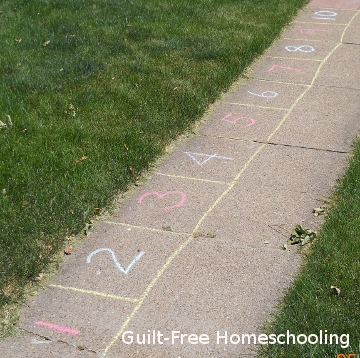
Once he is able to skip-count by 2’s, you can repeat the activity by having him skip-count by 4’s. If the increments become too large to step or jump to, he can run quickly across the “skipped” numbers and stop on the desired number, shouting the number loudly as he skip-counts the increments. If numbered boxes on the sidewalk do not work for your situation, try using kitchen floor tiles or stairs, or use masking tape to “mark” a line on your floor or carpeting.

Next, shift the concept from kinesthetic to tactile by drawing a series of smaller numbered boxes on paper and have him do “finger skipping” from one number to another, first by 1’s, then by 2’s. You may eventually want to let him use some game pawns, moving them from square to square while counting off the increments.

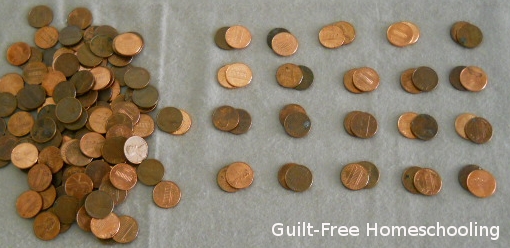
When your child understands the entire concept of skip-counting, you can pour out a large quantity of the substance of your choice onto the table (or a cookie sheet) and allow your student to start counting objects: M&M’s, oyster crackers, dry beans, buttons, Lego’s, or checkers. Count them by 1’s until he has the idea that counting them all individually will be a long process. Now have him move two at a time and try counting by 2’s. Allow him some time to practice this concept — it can be difficult to do any task until you are used to it. After he has the 2’s mastered, then you can move on to skip-counting by 4’s, 3’s, 5’s, 10’s, or any desired increment. (Counting by 4’s is an easy concept to follow counting by 2’s, since it is just a larger extension of counting by 2’s — counting just the even numbers by 2’s. I recommend doing the 4’s before the 3’s for this reason. In the same manner, follow counting by 3’s with 6’s, and follow 5’s with 10’s.)
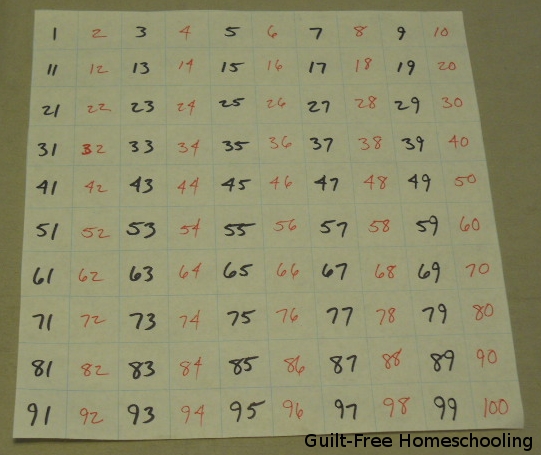
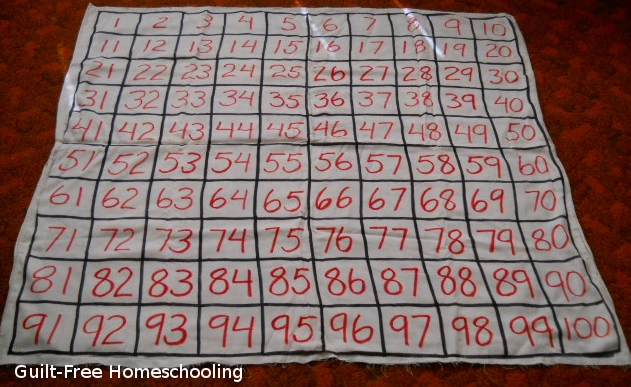
Another activity to help a student understand skip-counting by 2’s is to fill in a 100-chart with colored markers (adding a strong visual element). Draw* a chart of 10 x 10 boxes (10 rows of 10 squares each). Now alternate filling in the numbers: Mom writes an odd number in black, and the student writes an even number in red. Say each number aloud (here is the auditory part of the lesson) as you write them. Read the numbers over again when the chart is all filled in, alternating as Mom says a number she wrote and the student says a number he wrote — and suddenly the student is counting by 2’s! Then Mom can be quiet while he reads only his numbers aloud to reinforce his new skill. (Adapt this activity to other increments as needed for skill in skip-counting.) *Note: 1-inch graph paper is available at office supply stores in a poster-sized display tablet. I LOVE THIS STUFF! It is great for fast number charts — and hundreds of other homeschool uses. I rolled mine up and tied the roll securely with string for easier storage on a closet shelf.

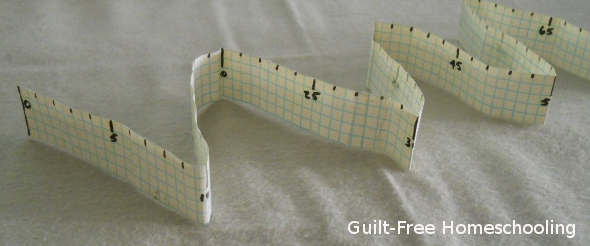
Graph paper marked with five squares per inch (also available in office supply stores) can be used to make a measuring tape for math as a good tactile and visual learning aid. Cut a few sheets into 1-inch wide strips and tape them together for the length you desire. This scale is compatible with the centimeter-scale Cuisenaire Rods: 2 graph-squares = 1 centimeter, so marking numbers on every other line produces a centimeter measuring tape. I used it to illustrate multiplication and division facts by accordion-folding the paper tape into 6 sections of 8 centimeters to show 6 x 8 = 48 and other facts, but a similar principle will work for skip-counting. Fold the tape on every other number, and then read off (auditory) the numbers at each fold for skip-counting by 2’s. Adapt and repeat for other increments.
When your student has advanced to skip-counting by 10’s, draw a large 100-chart on the driveway, and your student can jump or run from box to box (kinesthetic), or have him fill in the numbers with colored chalk (tactile & visual). Do the 100-chart activity on paper with red numbers on the 10’s only (tactile & visual), but black numbers on the other squares. Then write 1-10 in a vertical column on paper, saying them aloud (auditory). Now add a zero to each number, and read aloud again to count by 10’s. Repeat, adding more zeroes, to count by 100’s, 1,000’s, 10,000’s, or as many zeroes as your child can handle.
Kinesthetic teaching tactics will involve large muscle groups: moving arms from the shoulders or moving legs from the hips. Walking, hopping, running, and jumping, and throwing, catching, and reaching are excellent ways to teach a kinesthetic child. You want to have him move his entire body whenever possible. If a child is easily distracted while trying to sit still, he is probably a kinesthetic learner. If the lesson takes place while the student is seated, it is probably not a kinesthetic lesson. If you want a kinesthetic child to learn, do not try to keep his bottom stuck to a chair seat. Let him stand, let him walk around, let him throw a ball to you while reciting, if necessary, but incorporate his need for movement into your lessons. (Notice that this is not wiggling and moving around just for the sake of wiggling and moving and trying to disturb others. This is taking in information through well-coordinated muscles and reinforcing it through repeated muscular actions.)
Tactile teaching tactics will involve small muscle groups: moving hands from the wrist, moving fingers, and touching, feeling, and rubbing with fingertips. Textures, from dramatic and rough to subtle and smooth, and finger and hand movements are excellent ways to teach a tactile child. You want to have him touching something related to the lesson whenever possible. If a child is easily distracted while trying to keep his hands still, he is probably a tactile learner. If the lesson takes place while the student’s hands are empty, it is probably not a tactile lesson. If you want a tactile child to learn, do not try to keep his hands empty and quiet. Let him touch things, let him make something, let him hold a toy while reciting, if necessary, but incorporate his need for touching into your lessons. (Notice that this is not touching and fiddling with things just for the sake of touching and fiddling and trying to disturb others. This is taking in information through an acute sense of touch and reinforcing it through repetitive touches.)
Auditory teaching tactics will involve sound: incoming sounds and outgoing sounds. Speaking, singing, and humming, and listening are all ways to teach an auditory child. You want to involve his ears and vocal chords whenever possible. If a child is easily distracted while the room is quiet, he is probably an auditory learner. If the lesson requires the student to read quietly, it is probably not an auditory lesson. If you want an auditory child to learn, do not try to keep him quiet. Let him hum, let him sing, let him read his assignments aloud, let him discuss the lessons with you, let him listen to music in the background, if necessary, but incorporate his need for vocalization into your lessons. (Notice that this is not making noise just for the sake of making noise and trying to disturb others. This is taking in information through highly sensitive ear-gates and reinforcing it through vocal repetition.)
Visual teaching tactics will involve illustrations and colors: graphs, charts, and diagrams, and lots of bright, stimulating colors. Posters, maps, forms, and worksheets, and color-coding are excellent ways to teach a visual child. You want to involve his eyes whenever possible. If a child is easily distracted while listening, but is not bothered by sitting still, he is probably a visual learner. If the lesson takes place while the student has no examples to look at, it is probably not a visual lesson. If you want a visual child to learn, do not try to keep his eyes focused on you. Let him read, let him draw, let him color while you read aloud, if necessary, but incorporate his need for visual details into your lessons. (Notice that this is not looking around and daydreaming just for the sake of looking and daydreaming and trying to disturb others. This is taking in information through very observant eye-gates and reinforcing it through recalling memory-pictures.)
Any lesson can be adapted to include elements of the various learning styles. Do not be afraid to be creative in trying revolutionary approaches that seem to be unusual applications for the subject at hand. Your “crazy idea” may be the exact key that unlocks the door to learning for your students.

Goal: To Learn Equally Well in All Learning Styles!

Curriculum Choices and Shoe Shopping, an Analogy

New homeschoolers often ask which curriculum or which homeschooling method they should use. The answer can be nearly as varied as the answer to which shampoo to use or what toppings taste best on ice cream. However, I might be able to help you narrow the field just enough to make your decision easier. Join me at the mall — we are going shoe shopping.

Look at all these selections that are available! Now should just I point to the prettiest ones in the first window and say, “I’ll take those — size doesn’t matter”? No, of course not. At the very least, I need to get shoes in the correct size for my own feet, but let’s discuss this a little more as we browse.

First, I want my shoes to be comfortable: my size, not too tight nor too loose, not pinching toes or flopping at the heels. Beyond those basics, my feet need a good arch support, so I must remember to check for my personal requirement as well as general size and fit. Homeschooling materials should fit your students’ “sizes” or levels of learning. I am not using age as a factor, since many homeschooled students work at levels that may not exactly match their chronological ages or relative grade levels in school. Some students work at multiple levels, a different level for each subject — some may work at a level higher than their peers in certain subjects and at a level lower that their peers in other subjects. (That flexibility is precisely why many families choose homeschooling.) The homeschooling materials that you choose should fit each of your students — not too simple in reading level for this one, not too far advanced in math for that one.

I ordered a fifth-grade math textbook for my fifth-grade daughter, which turned out to be a repeat of material she had already learned. I exchanged it for the next higher level and found that book to be a much better fit. If we had kept the first book, she would have been flopping around in boredom, not challenged to learn new concepts. The correct book was the one that fit her skill level.

Second, I want shoes that make me feel relaxed. If your life is anything like mine, you have many things to tend to each day and cannot afford to waste time worrying about your footwear. I need to know that my shoes will solidly support my every step. I need to trust my shoes to do their job, so that I can do my job without giving them a second thought. Someone who normally lives in athletic shoes will be struggling at every step in stiletto heels. A woman who normally wears slinky pumps may be very self-conscious in chunky oxfords. If you do not feel “relaxed” in your shoes, you will not be able to do your job to the best of your ability. You will be losing valuable time focusing on the wrong issues. At the same time, you must have confidence in your homeschooling materials in order to relax and do your job as Teacher. If you have no confidence in the materials, you are “wearing the wrong shoes.”

I found myself questioning a program that used a unique approach to an old subject. The language arts material did not present grammar rules in an ordered sequence, but used dictation and copywork to acquaint students with passages from well-known authors. I became uncomfortable with what I saw as a lack of organization and structure. I wanted work boots that were ready to get down to some serious business, and I viewed this material’s approach as lighthearted casual sneakers that only wanted to play around. I lost my confidence in the material’s ability to handle the subject, and therefore, I could not relax while using it. Obviously, whoever designed that particular material was comfortable and relaxed with that approach, but it did not suit my individual taste. They were more of an easy-going slip-on shoe, while I was definitely the laced-up-and-tied-securely type.

Third, the shoes must fit my needs. Will I be on my feet all day? Do I need proper foot attire for stomping around in the barn? Will I be going hiking in these shoes? Will these shoes be taking me to special, dressy occasions? What exactly do I need these shoes to do, and can they live up to my expectations? Snow boots and bedroom slippers can both be comfortable, but they are not both appropriate in the same circumstances. Beginner packets and advanced instruction both have their places, but not at the same time for the same student. I once put both of my feet (one on top of the other) into a single clog to illustrate to a friend that clogs simply would not work for my thin feet and fallen arches. Shoes are not “one size fits all” and neither are homeschooling materials. What works well for me may be too restricting for you, and what fulfills your every desire may leave too many gaps around my needs.

We knew a family who loved a phonics program that used songs to teach certain concepts. They had used the same program for each of their children with great success. However, they had all girls and began using the program at a preschool level, but I began homeschooling my son when he was seven. The cutesy preschooler songs had no appeal to him whatsoever — he felt himself to be much too grown up for that. And he was a boy who viewed those particular songs as girly stuff. What fit the other family quite well was not at all a good fit for my child.

After size, style, and use have been established, minor details like color (or particular storybooks, for example) will have little effect on the more important aspects. Individual tastes and learning styles can be accommodated through supplemental activities. Price is another area that does not always indicate the value of the item. An expensive pair of shoes that fit like a dream and make you feel great every time you wear them will cost much less in the long run than a low-priced, uncomfortable pair that sit forever unworn in your closet. The same philosophy applies to homeschooling materials: if the Big Box Curriculum turns your students into educational sponges who soak up every bit of knowledge placed before them, then it may be well worth its high price. Similarly, a bargain book is only a bargain if someone actually reads it and learns from it — it is not a bargain at all if it sits forgotten and lonely on the bookshelf, collecting dust.

Once in a while, you may try on a good-looking shoe, and it feels right in the store, but upon wearing the pair several times, you become dissatisfied. The shoes just never “break in” and feel like a part of you. Maybe your little toe gets pinched or a strap irritates the top of your foot. Maybe the lack of an arch support begins to hurt after several hours of standing or walking. Short periods of wear are tolerable, but they just do not work for the long haul. Maybe brief, special appearances are fine, but the shoes are worthless for extended, everyday wear. Homeschooling materials can sometimes suffer the same fate: it looked great in the catalog or at the curriculum fair, and it started out working well with your students, but in the long run, the material just did not prove to be the best choice for your needs. Maybe the lessons were not as complete as you had hoped, or maybe the material advanced too quickly and left your students struggling and confused. There are times when we cannot judge every possibility without actual, regular use, no matter how comprehensive our research may have been. Sometimes it takes using a product every day to prove whether or not it can do what we need it to do. In those cases, we all have to swallow hard, admit our defeat, and let our next step be toward success as we apply the lessons learned through our own experience.

There may come a day when your favorite pair of shoes will not be suited to the events of the day. Personally, I would prefer do everything in sneakers, but there are occasions when my everyday, casual shoes just do not make the grade. Weddings or similar dressy affairs simply require something more formal. The day may also come when your stand-by favorite homeschool materials are no longer suitable for the needs of the day. Once in a while, occasions arise that require something a little different. When that happens, you can adapt to the new, special needs and keep on going. It does not mean that your old favorite was a poor choice — on the contrary, you got a lot of miles out of that material! However, now you have found yourself temporarily detoured onto a different road that merely requires a different approach. When your needs change, do not be afraid to change with them. Daring to switch may bring the very success that you and your student have been hungering for. At the very least, you may realize that what you were using before really was good, and you return to it with renewed confidence and vigor.

So which homeschooling method or curriculum should you choose? Not necessarily the first pretty one you see. As with shoes, ask for your size, try it on, and walk around a bit to see how it fits. Make sure it has the features which will meet your needs. If, by chance, you find later that what you have chosen is not the best option for you, realize that you have purchased experience, something which rarely comes out of a box or in a book. You now know, like Thomas Edison in his quest for the perfect light bulb filament, one more thing that does not work, and while you add this to your base of knowledge, you will also be wise enough not to make that same mistake again. Ahh, here is the Food Court! Let’s sit down with a refreshing beverage and rest these tired feet while we continue our chat.

If you are just starting out with homeschooling, it is normal to have no idea of where to begin. My advice is to start with only one subject during your first week and add a few subjects at a time (1 or 2 each week) until you reach your full schedule, using books from the public library or borrowing books from friends until you can confidently purchase your own. I was able to spend an entire summer planning to begin homeschooling that fall. However, by dedicating that much time to anticipation, I basically over-prepared myself: once we began, I found homeschooling to be much easier than I had imagined it would be.

How did I pick which books to use? I visited with other homeschooling families that I knew and looked at their materials. I asked what they liked, why they liked it, and whether they had any advice for me on things to avoid. I let my children look at the materials to see what they liked: what appealed to me as a teacher sometimes was in complete opposition to my children’s learning styles and preferences, and therefore doomed to failure. Ultimately, any purchases I made without getting my children’s input were wasted; even discussing catalog descriptions of books with my children proved to be valuable, giving them a sense of ownership in their own education. Some Christian bookstores now stock a selection of homeschooling materials, and internet shopping frequently offers the ability to see example pages online — neither of which was available to me when I began this process.

I tried to give thoughtful consideration to any new program before trying it with my students. Trust me — a fad that fails can actually set your progress back several steps by breaking your familiar routine, not to mention the hard-earned money you risk on expensive curriculum. I purchased a popular Bible course that was reviewed as being suitable for all ages and included discussion questions, memory verses, everything I should ever want all in one package. We hated it. I later resold it. Before changing materials, seriously ask yourself: how is this going to benefit my students? What might the consequences be if we do not like it? Could a change in curriculum actually make an important difference, or do we just need to add a few supplemental activities to what we are already doing?

There are times when you may have nothing to lose by changing methods — when the only way to go is up. In our case, I only changed materials when I felt we had no other options left — that any change would be better for us than no change. We tried out three different grammar programs in our first year before hitting on one that “clicked.” Each change brought relief from previous frustrations, so we felt like we were at least making some progress, but our final choice was devoured by my student as she eagerly raced through lessons. Any materials that did not work for us were later resold to other families who were happy to get them, enabling us to recoup at least a portion of our initial investment.

A friend of mine began homeschooling her oldest son a couple of years after we started homeschooling. She came to me a few months later with frustrations over his math book — it was much too simple for him, so he was frustrated with boredom. It was the second book that they had tried, and both books were correct for his grade level. I loaned her a book we had finished for him to try out, but she lamented that since it was already January, he would be starting over at Page One yet again and becoming further and further behind. I suggested that she have him take the weekly tests instead of starting with the lessons: as long as he passed the tests with no trouble, he should keep doing them one after another. Once he finally hit a snag and did not know the information being tested, they should back up to the lessons covered by that particular test and begin the book with those lessons. It worked perfectly! He had also been bored in his previous public school classroom and enjoyed the challenge of taking multiple math tests in a row to show how much he actually knew. When he finally hit new material, he was excited to be learning something for a change.

What about curriculum fairs? Oh, when I’m looking at homeschool materials, I need to lock my checkbook, cash, and all credit cards in the glove box or trunk of my car! The walk out to the car in the fresh air can do wonders to clear my head of the impulses to buy things. An exhibit hall full of colorful booths and a crowd of frenzied shoppers can take on a carnival atmosphere, enticing the most frugal budgeter to snatch up the last remaining item of a popular series that everyone is buzzing about. Simply walking away for a few moments will bring me back to reality with marvelous perspective. Most popular items are available from multiple vendors, so even though one booth sells out of a desired item, it may still be available elsewhere. If I find some materials that I do intend to purchase, I can always ask the dealer to hold them for me (or have a friend stand at the booth holding onto my choices for me) while I retrieve my money. I have consoled myself that paying a little extra for shipping a book mail-ordered after a conference is still cheaper than the full purchase price of the wrong book I really did not want, but bought on impulse.

Today there are so many choices available to homeschoolers that it almost becomes a harder task to select your materials than it is to teach your students. Some quick investigation into the learning styles of your students and consideration for their preferences will narrow the field to more manageable choices. Browse through online sites or mail-order curriculum catalogs, interview other homeschoolers about their choices and the reasons behind them, and look through the actual books whenever possible. Your first choice in materials does not restrict you to remaining with something that both students and teacher absolutely abhor. Some homeschoolers choose one program and stick with it for the duration; others pick and choose from a variety of sources, altering their plans to suit their developing interests. By choosing to educate your children at home, you are already surpassing the one-size-fits-all category of the public education system.

Guilt-Free Homeschooling is based in the homeschooling method which is comfortable for you. It is just the right size for your family, not overly complicated nor overly simplified. It is not too restricting, nor too undefined and vague.

Guilt-Free Homeschooling keeps you relaxed, using materials that you know you can trust to do their job, so that you can do your job without worry, fear, or guilt.

Guilt-Free Homeschooling fits your family’s lifestyle, whether you like to be up to your elbows in bread flour or up to the minute on current events. Maybe your children learn most of their lessons from textbooks — you can do it Guilt-Free. Maybe your students learn most of their lessons in the garden or in the barn or in the machine shed — you can do it Guilt-Free. Whether your family travels together or waits patiently at home for Dad to return from his current business trip, whether you make simple art projects from tissue paper or make grand trips to the latest museum exhibitions — you can do it Guilt-Free.

Choose materials that feel comfortable, methods that keep you relaxed, and studies that fit your family’s needs and desires. Get the correct sizes for your students’ abilities, and then try them on. Walk around. Jump, skip, and dance. If the materials will take you where you want to go, then relax and enjoy the journey, Guilt-Free.

And you are going to love those new shoes — I just know it!

(For further information on matching curriculum to your students’ individual needs, please see Topical Index: Learning Styles and read the articles on Auditory, Kinesthetic, Tactile, and Visual Learners.)

Verified by MonsterInsights