Archives for August 2012

Workshop Wednesday: Color-Coding As a Learning Tool

[This article was written by Jennifer Leonhard.]

Is your student attracted to color or motivated by markers? Does your student struggle with staying organized when studying? Color-coding is a great learning tool. Visual learners respond well to color as an organizational method, and non-visual learners can improve their visual skills by using color to organize information. As classes become more complex in high school and college, color-coding becomes an even more valuable organizational tool.

As a strong visual learner, I used assorted colors of index cards and highlighters to help me organize my thoughts and the material I was studying in my college classes. I used the order of the color spectrum as my color code whenever I needed to maintain a beginning-to-end, front-to-back sequence: red, orange, yellow, green, blue. My system always began with red (pink worked as the closest available color in note cards and highlighters) and proceeded through the spectrum to blue (violet/lavender was too hard to find in highlighters).
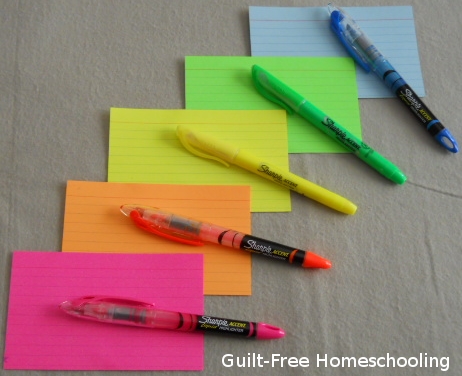
Here’s how I wrote the various parts of a speech or oral presentation: one pink card held the introduction, several orange cards for the information for Point 1, several yellow cards for Point 2, several green cards for Point 3, and one blue card held the conclusion. I could rehearse a presentation using these cards, and if I dropped them or they got mixed up in my backpack, I could easily put them into color spectrum order again. Any supporting quotes had their own index cards (using the appropriate color code for each point), and I would draw a squiggly outline on those cards to indicate that they contained the quotes. Each card had a topical title at the top and a number in the corner to indicate its order within each color group. I rarely ever needed to look at my note cards when giving a presentation, because I had them so well organized that I could easily see them in my head and go from there, but I did keep the cards with me in case of a blank-out moment. I could also turn them in to the teachers who asked for them as part of the assignment.

I also used this system for writing extensive research papers to create an outline in this format. I could put anything supporting Point 1 on orange cards and just go through all the orange cards later to put them in order for writing my paper.  When doing research papers and printing out a stack of articles for a 50+ page paper, I would use highlighters in the same colors as my note cards to circle significant points in the article. I could then grab all articles with orange outlines and work just on my first point without being distracted by all the other sections.  If an article had information for several points I would do a thicker outline in the color that it discussed the most and a thinner outline in the color of the point it discussed less, and then highlight or circle the section of text that pertained to each part in the appropriate color.  I could flip through my notes very quickly and efficiently in this way and find exactly what I was looking for at any particular moment.  I rarely had a “blanking” moment when writing, because I had a system that provided me with a place to start.  I didn’t have to write the individual sections of the paper in any particular order, and if I found myself overwhelmed by the sheer amount of research information I had printed, I could simply start color-coding instead of freaking out.  If I found myself unsure of where to stand on an issue or how to phrase my findings, I could simply grab all of the items outlined in orange and start highlighting, circling, or underlining the important sections that I wanted to use.  Stuck on what to write for orange? No problem! Just work on the yellow items for a while, and then come back to orange later.  I had no fear of getting confused or forgetting what I was doing next, because everything was very plainly color-coded for picking up where I left off.

Similarly, I would use this method to study complex material. I used the same color-code for highlighters, note cards, in my lecture notes, and in the text books, so that I could start the process while reading and know what to put on the index cards later. I used yellow as my color-code for keywords from the text. Pink was for any important dates to remember, green signified important people, and orange was for formulas and diagrams. Blue was for any other information I needed to make sure to remember. By categorizing things like this, I could pull out just my orange cards right before a test and review the formulas and diagrams, if I thought I was suddenly blanking on something. I’m bad at remembering specific dates, so I could grab the pink cards to quiz myself on those. This made it easier to categorize the test elements in my head, and instead of all the information being a blur of grey pencil notes on white lined paper, I could focus my memory on just the orange parts, or just the pink parts. The colors became just as important as the facts themselves, especially when trying to sort through all the facts in my head to find the one correct answer I needed on a test.

Whatever color-coding system you choose to use, the color significance can vary from subject to subject, but consistency within each subject is the key to making your system work. Yes, I bought a lot of index cards and highlighters, but they became valuable assets to my study habits, and the positive results proved their worth. Other colored items could also be added to a colorized system, such as colored pencils, file folders, pocket folders, notebooks, divider tabs, sticky-flag bookmarks, and whatever else your favorite office supply store has crammed into its aisles. Using color-coding is a great organizational and memory tool, and it strengthens your visual learning skills, even if visual skills are not your strongest learning style. And who doesn’t like playing with a whole rainbow of highlighters?
Workshop Wednesday: Tactile Card Holders, Version 2

Based on last week’s Tactile Card Holders, Version 1, this week’s version uses a few different supplies to create a similar product.

Equipment:
Cereal box cardboard
Photo corners for index cards
Glue (optional)

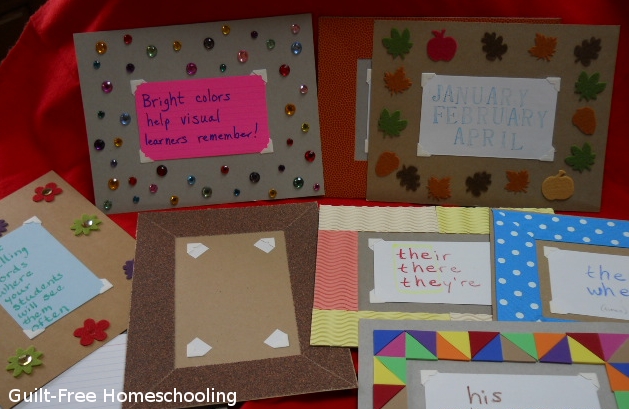
Yes, we are breaking out our old friends, the cereal boxes, to make yet another great learning tool. I cut the cardboard into pieces larger than my index cards and attached self-stick photo-corners in the middle for the index cards. You can use 3×5″ or 4×6″ index cards, depending on what you have available and how much information will be put onto the cards. Then I decorated the surrounding “border” with whatever was available (1 “theme” per card), using glue to attach the things that weren’t already self-stick.

Edges decorated with:
Ribbon
Sequins
Craft foam/felt stickers & shapes
Sandpaper
Acrylic rhinestones/gems
Textured papers

The examples in the picture show photo corners without an index card inserted, along with a few examples of spelling rules. As in last week’s article, these card holders can be especially helpful for older students who are trying to memorize more complicated information and formulas. Once learned, the note cards can be easily switched with new cards for studying new facts. The border textures work by appealing to tactile fingers and giving them something to focus on while the eyes are busy reading the facts on the cards. Later on, when the mind tries to remember the facts, the textures, patterns, and colors from the borders of each card holder will serve as markers on a virtual road map to help the brain find those facts and pull them up into view. Students who have had trouble memorizing dull, dry facts in the past will find these note card holders add some pizazz to the process and actually help stimulate their memories.

The borders of these card holders will offer even more tactile interest than the ones from last week that simply had their edges trimmed with special scissors. My favorites among these have to be the cards with sandpaper borders — I made several of those, each with a different level of coarseness. Satin ribbons offer a smoother texture, but grosgrain ribbon is different yet. I also found some wonderful textured papers at a scrapbooking supplies store to expand the variety of textures and visual appeal. Other cards had their borders adorned with thick felt stickers, craft foam shapes, acrylic “gems,” and other crafty materials to add texture and color. Let these examples spark your imagination and see what you can come up with!

Workshop Wednesday: Tactile Card Holders, Version 1

Sometimes certain facts work well for studying from homemade flashcards. However, some students just don’t do well with trying to learn from ordinary index cards. Today, we’re going to make those cards extraordinary! These card holders will work especially well for teens who are trying to learn complicated facts and formulas, but who need some extra learning methods thrown in.

Equipment:
Index cards to hold the facts or information
Bright colored card stock
Razor knife for cutting slits
Scrapbooking scissors for trimming edges

How To:
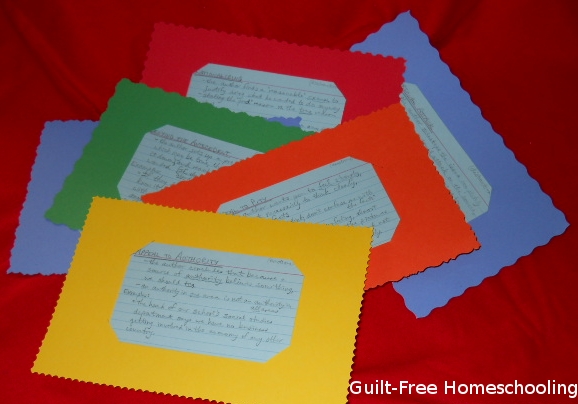
I started with 8 1/2″ x 11″ sheets of brightly colored card stock and cut them in half to make two pieces 5″ x 8 1/2″. Lay an index card in the middle of each of these sheets and mark about 1/2″ from each corner. Use the razor knife to cut angled slits (connecting the marks you just made) for the corners of the index cards. You don’t need to get the cards exactly centered or the slits angled perfectly; if you have a student who is fanatical about precision, give this job to him. Either 3×5″ or 4×6″ index cards will work, depending on what size you have on hand or how much info will be put on each card. The bright colors add visual interest to the boring facts (did I just say boring? oops), and colored index cards can do the same thing (the ones in the photo are light blue, but white cards work just fine). Just be careful that the colors don’t clash or create such a visual disturbance that no one can stand to look at them!

I had a variety of scrapbooking scissors available, so I trimmed the edges of the card holders, using a different pattern on each card. If you only have one or two fancy scissors (or even just a pair of pinking shears), that will still work. You could even use regular scissors and just cut some wavy or zig-zaggy edges. The idea here is to create a little bit of tactile interest for the fingers that will be holding the cards.

As your student studies the facts on each card, the bright color of the card holder will become a visual cue to those facts, and the tactile edge will do the same for his fingers. Reading the card information aloud lets the student say and hear the info, important methods for auditory learning — and when he stops reading aloud, he’ll catch himself wandering off-topic. The large size of these card holders makes them more of a kinesthetic learning tool than just small index cards are. The colors, edge textures, size, and reading aloud will all provide memory keys that his brain can rely on when trying to remember the facts on each card. Hmm… that card was in a red holder… I was holding it with both hands… the edges were pointy… I remember hearing myself say these points over and over… I know — it said THIS!

By inserting the index card’s corners into slits, the holder becomes reusable. When this set of facts has been learned and the student is ready to move on to learning different information, the index card can easily be slipped out and another inserted in its place. Make as many card holders as needed, but if possible, trim the edges of like colors with different patterns to make them different (notice that the 2 blue card holders in the photo have different edge patterns).

The cards shown here are for fallacies of reasoning, but you can use this method for learning vocabulary words, their spelling, and meanings; math or science formulas; historical events or people; or anything else that needs to be memorized.

Also see Tactile Card Holders, Version 2 for more ideas!

Workshop Wednesday: The Moving Answer Worksheet

Addition facts are not tricky; they are merely a short-cut to counting from one number to a higher number. Subtraction is not a difficult procedure; subtraction is just un-doing addition. When taught together, addition and subtraction become different ways of looking at the same problem. Children often get the impression that addition is one skill, and subtraction is a completely different skill. They are not different skills, they are just different methods of looking at the same facts. It’s the same principle as if you and I were holding several pencils, but I give you a pencil, and then you give me a pencil. We can trade pencils back and forth for as long as we want, but we are still holding the same total number of pencils.

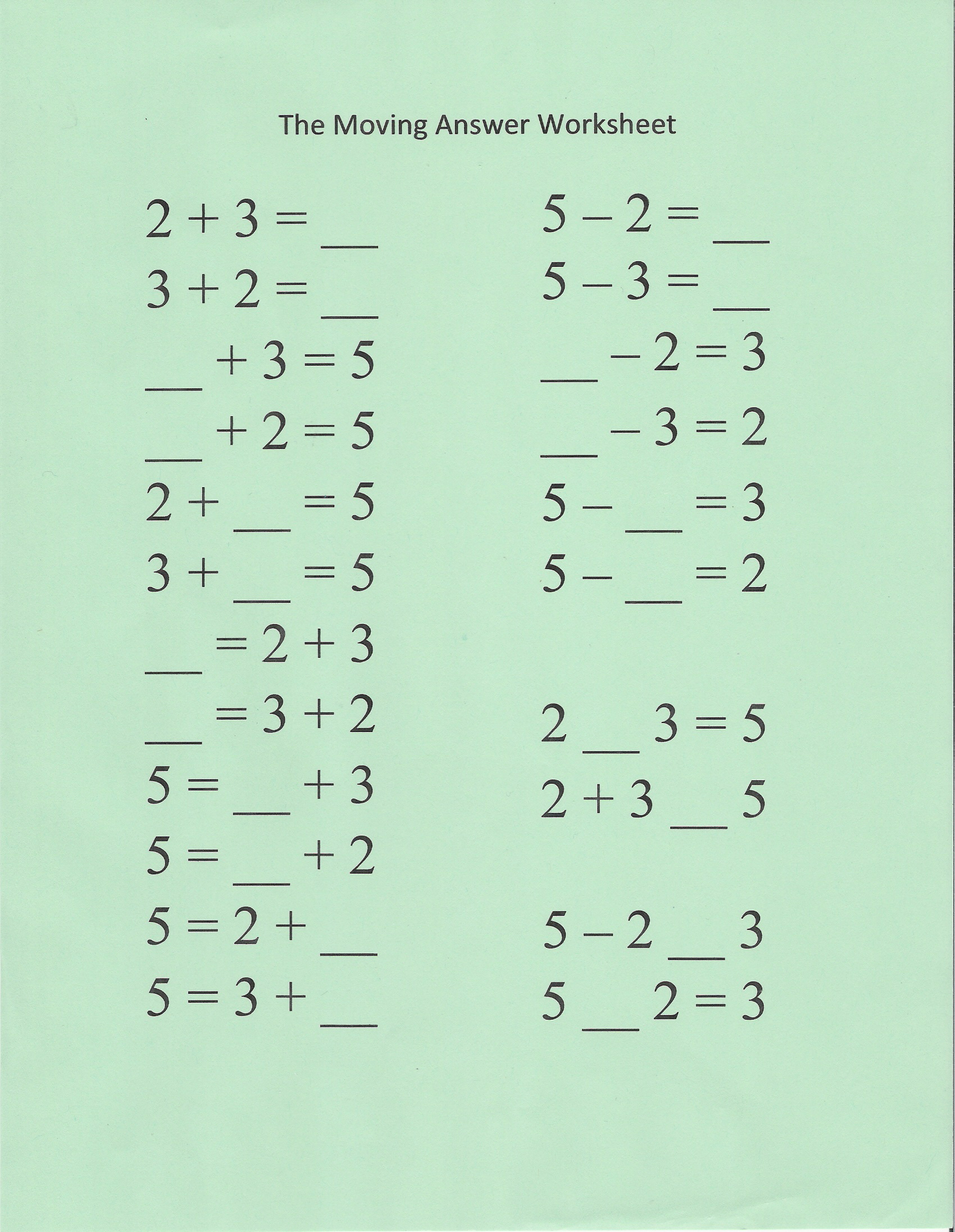
When my kids got stumped on variations of the same math fact (is 2+3 different from 3+2?), I created a simple worksheet to show them how to see those variations as always being the same statement, no matter what form it took. I rearranged the numbers in every way possible, and I moved the answer blank around to different locations, too. By completing this short worksheet, my kids learned to see the statement as a whole, instead of seeing each variation of it as a completely different problem. By combining the addition and subtraction variations of the same math fact, my kids caught on quickly to the idea that those particular numbers always went together, whether adding or subtracting.

Some math teachers and some math programs only place the answer blank at the extreme right end of each problem at this stage. Some students who experience this consistency can become incredibly confused when they are eventually presented with a problem that has the answer blank in a different location. Learning to relate to each set of facts as a completed puzzle helps students identify which piece of the puzzle is missing, and the many variations possible in this worksheet will prepare students for later math (such as algebra) when the answer blanks shift around to different positions within the problems.

Notice how this method was extended in a few examples to include the arithmetic symbols, as well as the numbers, such as in 2 ___ 3 = 5. Obviously, a plus sign belongs in that space, since 2 and 3 must be added to equal 5. It’s obvious to you and me, because we’ve been doing this for so many years, but to a youngster just learning arithmetic, it’s not quite as apparent, and a little discovery is good for the brain cells.

This principle can also be applied to multiplication and division facts, as division is simply the un-doing of multiplication. The stage of learning the facts is a good time to combine these skills, since there are no remainders yet.

The worksheets don’t have to be fancy at all — a handwritten version is just as valid as a computer printed one, but handwriting will probably be much faster and easier to produce. Stick to one set of numbers for each worksheet, but include all the possible variations. Your students will catch on quickly!

Use other learning style methods along with this visual worksheet. Auditory learners will benefit from discussing the patterns in the problems and will appreciate a chance to answer orally. It helps to connect learning styles if you encourage them to write their answers in the blanks after giving the correct oral answer. Do any of the following activities with your auditory learner, but talk about what you’re doing and read the problems aloud, or let him talk aloud to himself. Background music is also helpful for auditory students who need it as “white noise” to drown out other noises and help them concentrate, so keep the iPod and headphones handy! If you have any other students nearby who are not auditory learners, they may appreciate being allowed to do their work in another part of the house — my visual/tactile daughter did a lot of lessons quietly in her bedroom while her auditory brother and I discussed his work in the kitchen.

Tactile learners can use manipulatives to help solve these problems, such as small blocks or dry beans. The same group of objects can be used for the entire worksheet by rearranging them to fit each of the various problems. Other helpful items may be individual cereal-box cardboard “flashcards” for each number and arithmetic symbol–students can arrange and rearrange them to see which piece of the puzzle is missing. Tactile learners need to keep their fingers and hands involved during the lesson, so use whatever materials you have available to make that happen, even if that means making the worksheets large enough to hold numbers formed from Play-Doh on each answer blank!

Kinesthetic learners work well with large-scale manipulatives, such as sports balls arranged in groups in the back yard to fit the problems. You can adapt tactile manipulative, table-top methods for kinesthetic learners by making things large enough that they will be using the big muscles of arms and legs instead of just fingers to move items around. Another good kinesthetic learning method is to write large problems on a whiteboard or chalkboard, or use a slick-finish white shower curtain liner as a giant piece of paper on the floor and write on it with wet-erase markers (or use Post-It notes for the answers). Chalk on the sidewalk or driveway is another good stand-by for over-sized writing projects, but don’t forget that your kinesthetic student will also respond well to doing standard worksheets if he can lie on his tummy on the floor to do them! Any method that keeps those big muscles active is a kinesthetic method, so if you want your student sitting quietly in a chair, it’s not a kinesthetic lesson.

Whatever your students’ learning styles may be, it should be their goal to learn how to learn through every style. Therefore, using a few of the above ideas for each student in whatever lessons you do will increase their ability to learn through other styles and increase their overall understanding. Besides that, variety just makes the learning that much more fun!

Verified by MonsterInsights