Archives for 0

Top 10 Signs that Unschooling Has Overtaken Your Life

This article was written by Jennifer Leonhard.

Top 10 (tongue-in-cheek) signs that unschooling has taken over your mindset completely and you might just need a spa day:

  1. When unloading your cart at Walmart, all you see is a giant algebra equation.
  2. You go for a walk in the park and tell your kids to get off the playground equipment because they have thoroughly proven the law of gravity, and it is time for biology class before this butterfly flies away again.
  3. You canceled your subscription to your local newspaper because your children were spending too much time correcting grammatical errors and not enough time on math.
  4. The guy sacking your groceries knows you well enough that he answers “Everyday is a learning day, and life is their classroom” when the cashier asks your kids “So, no school today?”
  5. You know that if you took a spa-day you would feel guilty that your children were missing out on a vocational field trip.
  6. Your kids ask if you can go out to eat tonight, not for the food, but because they are tired of studying fractions which inevitably happens every time you have them help you cook dinner.
  7. On date night with your husband you find yourself discussing the properties of beeswax and paraffin, instead of looking into his eyes over the candles he so thoughtfully lit to set the mood.
  8. When people ask where you get your scope and sequence for math and science, you answer “I DVR The Big Bang Theory.
  9. During a trip to the grocery store, your kids automatically replace the items you casually toss into the cart with choices that a) cost less per ounce, b) contain healthier ingredients, c) contain more food than packaging, or d) all of the above.
  10. Your kids ask to stop at the craft store and the library, but you tell them you’ll have to go home to get the big car first.

Have you noticed other fun indicators that unschooling has taken over your life? We’d love to hear them!! Share them in the comments!

When Did I Become an Unschooler???

I went to public school for my education. It was a rural school with Kindergarten through twelfth grade all in one rather small, three-story building. The teacher-to-student ratios were fairly low, since most classes rarely exceeded twenty students. Most of the teachers used traditional methods of oral lectures and reading assignments.

I remember feeling detached from the rest of the class, because I was either way ahead of the teacher or way behind. In Kindergarten, I could already read enough to know what the workbooks said, and I could tell when my teacher was changing those directions and leaving out the parts that I thought sounded like more fun than what she wanted us to do. I had to sit and wait and sit some more, surrounded by a roomful of enticing learning toys that could never be touched. And my teacher insisted that sitting quietly and listening quietly were the best and only suitable ways to learn anything.

In fourth grade, I knew nearly all of the spelling and vocabulary words before my teacher wrote them on the board, but she often mispronounced them. I had my very own personal dictionary in my desk, something I loved to read more than any of the storybooks on the classroom shelves. I pulled it out one day to show my teacher what the correct pronunciation of a certain vocabulary word was, because I thought she would want to teach things accurately. Instead, she just got upset. For some unknown reason, we didn’t get along for the rest of that year.

In sixth grade, I had a very old, very worn out teacher. She had her methods that she had used for decades, and she expected them to work forever and for every student. She also had certain subjects that she didn’t care to teach, so she glossed over them with the same three words for every assignment: “Outline the chapter.” I learned nothing from geography that year, except that I could not possibly produce an outline to her satisfaction.

Occasionally, a random teacher would allow us to do a special project as an assignment, but it didn’t happen more than once every few years and never in more than one subject. Any project was also limited to about a week in length and still had to meet that particular teacher’s expectations. The year I prepared a typical Medieval meal for my World History teacher, I thought he was going to have a stroke right there in the classroom. He seemed very concerned that I had smuggled some beer into the school building, until I whispered to him that his tankard contained cream soda as a visually-similar substitute. Despite all my research into the types of foods, serving utensils, and customs common to the time period, he didn’t know how to grade my beef stew and fake beer. He was much better with salt-dough castles and cardboard armor.

All in all, I hated school. I hated the teachers who treated me with contempt for daring to want something other than outlining the entire geography textbook and droning through random passages from Shakespeare read aloud in class. I hated the endless repetition, year after year of boring textbooks that all said the same boring things. I hated it all.

Once I had my own children, everything changed. I loved watching my kids discover the world for the first time. I loved the expression of recognition on their faces each time something new began to make sense. We played games, we played house, we played dress-up, we played everything we could play. We made forts, we made cookies, we made make-believe. We read stories and more stories until we knew them by heart, and then we recited them together when the books weren’t close at hand. I read them simple stories, pointing out the details in every picture. I read them chapter books beyond their years, allowing them to meet brave explorers like Christopher Robin and form pictures in their minds of what “heffalumps” and “woozles” must look like. I read them the lyrical poetry of A.A. Milne, Edward Lear, Robert Louis Stevenson, and countless others. And then suddenly they were old enough for school.

When I sent my children off to public school, they fit into their classrooms just as well as I had in mine, which is to say “poorly.” They wanted to play with the hundreds of wooden blocks at the back of the classroom, instead of sitting at the teacher’s feet as she did yet another mind-numbing counting-to-ten exercise. They had to endure adding 1 + 2 + 3, being told it was difficult and challenging, when they had already figured out how to do 2-column subtraction in their heads. They had to sit and wait and sit some more, surrounded by a roomful of enticing learning toys that could never be touched. And their teachers insisted that sitting quietly and listening quietly and reading quietly were the best and only suitable ways to learn anything.

When my husband and I made the decision to remove our children from public school to begin homeschooling, I used the traditional school model of textbooks and worksheets, simply because it was the only thing any of us had ever known. There I was, ordering boring curriculum, assigning boring lessons, and grading boring worksheets, doing all the same things I had hated all through my own school years and boring my own children with every step.

My students began stumbling over what I called “potholes”—missing portions of vital information that their former teachers had failed to impart. My 5th-grader was delighted to discover that anything she hadn’t understood at public school could be re-studied at home without penalty or ridicule, and she provided me with a list of math concepts that she wanted to master, including fractions, decimals, percents, and measurements. Specialty workbooks helped us fill in those gaps, but actual practice in real life experiences gave the concepts purpose. We measured dozens of things around the house, maybe hundreds of things. We converted the measurements into fractions and decimals. We converted the fractions and decimals into percentages, until it was apparent that the different forms were just “nicknames” for the same amounts. Manipulating the numbers became fun, and math lessons became less intimidating.

I realized that my children were benefiting from the hands-on experiences that solidified what the textbooks had to say. When a math problem spoke of so many red trucks and so many blue trucks, and my child wasn’t understanding it, we used colored blocks to illustrate the problem in a way she could do over and over again until she got it. When my daughter couldn’t solve an anagram for her spelling lesson, she took the letter tiles from the Scrabble game and rearranged them until she figured out the word. The enticing learning toys gave the lessons tangibility, and the fingers understood what the eyes had missed.

I haven’t met a spelling curriculum yet that I like. Phonics is a systematic method for learning to read, but why should that be followed by repetitive lists of spelling words that anyone with a decent grasp of phonics could spell without difficulty? Vocabulary words were never much different from the spelling words. If my students could break the word down into its phonetic components and learn to read that word, either they already knew its meaning, or we would look it up in the dictionary together.

As a child, I had loved having my own personal dictionary, which I routinely browsed for new words. That was the basis of my own vocabulary expansion. Using the pronunciation guides, I could learn to read any word I came across, and the definitions, origins, and various forms of the words added even more to my personal studies. My son picked up this habit himself and regularly quizzed me with new words he had discovered, trying (usually unsuccessfully) to stump Mom. Reading material is an excellent source of new vocabulary words – if it’s not, then your students are reading things that are too simple for them. Another personal habit of mine is to keep a dictionary and pencil close by while I’m reading. Any unfamiliar words get their definitions written in the margin of the book. (Don’t tell anyone, but I’ve even been known to pencil a definition in the margin of a library book, reasoning that if I didn’t know that word, the next reader probably wouldn’t know it either and would be grateful for the notation.)

No matter how many curriculum programs we tried, nothing was a perfect fit for us. The textbooks were too boring and too far removed from everyday life. We supplemented the textbook studies with activities, games, and field trips, and we always found that we learned much more from the extra activities than we did from the textbooks and workbooks. Even the math texts that provided solid teaching were tedious in their repetition-without-application. Board games could always be counted on for practice in the same concepts, but with much more enjoyment. Although we enjoyed a wide variety of supplemental activities, most of the time we stuck to a pretty structured sequence of academic studies. It was only toward the end of our homeschooling journey that I began to research and understand learning styles and see the full value and effect of alternative types of study over traditional methods.

Today, I’m much more likely to recommend family activities, a video-and-discussion session, or a round of board games instead of textbook lessons. How did I get to this point? When did I become an unschooler? If we had it all to do over again, we would probably be more like that eccentric unschooling family we met when we first started homeschooling—their spontaneous and unconventional approach to learning did not fit into my definition of education at all (but they did seem to be having a lot more fun at learning than we were). We would read more biographies from the library shelves, instead of purchasing over-priced textbooks that barely scratched the surface of any remotely interesting topics. We would spend hours dropping Mentos into Diet Coke, instead of just watching the You Tube videos. We would have all sorts of wonderful fun, we would learn all sorts of wonderful things, and we would enjoy journaling all our wonderful exploits, because we would be making and documenting real history instead of slogging through yet another tedious assignment made up by some stranger who knew nothing about us or our interests.

The way I see it, looking back over many years of actively homeschooling and many more years of mentoring homeschoolers, if a student can learn something well by reading it in a book, he doesn’t need anyone’s help. On the other hand, if a student is struggling to learn from reading and struggling to learn from discussions and explanations, that student needs a hearty dose of unschooling methods. Get elbow-deep in an experiment, work out a physical representation of a math problem with some type of thingamabobs, watch someone demonstrate a real-life skill and ask them to help you learn it step-by-step. Going places, seeing stuff, and doing things are much more valuable methods of learning than just reading about someone else going places, seeing stuff, and doing things. If unschooling means leaving the books behind and getting out there to learn from life itself, then I’ll happily call myself an unschooler. I never did fit into a classroom very well.


[For a further explanation of educational potholes, see Meatball Education: Filling in the Potholes of Public School]

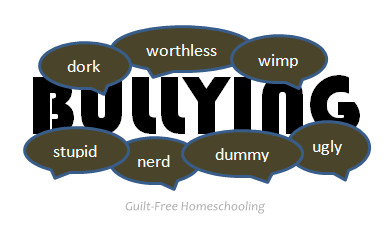
Bullying

Everyone encounters bullies somewhere. Even homeschooled kids can be confronted by a bully in group activities or once they become old enough to enter the work force. “Forewarned is fore-armed,” so we are presenting several strategies for equipping your children to recognize bullying behavior and strengthening them to be able to deal with bullies effectively. The headlines are current proof that when allowed to continue unabated, bullying will escalate to extremely serious, even lethal consequences. Our aim is to help you stop it in its very early stages. Since not all of our readers are able to homeschool, this article also addresses bullying in school situations. Many of the scenarios presented here are also used by adults, whether deliberately or just out of habit. As parents and role-models, we must break the cycle of bullying among our own peers, as an example to our children. Some readers may object to the statements made in this article, and those who do are invited to take a long, hard look at their own behavior, beliefs, and values, because they may unintentionally be using bullying tactics themselves.

Why Bullies Bully

Bullying affects almost everyone in some way at one point or another. Some people willingly and eagerly push others around (whether physically or verbally) in an effort to make themselves feel more powerful or important. Some people become their unfortunate victims, just by being in the wrong place at the wrong time. Simply put, bullying is a way to manipulate and control other people.

Help your children see that people who pick on others have been picked on by someone else.  Explain that the kids at the park who say mean things are probably being verbally abused by others—very likely by their own family members. When kids have someone in their lives who is routinely insulting to them, they feel the need to pile insults on someone else. They have learned through what has been done to them that it is right and acceptable for them to do this to others. Many families know nothing else: all forms of abuse become generational, simply because no one knows any other way to behave. For someone who comes from an environment where name-calling and ridicule and manipulation are rampant, bullying becomes their interpretation of “appropriate” behavior. Knowing nothing other than this pitiful behavior, they grow up to continue the hurtful legacy with their own children. Breaking the bullying cycle requires adults who are willing to reassess their own value systems and stand up against the patterns of needless hurt, but it can be done successfully.

I know a woman who accepts bullying from her friends because she is dependent on the company and approval of others for entertainment and self-worth. She bullies her friends in return, trying to manipulate them into doing what she wants to do. She’s a grown-up who never learned to cope with bullying in a grown-up manner and therefore dishes it out herself as part of an endless cycle.

Subtler  Methods Used by Bullies

It’s easy to identify the playground bully who shoves other children out of his way and stomps on their toys. The adult bully who loudly curses at the Little League umpire or uses his vehicle as a road-rage weapon is also easy to spot. Recent headlines have provided horrifying examples of bullying taken to such extreme ends that it resulted in murders or suicides. However, most bullying begins with much simpler, less conspicuous methods. Beyond the obvious punching, hitting, and name-calling, there are many more subtle forms of bullying:

  • Putting down others just to make oneself feel good
  • Telling someone they are “useless,” “good at nothing,” “a baby,” “a loser,” or other demeaning labels
  • Making rude comments that only the bully considers to be funny, but everyone else recognizes as just rudeness
  • Not allowing others to voice their opinions (especially dissenting opinions), whether objecting face-to-face, behind the back, or through social media
  • Needing to have the last word
  • Touching someone who doesn’t want to be touched, no matter how lightly
  • Tickling!
  • Reprimanding a student for asking too many questions in class or for answering questions too frequently in class
  • Labeling a child as ADHD or other “disability” where none exists, just as a method of controlling the child’s thoughts and behavior. [I’ve seen teachers label eager-to-learn students as ADHD to make them be quiet, because they (consciously or subconsciously) didn’t like the student’s teach-me-more attitude.]
  • Exhibiting overly dramatic behavior or adding drama to nondramatic situations to gain attention, create or break alliances, and fuel their own desire for power or control
  • Bribing others to be nice (doing whatever it takes to maintain control)—not to be confused with rewarding good behavior [see Is This “Acceptable Behavior”?, linked below]
  • Insisting on being bribed to be civil
  • Being irresponsible as a means of controlling a situation, such as not doing a task that others are depending on
  • Making excuses and/or blaming others for their own irresponsibility, mistakes, and shortcomings; the need to assign blame for whatever goes against their wishes; not accepting the premise that they can be at fault
  • Keeping others waiting, as a means of control
  • Arriving unprepared and making excuses, rather than admitting it; forging ahead anyway, assuming his (or her) “talent” will make up for it
  • Whining, as a means of control
  • Treating every facet of life as a popularity contest
  • Assuming everyone adores and admires him (or her) and getting angry and vengeful when someone doesn’t
  • Not allowing others to learn to lead; won’t delegate or train a replacement; believes no one else could possibly do what he (or she) does as well as he does it
  • As a leader, serving his (or her) own purposes first, before the group’s

The most frequent bullying I had to endure in my own school years was from my teachers: drawing the other students into laughing at one who had fallen asleep or given a wrong answer, rolling his or her eyes at a student who asked a question that the teacher felt had an obvious answer, asking pointed questions of a poorly achieving student to emphasize his lack of preparedness. One of my teachers in high school dubbed one of my classmates “Flycatcher” because she yawned once without covering her mouth, and he called her that for the remainder of the year. I even had an elementary teacher who got angry with a little boy who kept putting his hands in the pockets of his jeans. She stood him at the front of the room, pinned his pockets closed with huge safety pins, and then forced him to stand there while she led the rest of the class in pointing fingers at him and singing a little ditty about putting his hands in his pockets, and not just once—she made us all repeat the song several times and encouraged us to repeat the song any time we noticed him with his hands in his pockets. I found it horribly humiliating, and I wasn’t even the boy being singled out for embarrassment by the teacher. Should I mention the set of monstrous rubber ears she made another student wear who was caught not paying attention? I doubt that any of her students went home to tell their parents about what a bully that woman was, just because she held that much power over them. Even if the parents had learned of her abhorrent methods, they were just as afraid of her as their children were, and no one would dare to cross her. That teacher had no respect for the children she taught, and she proved it through her bullying tactics.

In institutional school situations, teachers, staff members, and bus drivers are now being encouraged to stop bullying when they see it. Schools and communities are enrolling in popular anti-bullying campaigns today. However, those same authorities aren’t likely to judge a few quick remarks or intimidating glances from one student to another as bullying, but instead consider it just as “kids being kids.” After all, if they recognized those methods as bullying, they would have to stop using those methods themselves! A closer look at some of the anti-bullying propaganda reveals that they are attempting to bully the bullies into submission. Is that really supposed to be an improvement?

As a homeschool parent, I witnessed bullying from adults in church situations—and I must admit that much too often in our experience, those adult bullies were closely connected to the public schools as teachers or support staff. They viewed their own behavior as being “instructional” or “disciplinary,” but it is just flat-out bullying when an adult ridicules another person (of any age) for any reason, especially when they encourage others in the room to ridicule and laugh at their victim, too—or they don’t stop those who are bullying through ridicule, name-calling, finger-pointing, or other unacceptable behavior.

Parents are not immune from bullying either, and often exhibit it toward other parents. Consider the moms who put hours and hours into organizing some mom-and-kids events, only to have other families arrive late or not show up at all (despite their promise to attend) or complain about the details of the events. They are showing disrespect for someone else’s work by making sure it doesn’t happen as planned. It’s subtle sabotage, and it’s bullying to maintain control. Yes, there are times when unavoidable delays happen, kids get sick on the way out the door, or numerous other problems might prevent a family from fulfilling their plans. However, one quick phone call can let the others know what has happened, and even if the apology comes a day after the missed event, respect and appreciation are still shown to the organizers. The person who undermines the plans and hard work of others is a bully who wants to control events to keep all the attention focused on himself. Ignoring the effort, commitment, and time expended by others on your behalf is a form of bullying. If you join a group, whether an organized club or an informal play group, you must be willing to set aside time on your calendar to participate. If your time, money, and energy are too important to be wasted on the group, do the other members a huge favor by dropping out and letting them get on with their plans.

This also applies to that one family whose single veto can shut down an event that all the other families in a group want to do. No matter if the group is made up of public school parents, homeschooling families, church members, sports teams, or dance moms, allowing a single voice to overrule the majority for his (or her) own selfish reasons, is openly granting bully privileges to the troublemaker. If one family doesn’t approve of a specific event, they don’t have to come. If they are not available during the scheduled time frame, the group shouldn’t be required to change the entire schedule to suit the bullies. On the other hand, if all members of the group are in agreement and are making a courteous effort to accommodate each other, that’s completely different from one member disrupting everyone else’s plans, just for his personal convenience. Mutual respect compromises; bullies command and control.

Some people are able to break the pattern of bullying and stop the abuse; others carry it on, and the bullies from high school become the bullies in the workplace. Bullying is nothing more than showing disrespect. Most bullies don’t even know they are bullies—they just know that they are only happy when they get everything they want. They don’t have enough consideration for anyone besides themselves to even know they are being disrespectful. Narcissism and bullying go hand in hand.

Ways to Deal with Bullies

Be extra-nice to take the power out of their “punch.”   Proverbs 25:21-22 “If your enemy is hungry, give him food to eat; if he is thirsty, give him water to drink. In doing this, you will heap burning coals on his head, and the Lord will reward you.” (NIV) Thinking back to the two main bullies I had in school, Mom pointed out Proverbs 25:21-22 and Matthew 5:44 to me and told me to be super-duper nice to them when they were being mean.  If they said something mean, then I said something complimentary to them. If that didn’t work, then I asked them if they wanted to hear about Jesus or pray with me, and they just started avoiding me. ~Jen

Pray: God can change what we can’t.  Matthew 5:44-45 “But I tell you, love your enemies and pray for those who persecute you, that you may be children of your Father in heaven. He causes his sun to rise on the evil and the good, and sends rain on the righteous and the unrighteous.” (NIV) God loves the bullies just as much as He loves anyone else, so pray for Him to bless them and make their lives better, taking away their need to hurt others.

Empathize. Consider why the bully acts the way he does, perhaps he is being bullied by a family member or other authority, such as a teacher, coach, or boss. Understanding that, we can be sympathetic to him, although we probably can’t fix his problems. Parents can also help their kids to see that they don’t have that abuse happening elsewhere in their own lives (like the bully does), which is a good thing. It can confirm to the child that the name-calling is only the bully’s opinion and no one else’s.

Expend energy. Whether you’re crocheting an awesome princess costume for your friend’s cat, kicking a soccer ball around the yard as hard as you can, running a few miles, hammering nails into a block of wood, or cleaning out the shed just because it’s fun to break up all the junk and slam-dunk it into the trash can, finding a way to use up all your pent-up aggression will help you to decompress from the stress of the situation. While working at a consignment shop, my daughter would occasionally notice an employee being harassed by a rude customer and assign that co-worker the task of hauling discarded glassware out back to the dumpster. A session of practicing 3-point-shots with cracked plates and chipped vases never failed to redeem that person’s entire day!

Respect yourself. Finding your self-worth from what peers think of you makes you more susceptible to bullying and peer pressure.  If you have learned to find pleasure in your own company through hobbies and personal interests, you won’t be dependent on others to provide you with entertainment, and bullies won’t be able to control you by taking away your sources of pleasure and recreation.  Someone with hobbies, interests, and proficient talents is also less likely to believe another’s put-downs and more likely to have friends who will defend their worth. If your child is being bullied, build up his self-image by reminding him of the things he is good at and the things you as a family value in him. Give him a list of positives in his life, and let him know that you see worth and value and importance in his life. Can he make awesome origami animals? Does she have the recipe memorized for chocolate chip cookies? Has he never yet been stumped by a math problem? Has she picked up complex lesson concepts more quickly than you anticipated? Does he have flawless rhythm or a beautiful singing voice? Can he impress Grandma with his card tricks? Has he studied his hobby extensively and can rattle off dozens of facts about it? Think about all of the skills your child has that you consider ordinary just because you see them every day, and let that child know that not every kid can do these things. These are the skills that make him special and unique and important. Being able to entertain oneself through those hobbies and interests means that even when no one else is available, you can still be in the delightful company of yourself, where every activity is enjoyable.

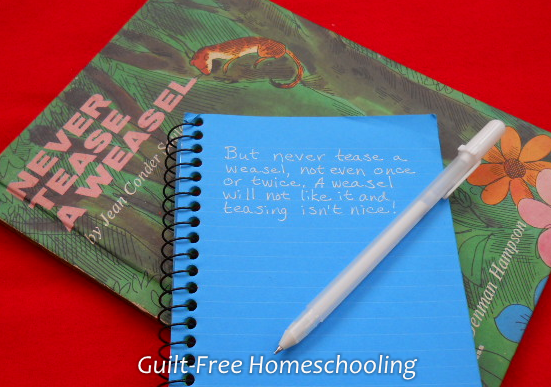
Respect others. Respect and bullying are polar opposites. Teach your children that everyone has value, everyone is good at something, and everyone is knowledgeable in some area. A person who respects others can learn something from every person and every situation. Teach your children that unkind words are not acceptable. We had a favorite children’s book called Never Tease a Weasel that we quoted often, as a reminder that teasing was a form of bullying and unacceptable behavior: “Never tease a weasel, not even once or twice. The weasel will not like it, and teasing isn’t nice.” The excuse of “I was just teasing” is a definite sign of bullying.

Surround yourself with positive influences. If someone has enough supportive friends and family around them, a bully isn’t going to take them on—they’re too well protected.  In extreme cases, that may require walking away from an unsupportive, negative situation. If that means leaving public school and beginning homeschooling, or finding a better homeschool group, church youth group, club, or whatever—do it. After all, you joined these groups for their positive influences, so if they only offer negativity, then they aren’t the right groups for you. Removing yourself from a bad situation, leaving a group, not replying to a rude comment, or any other method of “walking away” is not defeat—it is actively taking back control over your own life by breaking the cycle the bully needs to continue to maintain his power and control.

Involve yourself in your child’s situation.  My husband used to join our daughter for lunch occasionally at her public school.  She felt protected and encouraged by his presence, and whenever a bully came up she could introduce her dad, and suddenly the bully wouldn’t want to bug her any more. (He also may have promised to hire a big 5th grader to beat the kid up if he didn’t stop behaving badly, but that’s mostly an unsubstantiated rumor.) Years later, when bullied in her workplace, Jen used her established friendships with her managers to let the bully know that she had influence in high places.  She could casually ask her managers “Do you know what’s wrong with Mary? She seems angry anytime I talk to her.” Then they would ask Mary why she was upset, sending the subtle message that they were looking out for Jen, too. By surrounding herself with metaphorical parents and siblings, she let the bully know she had a powerhouse of support.

Be weird. Weirdness scares bullies, who are counting on predictable reactions.  If you are a loose cannon, you are intimidating. Example 1: My daughter works in a retail store where she wears elf costumes to work during the Christmas season. Her curious attire and jovial spirit are welcoming to the innocent shopper and threatening to the co-worker bully who just doesn’t understand how anyone can be that happy all the time. Example 2: My son enjoyed his buddies and loved them like brothers, but one day things had gotten to the point of him always being the victim of their shenanigans. He restored balance quickly by seizing opportunity and turning his face to sneeze directly into the face of the oldest and largest boy, who didn’t mess with him after that. Incidentally, bullies usually don’t have a true sense of humor, since that requires showing appreciation for another’s creativity. A rubber chicken produced at an opportune moment can be a delightfully effective, yet harmless weapon against a bully. Hone your inner Robin Williams; yodel along with your iPod; disclose a secret wacky talent; scream like a velociraptor; or reply to a bully, “I’m sorry, I don’t speak English,” spoken in perfect English.  Catch a bully off-guard with something bizarre, and he won’t have a prepared response, and that takes away his power and control.

These coping strategies may not completely convert a bully back into a human being, but they can enable someone to tactfully deal with him and remove his phony authority from the situation at hand. Family-as-a-team provides the wonderful advantage of familial support, giving children more reassurance of their worth and status, the things that help them recognize the lies that bullies spew. A child who knows his own value will not be intimidated by a bully—he will be more apt to scoff sarcastically, “Yeah, right, good one,” and walk away.

Teacher-bullies are an example of a bully that can’t usually be overcome by being nice or funny. They have all the control in their own territory, and as the supreme authority, they are power hungry. This is where parents can step in for their child and try to settle matters, but a true bully teacher still won’t be intimidated. They will hurl all the typical arguments (excuses) of how they know what’s best since they are the “professional,” they have taught this way for years, it’s your wimpy kid who’s the real problem, and so on, ad nauseum. The administration will stand behind their teacher, unless you can produce copious amounts of evidence and witnesses to the contrary. The only way out of that circumstance is to change classrooms, change schools, or homeschool—my preference.

The hurtful things that rude people say to us are like bags of garbage they throw onto our doorstep. We can’t stop them from dumping their garbage there, but we don’t have to drag the garbage into the house, dump it all out, and spread it around on the furniture. Let a bully’s hurtful words remain outside your door—they don’t belong to you. To counteract bullying, you have to break the cycle and disrupt the bully’s plans.  A bully cannot be a bully without a victim. Refuse to cooperate with him, walk away, or do anything necessary to leave him victimless.

See also:

The Socialization Code

Respect Must Be Earned

Becoming a Successful and Proud Quitter

Dropping the Drama

Family Is Spelled T-E-A-M

Siblings as Best Friends

Is This “Acceptable Behavior”?

If You Can Present Your Case with Facts and Logic and Without Whining, I Will Listen with an Open Mind

Teach Your Children the Art of Amusing Themselves

Never Tease a Weasel (children’s book)

Workshop Wednesday: Handwriting — Beginning Techniques

Most children struggle with learning handwriting, and yours may currently be having trouble with it. Handwriting is a difficult task, especially in the very beginning. There are all those different letter shapes to remember, and trying to draw them with any consistency at all is tough. Children often wonder how adults write so effortlessly, because they don’t realize that those adults have had years of practice. Beginners can struggle just to hold on to the pencil or to draw the letters—doing both at once is a Herculean effort!

To begin with, young children who are just learning the skill of handwriting may not yet fully understand the need for letters and words to be written in a left-to-right orientation. They aren’t at the full reading stage yet, so (in their view of the world) they don’t yet see the need or importance of a left-to-right progression. Therefore, right-handed students are prone to begin writing on the right side of the paper, a more natural orientation to their pre-reading way of thinking. “Stealth learning” can help here. When reading favorite storybooks aloud to your child, place your finger underneath each word and move your finger smoothly across the page to reinforce the left-to-right movement, even if the child is not yet ready to read the words. Seeing the progression of your finger will help to build that left-to-right idea. You can hold her hand, too, and move her finger from letter to letter and word to word, again casually demonstrating the left-to-right progression as you read each word aloud. As your child learns to recognize individual letters, you can add “Find the letter B on this page” to your visual and comprehension activities.

Remember that reading and handwriting are two separate skills. Reading is much easier, since it’s all in the mind and doesn’t require any new muscle training. “Handwriting” and “composition writing” are also two separate skills: handwriting is the mechanical action of reproducing individual letters and connecting them into words; composition means thinking up the words, sentences, and paragraphs to form a story or essay. This stage is much too early for multitasking, so encourage your student to learn to read words without having to copy them perfectly, and encourage him to learn to copy sentences without having to think up his own sentences. Focusing on each of these skills separately will prevent over-emphasizing handwriting during any composition activities, a distraction that can stifle the creative process that you would much rather inspire.

There’s an important difference between everyday handwriting and special occasion handwriting—I love this analogy. We all have good clothes, and we have play-in-the-mud clothes. We have inside voices and outside voices, and we have indoor toys and outdoor toys. We have our very best handwriting that we use on Grandma’s birthday card, and we have everyday handwriting that we use for the grocery list—just take a peek at Mom’s grocery list! Allow your child to use “everyday” handwriting on daily worksheets that don’t matter as much, and then specify when his “best” handwriting is required, to take the emphasis off of perfection. Discuss with your child how he outgrows clothes quickly and how you can show him that he will outgrow his current handwriting, too. Saving a few copies of both his everyday and his best handwriting will show him that his handwriting is improving over time.

Helpful Tips and Techniques:

  • Start to teach handwriting with all upper-case letters to reduce the likelihood of letter reversals, since there are no b-d-p-q similarities within the upper-case letters. Once the child is confident in all the letters, the lower-case letters can be introduced as the “little brothers” of the capital letters. By that stage, your child will understand which letter is which and be able to discern which sound is needed.
  • When you want your child to copy a word onto paper, try showing her one letter at a time. For example, to write “DADDY,” you write the first letter, D, on the left side of a paper, and have her copy it exactly (both of you should have identical papers at first, to make it even more clear that she is to mimic every action of yours). Then you write the A next to the D, and have her copy it onto her paper. Continue one letter at a time, Mommy writes it first, then child copies. Letter by letter, copying each action individually, your child will learn to reproduce words correctly on the page.
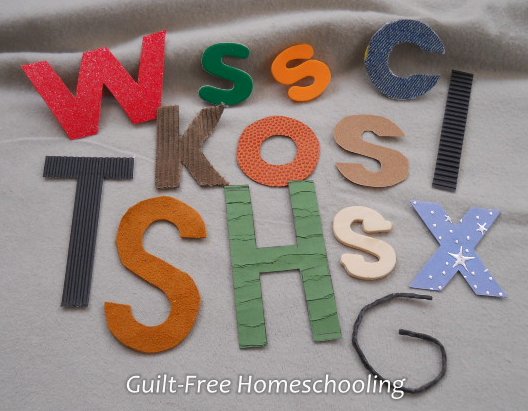
  • Letter cut-outs are an excellent teaching tool for tactile learners. The shape speaks to fingers and transfers the message to the brain in a way that goes far beyond the simple visual connection. Textured cut-outs are even better: sandpaper, textured scrapbooking papers, corduroy or other textured fabrics, foam or chipboard letters, wooden cut-outs, and more can either be made at home or found at craft stores. Some harsh textures may produce a negative reaction, so experiment to find what your student really likes. No matter what texture your student prefers, feeling the outline shape of the letter makes a deeper mental impression than just looking at a letter printed on a flat surface.

  • Students who have hit a roadblock with letter recognition will benefit from using materials other than pencil and paper. Try some of these options for drawing or shaping letters: finger-writing in dry cornmeal, sand, or shaving cream smeared on a window, patio door, or cookie sheet; Wikki Stix; pipe cleaners (chenille sticks); Pla-Doh or modeling clay; Lego bricks; pennies lined up on the table; or lying on the floor and bending their arms and legs into letter shapes (reasonably close, anyway). The important thing to learn is whether a letter uses short sticks or long sticks or half-circles or whole circles and where each of those parts goes. It doesn’t matter as much if they can form the letter perfectly straight or perfectly round or perfectly connected, as long as they know which parts go where. Elegant penmanship is a different skill, and that can be developed later.
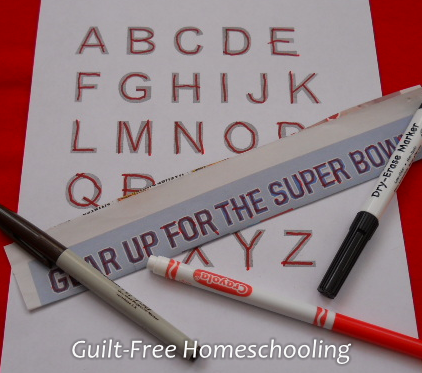
  • A great way to practice writing letters (or numbers) is to trace inside the fat letters of newspaper headlines (lots of wiggle room for shaky lines). Letters or words can be computer-printed in a jumbo font (use a light color and/or draft printing mode) for custom worksheets that use the same tracing technique. This is especially good for students who are having difficulty making steady lines or following connect-the-dots methods. Any thickness of writing utensil can be used with this method: pencils, crayons, markers, etc.

  • Encourage students to practice handwriting by copying a favorite storybook into a notebook (the child will already know the story and can focus on handwriting the words letter by letter and leaving spaces between words. No one has to see their work, unless they choose to show it off, and it won’t be graded, but they will learn a great deal about connecting letters into words and words into sentences, in addition to the spelling of the individual sounds that make up the words.
  • Allow rest breaks and hand exercises (like hand massage or squeezing a stress ball) to relieve sore or tired muscles. Imagine learning to play guitar or violin and how quickly your hands would tire—that’s what he’s going through with learning to write. Also let his legs have some exercise before trying to do writing assignments! Restless kids are much more cooperative for seat work when their bodies are worn out from running, jumping, and playing.
  • Pencil grips make pencils much easier for beginning writers to hold. My kids preferred the Stetro grips (see this link), available in educational supply stores or office supply stores. Stetro grips are adaptable for right-handed or left-handed use and teach kids the correct way to hold a pencil, reducing muscle fatigue, plus their jelly-like texture is fun to hold. We also used the foam core from sponge hair-rollers—cheap, easy to slip onto a pencil, and a pleasing texture. Fat pencils, triangle-shaped pencils, and other unique writing implements are also easier for kids to hold than the average pencil, which is awkward for young writers, just because it is so skinny.
  • Mechanical pencils require a lighter touch (or the lead will break) than standard pencils, which can help kids learn to draw the letters without as much fatigue. These helped my kids learn to let the lead do the work, instead of pressing hard and carving into the paper as often happens with a normal pencil.
  • Smooth-flowing writing implements, such as a whiteboard and markers, are another way to make handwriting easier, since heavy pressure isn’t required to make a dark mark. Whiteboard markers can also be used directly on a cookie sheet—just wipe off with a dry tissue to erase and wash the pan well before the next batch of baking. Wet-erase markers write just as smoothly as the dry-erase whiteboard markers, but won’t disappear from an accidental touch (erase these marks with a damp tissue). Found at office supply stores, these are sometimes called “transparency” markers, since they are usually used on overhead projector sheets.
  • Using light-colored gel-pens on dark paper (see craft stores) changes the visual dynamic enough to get the child’s mind off the act of writing and keep him more focused on the subject matter.
  • Try having your student start with writing little bits instead of full sentences—have him fill in a blank in a sentence or write a brief “label” under pictures he’s drawn. He can write longer portions on a whiteboard (effortless surface) and copy a small portion onto paper. Then every other week (or appropriate interval), gradually increase the amount of writing on paper, until it’s no longer such a chore.
  • We had great results from Italic handwriting workbooks. My fifth-grader had learned the standard cursive at public school but didn’t like the way it looked, so she asked if she could learn to improve her handwriting at home. Italic handwriting was simple and beautiful, and to encourage my daughter, I practiced along with my kids and changed my own handwriting, too. My first-grader learned Italic manuscript first and had no difficulty transitioning into Italic cursive.

Handwriting is a skill that takes time to develop and shouldn’t be rushed. As with any other skill, students will get faster as they become more confident in using it. Give them good tools and plenty of opportunities for enjoyable practice, and you should see positive results.

See also:

Start with Reading, Handwriting, & Arithmetic, and Save the Rest for Later

Letter or Number Manipulatives (DIY)

Letter and Number Recognition 

Preschool Is Not Brain Surgery

When Is Reading NOT Reading?


Husbands & Wives: Why They Teach Differently

If you and your spouse have shared the teaching responsibilities at your house, you have probably experienced this phenomenon: husbands and wives approach homeschooling from very different perspectives.

Here is a typical scenario: Dad goes off to work each day, earning the paycheck that makes homeschooling possible, and Mom is the primary teaching parent. One day when Dad is not at work, Mom’s normal teaching duties are handled by Dad. Mom may be sick in bed with whatever despicable virus has finally caught her unawares, or perhaps Dad has a vacation day, it’s a holiday break, Mom just needs a Me-Day, or fill-in-the-blank other reason that can take Mom away from the action. An efficiently organized Mom may leave a list of the lessons that she feels should be accomplished for the day, but Dad may also scan through the list and do things his way. The children may even think Mom wouldn’t do it this way, and they may or may not voice their opinions aloud, depending on how the day proceeds. Dad will get important things done, but they may not be the same things that are on Mom’s list, or they may not be completed with the same methods or in the same order or in the same time frame that Mom would do them. Husbands and wives approach homeschooling from very different perspectives.

I remember returning home after a day away from my homeschooling role to find that my husband had supervised some of the lessons but allowed the children to handle others on their own—whereas my normal routine might have been to micro-manage every lesson throughout the day. He had completed several household chores during my time off, but they definitely were not the same ones that I would have done, or they were done in an entirely different manner from my normal routine. I do know that it was always a good thing for me to see his very different approach to things: it usually taught me that I could step back and give up a little more of my control and allow others to handle the responsibilities in their own ways. I frequently found myself stuck in the rut of routine, thinking that this job must be done this way, every time. Witnessing my husband’s approach to the same job was very often a delightful revelation of time-saving, energy-saving shortcuts. My focus had been on managing the whole operation at once, concentrating on the end results, where his focus had been on each task individually, revealing unnecessary steps.

Women multitask. God designed women to be nurturers: able to maintain a comfy and cozy home environment, prepare the meals, tend to the baby’s needs, care for the growing children, and so on—all at the same time. Whether or not today’s woman is a stay-at-home mom-of-many, she has the God-given ability to handle multiple tasks at any given time, capably and efficiently.

Men maintain a singular focus. God designed men to be providers and protectors. As hunters and defenders, men must keep their eyes on the objective. Glancing away could mean death through attack or starvation from losing sight of the target. Even though most modern men do not spend every day literally in search of the next meal or fending off predatory enemies, they still approach their day-to-day business with the singular focus that God has placed within them.

Moms and Dads approach homeschooling differently, by God’s design. Moms can teach several kids at once, each child in a different subject, in multiple rooms, while keeping track of laundry cycles and watching the clock to know when to start dinner. On the other hand, Dad can get Junior unstuck from a tricky math problem in under 5 minutes. Then Dad will take Junior out back and teach him how to throw the football in a perfect spiral.

Mom may vent to Dad about her frustration with that day’s homeschooling, giving him a blow-by-blow account of all she did to try to discourage the twins from kicking each other under the table. Dad will quickly see past the details of the squabble and offer the simple solution of putting them in two separate rooms to do their work tomorrow.

Dad may come up with the idea for a great dad-and-lads camp-out for this weekend. Mom will gather all the necessary comforts of home, packing the cooler with sodas and milk, and send along all of the ingredients for making s’mores by the campfire—including clean marshmallow roasting sticks. Dad may protest at Mom’s insistence that they take along the band-aids and antiseptic wipes, but he will use them when Junior skins his knee after tripping on the hiking trail and sliding down the rocky hillside (but it wasn’t all that far, just a few yards).

Moms and Dads bring different sets of skills and talents to the task. Moms are good at cuddling and kissing boo-boos; Dads are good at rough-housing and playing horsey. Dad’s tools are hammers and saws and power-drills; Mom’s tools are rubber spatulas. Moms do have tools called beaters, but they get used for things like eggs and cream. “Changing the oil” may not sound very exciting, but when Dad does it, he gets sufficiently greasy and dirty to satisfy any child lucky enough to be allowed to help him. Moms often plan their lessons and stick to their plan. Dads often walk away from the books and teach lessons from real life. Moms and Dads both make excellent teachers, but we should never expect them to do the same job in the same way, with the same tools, or with the same flourish and finesse. To expect Mom and Dad to teach the same subjects to the same children in the same way is to expect at least one of them to deny the instincts God has placed within them both and to work counter to everything God has programmed them to do and to be.

Consistency in teaching is a good thing, but taking a break now and then is a good thing, too, and children and parents will be blessed by both. Moms and Dads, please recognize that your way and your spouse’s way are both valid, no matter how dissimilar they may be. One way is not necessarily the only right way, and another method is not necessarily a wrong approach. Sometimes different is just different, and variety is the key to learning.

Surviving the Mid-Year Slump

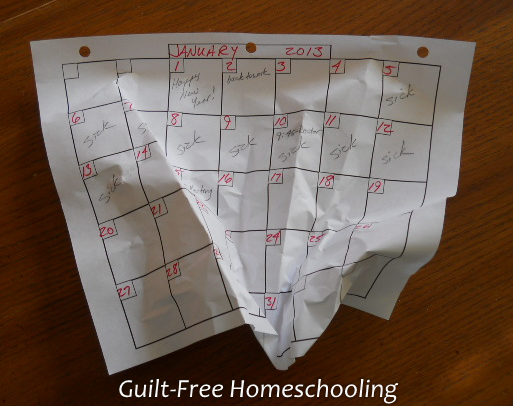
What is getting you down right now? The “We’re Only Halfway Through This School Year” blues? The “This Book Isn’t Working Any More” blahs? Or is it the “After-Christmas and No One Wants to Work” wall? Maybe you’ve been hit by the “Pestilence Apocalypse”? A suitable subtitle for this article might be “Stuck in the Middle with You,” since this is the time of year when homeschooling tends to take on a kids v. mom perspective. We want to turn that around to its proper alignment of us v. the books, proving to the kids that mom really is on their side in this educational endeavor.

Step One, get serious about what you want to learn. More than just getting serious, it’s time to get realistic about expectations. If your plans for the year were so incredibly lofty that your students have barely even completed the introduction to the material at the mid-year point, it’s time for some reevaluating. Don’t get me wrong — there is nothing wrong with having lofty goals, as long as you have the means to accomplish them. However, no one can run a 26-mile marathon in 4 minutes. You can make it your goal to run that full marathon or have the goal to run a mile in four minutes, but you can’t have it both ways, especially since either of those goals is still a lot of work!

When it comes to schoolwork, remember that publishers sell all-in-one products that cover a wide variety of needs, which is why teachers rarely use an entire book. (I’ll say rarely just in case there is a class out there somewhere that regularly completes every book from first chapter to last, but I haven’t seen it done yet, except by a few over-achieving homeschooling families who quickly burned out and then wondered why.) Therefore, don’t guilt yourself into thinking that just because the publisher included all those chapters in this book, that must mean that you must push your students to complete every one of them. Absolutely not! This now means that you and your students can browse through the rest of the book, deciding which chapters look the most interesting, which ones are repetitive or boring and can be skipped, and which ones might be included if you have enough time. Textbooks are the least efficient method for learning anything, since someone else had to pick and choose what would be included and what would be ignored. Biographies, autobiographies, journals, and first-hand-account histories give a much more accurate (and more interesting) portrayal of any topic, as far as books go (I like hands-on methods even better). Conquering the books puts you back in control of the lessons. Maybe you decide to skip the chapter on bugs that would have taken several days to go through, and instead you and your students spend an afternoon exploring everything you can find about bugs online. The intensity of the learning is what’s important, not the time involved. (More on this in Step Three)

Step Two, don’t let a schedule bog you down in unnecessary work. If a student gets it, let him move on. A wise mom once said, “If my kid knows how to start a sentence with a capital letter and end it with a period, why should I frustrate him by making him do 12 more lessons of starting a sentence with a capital letter and ending it with a period???” I regularly gave my kids a pep talk, reminding them that if they would take their time and get everything correct the first time, they wouldn’t have to go back over it again and again. Giving them incentive to pay closer attention made them more diligent at their work. By all means, stick with the child until he understands a concept, but once he’s definitely got it, let him move on.

Effective, daily communication requires a working knowledge of grammar, vocabulary, spelling, and so on, and handling personal finances every day requires a working knowledge of basic math, so I taught those daily. Skills that will be used every day as an adult should be studied and practiced every day as a student, but Google and “Siri” can now supply quick answers for just about anything else that is not needed on a daily basis.

Step Three, get away from the books more often, which does not mean to stop learning. If your students have been learning how to multiply fractions, let them put that knowledge into practical practice by tripling their favorite recipe for chocolate chip cookies. Make them and bake them, or freeze little balls of cookie dough for a quick-to-bake treat another day, but measuring, mixing, and tasting will prove whether or not they did their math correctly (and since it’s a yummy treat, they will be extra careful to get it right, because no one wants to eat cookies with too much salt in them!). Now pick another cookie recipe and double or triple it for more fraction practice. (Bonus tip: freeze some baked cookies in grab-and-go bags for your next field trip day!)

Watch movies related to literature or history as another pleasant diversion from the printed pages, one that can impart basic themes in a quick but memorable way. My teenaged son enjoyed reading books more if he knew what to expect from the story, so we fell into the method of watching the video first, so that he could learn the plot twists and who was connected to whom, and then he wouldn’t lose interest while reading through the book at a much slower pace. There was one day when we rented an action-adventure-movie-made-from-a-book, only to find out that Jane Eyre had accidentally been slipped into the wrong case, the one we had just brought home. He watched it anyway, so as not to lose his allotted video-watching time and ended up knowing the story of Jane Eyre, a book/movie he would never have chosen on his own.

Explore online. Watch a tutorial video. Read a website. Follow a blog. Play a podcast. Find a live webcam. Search for images. Find an out-of-print book in eBook form. Read a review. Zoom in on Google maps’ street-view. Listen to music. Download an app. In this 21st century, electronic age, it’s becoming more and more vital to expand our definition of learning to include paperless forms of information. I can learn a new skill from watching a You Tube tutorial faster than I can find a printed version of the same instruction. And I have. Learning is learning, no matter what the source — it’s not cheating, just because I didn’t learn it from an over-priced, hardback book. A very old but very worthy book that libraries no longer stock can be downloaded as an eBook faster than I can say “for free.” An elderly neighbor can tell personal stories from World War II that will never be written in books, because he was there and lived through it. A great musician no one knows can demonstrate techniques in an online video, reaching students he will never meet. Learning is learning, no matter what the source.

Play games. Board games are an under-appreciated educational resource. If the game isn’t fun, find a better way to play it: drop the score-keeping, loosen up the rules a bit, or add three extra dice to get you around the board faster. Invent your own “house rules” for certain games, such as “Jabberwocky Scrabble,” where any nonsense word is allowed as long as the player can pronounce it and make up a reasonably-acceptable (and probably hysterical) definition for it. Create  “Slumlord Monopoly” by letting each player roll the dice to determine how many properties he can pick from the deck and roll again to see how many houses he can put on them for free, before normal game play begins. Put a simple jigsaw puzzle together upside-down, placing all the pieces face-down on the table. Players will be forced to rely on the shapes of the pieces alone, improving their visual skills.

My kids quickly learned that if they could spend a break playing games together without squabbling, they got to stretch that break into a longer time period — but a frivolous argument would land them right back at the school table for structured lessons. They became very adept at figuring out the rules, solving disputes… and getting along. I called that a Win in every column: they became good problem solvers, they learned how to teach themselves, and mom got more time with fewer interruptions. The lessons still got done, sometimes more quickly because of the lessons learned while playing games: reading the instructions, critical thinking, math practice, and so on. Kids view playing games as just playing, not learning, but the savvy mom knows what lessons are being learned through the playing!

Step Four, schools and colleges create their own special-interest classes, and so can you! Use a child’s unique interest as a mini-class that cuts through the twaddle and gives him a boost in learning something he really enjoys. Maybe Penelope is begging to raise rabbits. Encourage her to do some extensive research first, to guarantee her success, then suggest she enter her future bunnies in the county fair, ensuring her diligence. Stewart wants another bookcase in his bedroom, but he never gets enough time after lessons for woodworking — so turn the project into a lesson by challenging him to design the bookcase, double-check the measurements for accuracy, visit the lumberyard to note the cost of all materials and compare them to the cost of a ready-made bookcase of similar size and quality. His completed bookcase might also make it to the fair, along with the photos of him proudly doing every step. Victoria is bored with her history book, but is intrigued by Abraham Lincoln. Let her have some time away from the traditional books to read his speeches and letters and a biography or two. Listen as she recounts every interesting tidbit, because those are much more exciting than any stuffy book report ever written.


The key to surviving the mid-year slump is to change your methods enough to put the focus back on the learning and not get bogged down in the tedium of the methods themselves. Some families may only need a one-day break from the normal routine; others may need a full week or two of refreshing change; still others may decide to scrap their former routines altogether and adopt the completely new approach as a routine-less routine. The choice is yours, and you’ll know what you want when it starts to work.

See these articles for more slump-busting ideas:

10 Ways to Ease into Homeschooling (great for getting started again after a long break, whether from holidays or illness)

Reschedule, Refocus, Regroup

Redeeming a Disaster Day 

How to Adapt Lessons to Fit Your Student’s Interests and Make Learning Come Alive 

Applying Learning Styles with Skip-Counting

“Stealth Learning” Through Free Play

Mundanes, Too-days, & Woe-is-me-days

Knowing How to Find the Answer Is the Same as Knowing the Answer 

Troublesome Students

Disrespectful Kids 

Stuck in a Homeschool Rut? 

Workshop Wednesday: Money Land Game

I absolutely love to teach with games. Playing a game transitions a lesson concept from tedious drill to fun and… well, games. My kids might have balked at the idea of doing yet another set of math problems, but they would voluntarily play board games using money, which required the same adding and subtracting as the math problems — only they could do the money problems aloud or in their heads while handling all those tactile game parts, instead of writing them on paper. The ability to do math in your head is a distinct advantage in life, so I encouraged my kids to play money games as often as possible, but they didn’t need much encouragement at all. They loved to play board games of all types, and games with money were a distinct favorite.

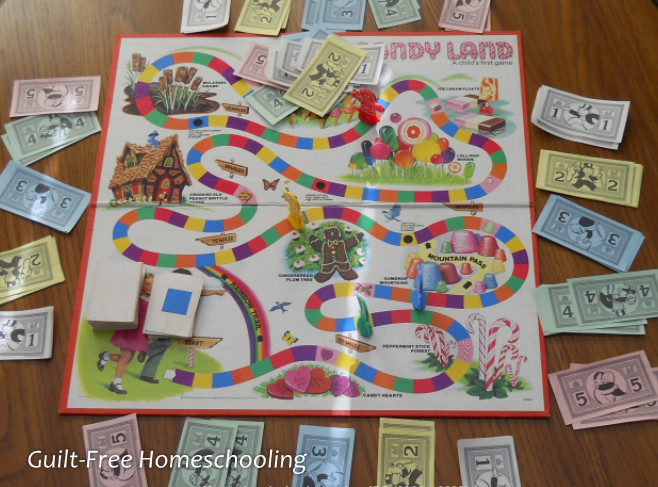
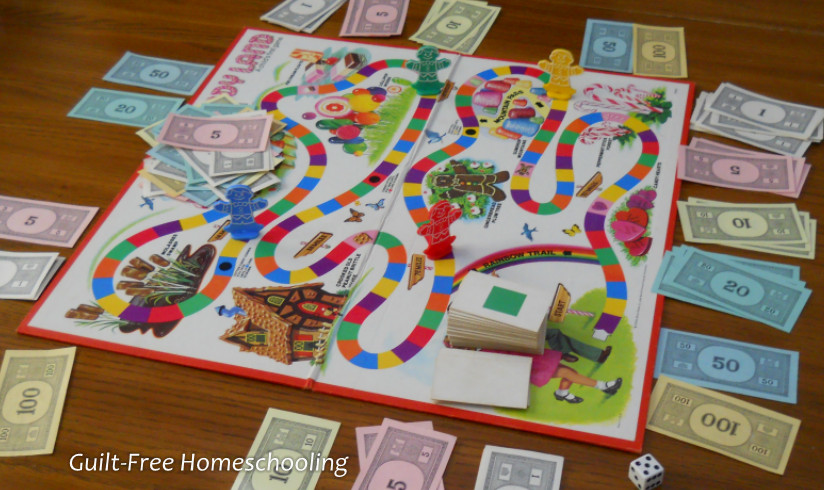
I also believe in borrowing equipment from games and combining those components to create a new game or a new variation of an old game. This is how we got here today, coming up with a new variation of an old game (Candy Land) that often falls into disuse once its players begin to read and move on to more complex games. By adding the math component of money, the Candy Land game once again appeals to older students, and with several variations that increase the complexity of the money transactions, this game can help students of all ages hone their mental math skills in a very stealthy way. Every turn provides all players with opportunities to improve their math skills, whether to avoid paying fines or to catch another player in a mistake and collect a fine from him. Winning the game is highly dependent on chance, giving all players an equal playing field. (Notice that the fines are not intended as meanness, they are simply incentive to pay attention during other players’ turns and to make players aware that they are doing their own math correctly. The fines also provide another way for an alert player to make money.  The fines are intended as a sporting challenge, not a way to make fun of other players. Fines may also be optional — see Fines section below.)

Instructions:

Basic Version #1 — Use the game board, cards, and pawns from a regular Candy Land game, but include the money from Monopoly, Monopoly Junior, or any other source. Begin a money “pot,” by placing $5 (in any combination of bills) on the Home Sweet Home area of the Candy Land game board, and give each player a total of $50 in bills of various denominations. Players do not all need to have the exact same denominations of bills, as long as they all start with the same total. (Suggested amounts for each player — standard denominations: 10 $1’s, 4 $5’s, 2 $10’s; Monopoly Junior denominations: 6 $1’s, 5 $2’s, 4 $3’s, 3 $4’s, 2 $5’s) Any leftover bills should be set aside and not used.

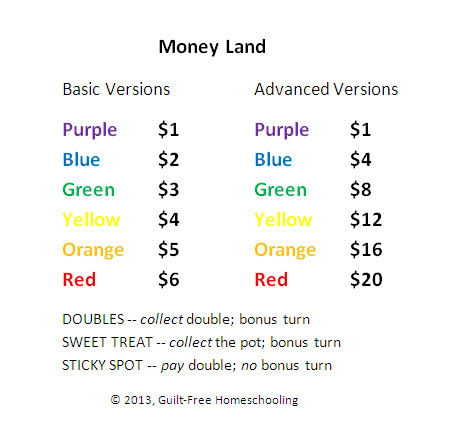
Assign the following number values to the Candy Land color cards, based on the colors of the Candy Land game board:

  • Purple square = $1
  • Blue square = $2
  • Green square = $3
  • Yellow square = $4
  • Orange square = $5
  • Red square = $6

Place the shuffled stack of cards face-down near the starting square. Play begins with the oldest player and proceeds to his left. Each player in turn draws a Candy Land card and moves his pawn to the nearest square of that color as in a normal game, but when his pawn lands on the square, he must pay the corresponding amount listed above into the Home Sweet Home pot. (The Rainbow Trail and Mountain Pass shortcuts have no significance in this game and are not used.)

Special Plays: 

Doubles card — Player moves to the appropriate square and collects an amount of money from the pot that is equal to double the dollar value of his color square (Example: a double-red card = $12). The player may then take a bonus turn.

Sweet Treat card — Player moves to the appropriate square, collects all the money in the pot, and takes a bonus turn.

There is no limit to how many Doubles and/or Sweet Treat cards may be drawn in succession by a single player, as long as the pot contains sufficient funds. However, if the pot does not contain enough money when a player draws a card that would allow him to collect more, that player collects all the money available in the pot, his turn ends, and play moves to the next player. If there is no money in the pot, the player’s turn ends, and he does not move his pawn.

Sticky Spot– A player whose pawn lands on a Sticky Spot must pay double the amount for its color, but may move on his next turn (he is not required to remain on that square until the appropriate color card is drawn). No bonus turn is awarded. In the rare event that a player draws a Doubles card that lands him on a Sticky Spot, no money is either paid or collected, and the player’s turn ends.

Fines —  If a player either pays or collects an incorrect amount of money, or pays when he should be collecting, or collects when he should be paying, any other player who notices this mistake may point it out at the end of the player’s turn, before the next player has drawn his card. In the case of a player who has earned a bonus turn, the mistake must be pointed out before the next card is drawn. In each case, the player who made the mistake must correct the amount AND pay a $5 fine to the player who pointed it out. If a player catches himself in a mistake and corrects it before the next card is drawn, no fine is required. (Fines may be considered optional, especially when young players are just beginning to learn math facts.  The fines can also be imposed by much younger players against more experienced players, and not vice versa, depending on the skill levels involved.)

Players who need to do so may make change from the pot in order to obtain the correct amount required for their turn. (Example: A player owing $8 to the pot may pay with a $10 bill and remove $2.) A player may also trade a large bill to another player in exchange for an equivalent amount of smaller bills, if the pot does not contain a sufficient amount for exchange.

If a player’s pawn lands on an occupied space, the other player’s pawn is moved backwards to the nearest empty space. The owner of the moved pawn does not pay or collect any money because his pawn was moved.

If the stack of cards runs out before the game has been won, the stack should be shuffled well and turned over to start again.

A PLAYER’S TURN ENDS WHEN —

1) he has drawn a card, moved his pawn to the appropriate square, and paid the correct amount into the pot, OR

2) he has met condition #1 as a bonus turn, following a Doubles card or Sweet Treat card, OR

3) he has collected less than what was owed to him from the pot, because it didn’t contain enough money, OR

4) he pays all of his remaining money into the pot. Any player who runs out of money during the game is out for the remainder of the game.

THE GAME ENDS WHEN —

1) one player ends up with all the money, OR

2) the game is down to the final 2 players and one is eliminated by running out of money, OR

3) one player reaches Home Sweet Home and collects any money remaining in the pot.  Home Sweet Home is considered to be located anywhere after the final square of the trail (no exact count is needed). A player whose pawn lands on the final square is not considered to have reached Home Sweet Home until his next turn, provided he draws any color card and not a Sweet Treat card that would send him back to another location on the trail.

Winning — Winner is the player with the most money at the end of the game.

Basic Version #2 (Dice-Addition) — Include a regular, 6-sided game die. Players will add the number on the die to the card’s dollar value. The rest of the rules apply as above, with the only change being the amount of money paid or collected on each turn. Each player rolls the die in addition to drawing a card, and alters the dollar value of the card according to the die. If any bonus turns are awarded, the player draws a new card and rolls the die for each additional turn. The die is not rolled whenever a Sweet Treat card is turned up. The amount paid for a Sticky Spot is not affected by the die. In the case of rolling Doubles and collecting money from the pot, the number on the die is added to the doubled value of the color square (Example: double-red = $12 + 4 on the die, collect $16).

ADVANCED VERSIONS FOR PLAYERS WITH HIGHER MATH SKILLS

Advanced Version #1 — Play proceeds as in Basic Version #1, but players receive a starting total of $200 (Suggested amounts for each player: 10 $1’s, 4 $5’s, 3 $10’s, 2 $20’s, 2 $50’s). The starting pot is increased to $20, and Fines are also increased to $20 each. The dollar value of each square changes as follows:

  • Purple square = $1
  • Blue square = $4
  • Green square = $8
  • Yellow square = $12
  • Orange square = $16
  • Red square = $20

Advanced Version #2 (Dice/Addition) — Include a regular, 6-sided game die. Players will add the number on the die to the card’s dollar value. Play proceeds as Basic Version #2 (Dice-Addition), but increases the starting value of the cards to Advanced Version #1 levels before adding the number shown on the game die. Pencil and paper may be used for calculating correct values. Starting pot is increased to $100, and each player’s starting total of cash is increased to $500 (10 $1’s, 4 $5’s, 7 $10’s, 5 $20’s, 4 $50’s, and 1 $100’s). Fines are also increased to $100 each. If any bonus turns are awarded, the player draws a new card and rolls the die for each additional turn. The die is not rolled whenever a Sweet Treat card is turned up. The amount paid for a Sticky Spot is not affected by the die. In the case of rolling Doubles and collecting money from the pot, the number on the die is added to the doubled value of the color square (Example: double-red = $40 + 4 on the die, collect $44).

Advanced Version #3 (Dice/Multiplication) — Include a regular, 6-sided game die. Players will multiply the number on the die times the card’s dollar value. Play proceeds as Advanced Version #2 (Dice-Addition), with the only change being the amount of money paid or collected on each turn. Pencil and paper may be used for calculating correct values. Starting pot is $100, Fines are $100 each, and each player’s starting total of cash is $500. If any bonus turns are awarded, the player draws a new card and rolls the die for each additional turn. The die is not rolled whenever a Sweet Treat card is turned up. The amount paid for a Sticky Spot is not affected by the die. In the case of rolling Doubles and collecting money from the pot, the number on the die is multiplied times the doubled value of the color square (Example: double-red = $40 x 4 on the die, collect $160).

Advanced players may choose to play subsequent games, continuing with the cash accumulated from previous games (instead of re-counting to starting cash amounts). In this case, no cash is placed on Home Sweet Home as a starting pot. Each subsequent game is started by the next player to the left of the one who began the previous game. Very advanced players may choose to add more than one die to Advanced Versions #2 & 3.

© 2013 Carolyn Morrison. These rules may be printed for personal use or shared for free, but these game concepts and their rules may not be reproduced for sale. This copyright restriction must appear on any printed copies.

Verified by MonsterInsights