Get our eBook special offer before New Year’s Day ends!! For details, CLICK HERE! Don’t miss this great 2-for-1 deal!
Equipping parents for homeschooling success!
Get our eBook special offer before New Year’s Day ends!! For details, CLICK HERE! Don’t miss this great 2-for-1 deal!
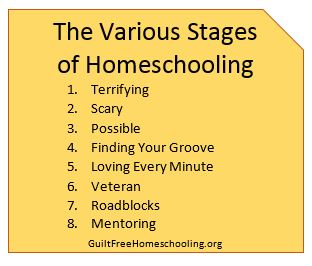
There were several distinct stages that I went through as we worked through our homeschooling journey, and you may recognize them in your own journey. This is the viewpoint that I had, as the Homeschooling Mom, the parent who was responsible for most of the teaching in our household. My husband and our kids probably saw things a little differently or had their own opinions about it, but this is how it felt to me. I have not applied definite time periods to these stages because some families may progress through one stage quite quickly, while taking much longer to move through another stage. Speed has nothing to do with the appropriateness for your family, as long as you are working at a pace that is suitable for your students’ abilities and for your family’s lifestyle. Some stages may fly by so quickly that you don’t even notice them passing, while others may stick around (rather like gum on your shoe) for a long, long, long time. Bear in mind that each family’s experience will be different, and what you zip through un-noticed may be what others get stuck in seemingly forever… and vice versa. Neither status indicates success or failure—that’s just how life goes.
1. Terrifying: You are considering homeschooling and trying to decide whether homeschooling will work for your family’s unique situation. You recognize that drastic changes must take place, but you don’t know yet exactly what those changes are, when they will take place, or how they will affect your lives. You are pretty sure that these changes will upset your domestic tranquility apple-cart and alter life-as-you-currently-know-it forever (or at least for the imaginable future), but you are also faced with the reality that these changes are inevitable.
2. Scary: By your first real day of homeschool lessons, the hardest decisions are usually behind you, and this process moves to being only scary instead of truly terrifying. This stage is somewhat like wading waist-deep into cold water—you’re there, you’re mostly wet, and although you’re not completely immersed yet, you feel fairly certain that the worst shock is already over.
3. Possible: Sometime in the not-so-distant future, you may begin to feel that this just might be possible. You’ve been at this for a while now, and you’ve found little bits of routine that worked fairly well and other bits that you definitely don’t ever want to repeat again. Ever. You also now are developing a mental list of other ideas you’d really like to try at some point. But it could be a really short list.
4. Finding Your Groove: After a longer while, you will probably have adopted a pattern of the things that are working best. That pattern may only apply to one small portion of your school day, such as lunch break, or you may have stumbled into a groove that works for most of the day. This can also be called the “So Far, So Good” stage.
5. Loving Every Minute: For most families, there comes a time when they are feeling more confident in their daily routine. You may notice that while still far from perfect, you have smoothed off a lot of rough edges from where you started. There have probably been a few days that you definitely don’t want to repeat, but they are now being over-shadowed by some truly wonderful days that are making this new process completely enjoyable.
6. Veteran: One day, after repeating the same cycles several times, you may find yourself thinking “I’ve been here before. I know what to do this time. I can handle this.” You will look back over all you’ve learned and marvel at how confident you now feel. You know exactly what to do today, this week, and this month, but you might still be unsure about next year. It’s okay to be a little shaky about the distant future, but remember that this is nothing compared to where you were at Stages 1 and 2, and you will get things figured out by the time that distant future becomes the present.
7. Roadblocks: This is an interim stage that really can occur at any time, including before or after any of the other stages. My daughter hit a roadblock in the midst of Algebra 2 and couldn’t make any progress until the next school year. She had had some health issues for a time and attributed her thinking-problem to that, but she just couldn’t grasp the concepts presented. Since that particular textbook was designed as a 2-year class anyway, she gave in and put the math book on hold even before the end of that school year drew near. Several months later, she was determined to try again and not let it beat her down, and by that time, her brain had processed long enough on the concepts that she had no trouble getting through it.
A different type of roadblock occurred when my son reached a point in early high school where he just couldn’t relate to the lessons in his textbooks. In my estimation, things had been working fine, and then… nothing was working any more. I scrambled to come up with alternative projects that would interest him enough to further his education without completely derailing his progress. The result was primarily that I was transformed into an unschooler without realizing it at the time, giving up the standard textbooks in favor of the more real-life learning opportunities that appealed to him.
Roadblocks are anything that hinders your progress, and they may last a few moments, a few hours, a few weeks… or much longer. The duration is insignificant—what you do about the roadblock is the important part. Back up and refresh or fill any gaps in the foundational skills, try something totally different for supplemental activities, or put the book on the shelf for a while, but don’t let the roadblock win. You can dig under it, climb over it, or map an alternate path around it, as long as you refuse to let it keep you stagnant. Some of our alternate paths included changing the order of classes to put the problem subject at a different time of day, changing the location for doing a particular class (a different room can make a big difference), continuing on with the rest of the routine but putting the difficult subject on hold while we looked for a new program or a new approach. We abandoned the programs that were most favored by our friends (to their shock and horror) but just didn’t work for us. We sampled other methods until we found something we liked, something that worked, something that didn’t leave us (student and teacher) in tears every day, all day long. More than once we used the information from one program and the order of lessons from another program, and combined them into a system we thought up ourselves, just because we wanted to try it that way… and it worked.
A few specific situations may contribute to requiring more time to work through a roadblock, such as a special needs student, students who have spent a long time in institutional school before switching to homeschooling, one or both parents who are (currently or previously) classroom teachers who insist on recreating school-at-home conditions, trying to keep up with the Homeschooling Joneses by doing too much or doing what doesn’t fit your family but was advised as vitally important by others because it worked for their family, and the dual-school family (also known as “Somer-Homeschool”: Some-R-Home, Some-R-Not). Regardless of the cause of the roadblock, keep digging, keep climbing, keep mapping, and keep refusing to be beaten. It’s not your fault, and it’s not your student’s fault; it’s the curriculum that just isn’t matching your needs. Review it, find a way around it, or wait it out, but remind yourself that whatever you choose to do is a plan: you are doing something about the roadblock, even if that something means taking some time off to let the stalled brain process on the concept until it is ready to try it again.
8. Mentoring: With a history of successful homeschooling comes the day when you may find yourself offering helpful information to other families who are seeking homeschooling advice. You may secretly giggle inside when they tell you how knowledgeable you are and how much they appreciate your input, because you still remember all too clearly just how terrified you were only a short time ago, when you were still occupying the spot they are in today. At the same time, you will be able to rattle off exactly which activities your family enjoyed the most, which materials were the least helpful to you, and how your family’s routine gradually developed into your own preferred style of homeschooling. Share how you adapted methods to fit your own family’s specific needs. Share willingly with all those who seek your advice—they are asking you because you are standing out from the crowd in a way that appeals to them!
Articles to Help You on Your Journey:
21 Things That Can Slow Homeschooling Progress
Do the Best Job You Can and Pray for God to Clean Up the Rest
Top 10 Benefits of Homeschooling with Grace
Family Planning (No, Not That Kind)
Top 10 Things I Wish I’d Known When I Began Homeschooling
Tests, Book Reports, and Other Un-necessities
Homeschooling Is Hard Work
10 Ways to Improve a Lesson
Articles to Help You Through the Detours on That Journey:
Homeschool Beginnings–A Child’s Point of View
Meatball Education: Filling in the Potholes of Public School
People Who Nearly Scared Me Away from Homeschooling
Redeeming a Disaster Day
Looking Back on the Bad Days
Reschedule, Refocus, Regroup
Bottom 10 Worst Parts of Homeschooling
Common Mistakes Made by New Homeschoolers
Homeschooling Failures I Have Known—and What Can Be Learned from Them
I’ve often been asked how we raised our kids, by those who are up to their armpits in the midst of the power struggle that parenthood can sometimes be. The answer is one long day at a time, but with the help of some very consistent rules. I should clarify that many of these weren’t unbreakable rules as much as they were our family’s unique customs or our preferred methods for handling specific situations. I didn’t remember having a lot of rules for my kids, but my now-adult children have reminded me of several of them over the years. They recognize behaviors in others that they were not allowed to do and say “You never let us do that!”—and I’m pleased to say they mean it as a compliment. My daughter, Jennifer, has often caught herself watching her friends’ or coworkers’ exploits and thinking “If you were my mom’s child…” She has quoted some of our family rules as if they were The Wisdom of the Ages, only to have the hearer ask “Who says?” “Umm… my mom and I!” is her reply as she realizes that, unfortunately, the rest of civilization has yet to catch up to Mom’s Standards for Proper Conduct.
Some of our rules applied to my children, some to us as a family unit, and some were reminders for me as a parent that good kids don’t just happen. Kids obey best when they understand the reason behind a rule, whether they participated in the decision-making process that created that rule or not. Most rules are made to govern the future as well as the present: “Don’t run out into the street” is for right now, but also for every time in the future that a speeding car promises harm. Whatever rules your family makes, be sure to craft them with one eye on the future, and help your kids understand that the future-aspect is there to help them learn how to grow up into responsible adults. After all, “parent” is a verb, and you can’t expect great results from doing nothing. [“Parent” Is a Verb, linked below]
Overwhelmingly, I used the Golden Rule (Treat others as you wish to be treated—Luke 6:31, paraphrased) to teach my kids appropriate behavior and respect for others’ feelings and property. From toddlerhood on, I explained (in language suited to their understanding) what they had done wrong, why it was wrong, how it made the other person feel, and what their response should have been (the preferred behavior). Once they understood the situation from the other side, then they were able to offer a truly sincere apology, if circumstances required it. Beyond that, the detailed explanations helped those little people learn to think things through and anticipate the cause and effect relationship of actions to outcomes. You should not have kicked your ball into the neighbor’s flower bed. Your ball broke several of their pretty flowers, and they had just bought those plants and worked hard to get them all planted today. You can kick your ball over here where there is plenty of open space, but you may not kick it so hard that it lands near those flowers again. Do you understand the difference? If you disobey and kick the ball into the flowers again, you will be punished. Do you understand?
My kids were allowed to repeat certain actions only 3 times and no more. Whether it was running circles around the kitchen table or bouncing a beach ball off the top of my head, they could get away with it three times. Behavior that would have hurt someone or something was stopped immediately, but otherwise let’s just say that they learned to obey the limit. Auditory learners and making noises go together like air and breathing, but the “Rule of 3” taught them to stop the repetitive noises after 3 times and save the remainder for more appropriate situations, such as when playing outside, or when in their rooms and not disturbing others. [My “Rule of 3,” linked below]
Nearly every “rule” we had was an extension of the respect relationship taught through the Golden Rule. Do you want your little brother barging into your room without knocking? Then be sure that you knock on his door before entering his room. The Rule of 3 was built upon respect for others’ personal space, and respect is in itself a Golden Rule relationship. Respect must be earned—it isn’t granted automatically. If you want it, what are you doing to deserve it? [Respect Must Be Earned, linked below]
Family is spelled T-E-A-M, and we are all on the same side. No one here is your enemy, especially not your siblings. Family is not a competition, and we’re all in this together. [Family Is Spelled T-E-A-M, linked below]
Speaking of teams, Mom should not be the only person working while everyone else is playing, because moms like to play, too. Get the household staff working—fill those machines and get them running, so you can feel good about all the jobs that are getting done. Teach your kids that if we get the chores out of the way first, then we can take a break, guilt-free. Work first, then play. [Using Your Household Staff, linked below]
I taught my kids not to interrupt a conversation (especially between adults), unless there was a true emergency involving large amounts of water, blood, and/or fire. I told them that if they stood quietly next to me while I was involved in a conversation that: 1) I would know they had something to tell me, 2) I would not forget about them being there, and 3) I would listen to them at the next appropriate moment. I also taught them to hold up one finger to help them remember what it was they wanted to say (or 2 fingers to remember 2 things—and it really does work). Yes, it was appropriate to wake Mom and Dad from a Sunday afternoon nap to report that the house next door was on fire. It led to very important life-lessons in how to remain calm in a crisis, how to use a fire extinguisher, and how long it takes from the time someone dials 911 until you can actually hear the fire truck’s siren. Good job! (Yes, that really happened, but no one was hurt, and insurance covered the damages.)
Whining, begging, nagging, and asking again and again will never convince me to change my mind. However, if you can present your case with facts and logic and without whining, then I will listen with an open mind. Notice that this is a two-way contract. My part of the agreement was to listen attentively to the logically reasoned case my kids presented, putting aside my preconceived notions about the topic and honestly considering the points they made. The result was that very often I had to reconsider and go with their proposal, because it truly was a better idea. [If You Can Present Your Case with Facts and Logic and Without Whining, I Will Listen with an Open Mind, linked below]
We discussed “our family’s values” so that each child understood why we do what we do, why we don’t do what someone else may do, and why we hold tightly to our specific beliefs and values. It made an amazing difference in helping our kids make up their own minds when confronted with peer pressure.
As part of understanding our family’s values, my kids were taught to respect the rules and value systems of other children’s parents by not sharing their opinions on whether they thought those rules were correct. When a friend said, “I wish my Mom used your Mom’s rule,” my daughter explained that our family probably also had a few rules that the friend wouldn’t like, so the friend shouldn’t automatically assume that one family was better than another. This also applied to individual privileges, schooling or homeschooling methods, TV or movie choices, church programs, family activities, and just about anything else that could prompt a comparative discussion.
My most controversial rule (as viewed by my peers) was that “authority” figures who had no true authority over my kids (not their parent or police, etc.) and/or who were clearly wrong (meaning they had the facts wrong) did not necessarily need to be listened to or obeyed. This came into play when a bully-parent (one of those aforementioned peers who disagreed with my views, particularly this one) made a faulty assumption about my son, after overhearing a snippet of conversation between my son and another boy at a homeschool group function. That parent attempted to exert her “authority” (just because she was an adult) over the boys because of what she thought she heard, but my son (knowing the full context of the conversation) knew she was in error and tried to explain the misunderstanding. She threatened to tell his mother (me) that he had argued with her, and he dared her to follow through on that, because he knew he wasn’t guilty of doing anything wrong. When she gave me her side of the story, it sounded completely out of character for my son, so I turned to him for his explanation (which made her even angrier to think that I would accept the word of a 13-year-old over her testimony). The outcome was that I didn’t destroy a family relationship because of another adult’s misconception. Adults can be wrong, and kids learn to honor truth by seeing their parents recognize that adults are not always right just because they are adults. A parallel rule to the false-authority issue was that if anyone said to my kids “Don’t tell your parents,” that was our family’s code for “Run immediately to your parents and tell them everything!” That was also played out, with the result that my child identified right away that the person saying it was up to no good. Reporting the conversation to her parents was the equivalent of calling in the cavalry and turning the problem over to someone who could stop it from escalating into a more harmful situation. Crisis averted; family relationships secured.
Our family used “Because I said so” as valid reasoning under very special conditions, usually a minor emergency or some similar circumstance. Spoken quietly and surreptitiously, it was another code phrase that meant “Do what I say now, and I will explain the why later, as soon as I have the chance.” Everyone recognized that hearing the phrase “because I said so” meant something was seriously wrong and immediate, unquestioned obedience was required for the safety and well-being of one or more family members. We were careful not to over-use this or use it frivolously, so that it maintained its emergency-situation-only status. In our family, it was used by both parents and children, depending on the circumstances, which varied from “That kid has been mean to me before, and I really don’t want to run into him right now” to quickly leaving public situations that suddenly became uncomfortable or appeared unsafe. The full explanation that came later always assured us that the hasty exit had been completely justified.
The “family whistle” was a signal we used to find each other in large stores, get someone’s attention, or call to each other in surroundings where shouting might not be noticed. We used a unique melody of 3-4 notes that signaled us to “Come now.” We started using the non-shrill whistle when our kids were nearing middle-school age, and it was a wonderfully subtle way to signal each other in large groups. Most by-standers never even noticed.
As with any set of rules, consistency is crucial. As adults, we need to know that other drivers will obey the rule that a red traffic light means Stop and a green light means Go. Kids need the exact same consistency in knowing that their parents’ rules mean what they say. Without consistency, the rules break down, and before you know it, everyone is going, no one is stopping, and chaos is the result. Set your family rules, be consistent in their execution, and enjoy the freedom that results.
See these articles for more complete explanations:
It’s an ages-old debate: should kids be required to do regular chores around the house? My short answer is yes. Mom’s time is too valuable to be wasted on menial tasks. That doesn’t mean that Mom can’t or shouldn’t do them, but it does mean that those tasks that don’t require Mom’s unique talents can be done by anyone, not only by Mom. However, kids will need to be taught how to do a task correctly before they can succeed in it themselves.
Doing chores teaches skills, responsibility, and independence. Some day, for some unforeseen reason, Mom won’t be able to perform all of the household chores and pick up after everyone else. Whether that condition is temporary (such as a case of the flu) or more-or-less permanent (a debilitating health condition… or worse), Mom needs everyone’s help in keeping up. Incidentally, all those things Mom does are things the kids will eventually need to do for themselves in life, so they might as well suck it up and start doing them now to lessen the blow of reality. They might even find that ironing a few shirts provides an ideal time to organize their thoughts, besides making them look sharp at the job interview.
There’s a principle in economics called TANSTAAFL (say it as “tan-stay-awful”), an acronym for “There Ain’t No Such Thing As A Free Lunch.” I applied it to home chores as there are no free rides: everybody can do his share. If you plan to eat this food, you’ll willingly help carry the groceries in from the car and help put them away. As my kids got older, it morphed into “Hey, Mom! I’ll do that job for you, so you can do this job for me,” whenever my kids wanted me to help them with a special project (often making a new costume). They would lay out their proposal and then offer to do something for me (often making dinner), providing me with the necessary free time to bring their idea to fruition. Helping (bartering?) in this way taught them the vital concept of earning: you have to give to get something in return. The job-trading offers showed that they understood the most important part: every player is capable of contributing something to the Family Team.
Starting Young
My kids learned to help put toys away as soon as they were old enough to play with those toys. We stored our toys on open shelves in an assortment of shoeboxes, ice cream buckets, small dishpans, and recycled baby-wipes boxes, each labeled with a simple drawing for what items went inside. I worked side-by-side with my toddlers or preschool-aged kids to help them learn to sort out the toys and get everything put away (nearly) every afternoon before Daddy got home. They could still get something out to play with while I fixed supper, but the worst of the mess had been cleaned up. We made clean-up time into a game by calling out one type of toy and getting all of those put away before focusing on another one, starting with the largest items and working down to the smallest. Then as the kids got older and more adept at sorting and multitasking, they could handle the clean-up tasks themselves, freeing Mom to start cooking or laundry or any other higher-skilled task. By the time my kids were both school age, I had come up with a new clean-up game: I would challenge each of them to run through the house and find ten things that belonged to them and put those away. With a little more growing up, that game became known as 52-Pick-Up and was expanded to include anything that was out of place, if they knew where it belonged, not just their own personal items. They learned to appreciate the look of a tidy home and enjoyed the peacefulness that came with it, so it wasn’t difficult to get them to participate, especially because we played it as a game, and I praised them and thanked them for their diligence. Who doesn’t like being praised and thanked for their efforts? No one here!!
A child who never learns organizational skills grows up to be an adult who still doesn’t know how to organize or clean—I know because I was one. It is because I have struggled as an adult to learn how to organize myself that I began teaching my kids organizational skills as soon as they could pick up an alphabet block and drop it into a box. We played that first as a game to learn coordination, and then we continued to play it later on as a clean-up game.
Later on, I made each child a picture-chart for the bedroom wall to help them learn how to tidy things up in their rooms. A sheet of paper with simple cartoon-drawings showed a bed with wadded-up blankets and an arrow pointing to a neatly made bed, a jumble of clothes on the floor and an arrow pointing to the hamper, a pile of books on the floor and an arrow pointing to books on a shelf. Simple, homemade, but very effective. Teaching them to make the bed first provided a large surface to use for further sorting duties, again working from largest objects to smallest. My younger child felt it was a rite-of-passage, growing-up milestone when he got a picture-chart for his room—he was a big boy now, and he was old enough to learn how to tidy up his own room. He was still far from reading words, but he could read those pictures!
Learning Life-Skills
Yes, it does take longer to do a task with a child than it does to do it yourself. However, the time that is dedicated to teaching the child how to do the task himself will pay off in the days, weeks, months, and years to come. By spending the extra time required to teach my children how to do a task, I was ultimately freeing myself from doing that task in the future. Yes, I can pull a full bag of trash from the kitchen wastebasket, take it to the outdoor garbage can, and replace a new bag within a matter of seconds. Teaching my child to do that chore and walking him through each step could take ten minutes. However, he will get faster with practice, and I can eventually stop supervising and move on to my own tasks for those valuable ten minutes. Even if I only spent thirty seconds emptying the trash myself, that time adds up. If I include emptying every wastebasket in the house and if a larger family means more trash, that can become a serious waste of Mom’s time and talents. More importantly, the children won’t learn to take on the responsibility for that chore.
My kids learned to do many household chores through the years: keeping their rooms tidy; emptying the trash; emptying and filling the dishwasher; sweeping or vacuuming; dusting; cleaning bathrooms; mowing the lawn; carrying and putting away groceries; sorting, washing, drying, folding, hanging, ironing, and putting away laundry; and many other chores that I can’t remember. Some of these jobs were regularly scheduled tasks, and sometimes the kids were just asked to help out with other tasks. Yes, they needed reminders occasionally—we all do. Yes, there were times when they grumbled—we all do. Yes, there were times when Mom still did the job herself—the object here is teaching skills and responsibility, not giving Mom a life of unlimited leisure while someone feeds her grapes and fans her with palm fronds. Yes, there were times when a job wasn’t done perfectly—but that’s not the point—the point is that they learned how to do these chores, and they learned to own tasks as their responsibilities. Family is a team, with all players contributing something to the team; it is a tremendous help if those players can be interchangeable in certain areas. When everyone knows how to do a certain chore, life won’t ever come to a grinding halt while we all wait for the one, single soul who can perform the required task and get us all rolling along smoothly again.
This process of learning how to do chores is important for more reasons than just sharing in household duties as a child. This process is teaching life-long skills in decision-making, organizing, and taking responsibility. No one wants to live with an adult who thinks that if he ignores things long enough, the Trash Fairy will come and make the mess magically disappear. Or the Laundry Fairy, or the Dirty Dishes Fairy. Moms, if you don’t teach your children now how to do chores and how to take responsibility for doing them, who will? Do you believe that allowing your children to be sloths and doing everything for them will somehow transform them into conscientious adults? I’m sorry if this offends you, but if this is currently the case at your house, you are already being offended by children who disrespect you and treat you as their maid. The new guy on the job who leans back in his chair and rests his feet on his desk is an only-slightly-older version of the preteen who played incessant video games amidst empty soda cans, dirty dishes, and smelly socks, while an overworked Mom cleaned up around him. The young adult who expects to draw a paycheck while texting or checking social media on his cellphone is the same kid who never lifted a finger to help Mom or Dad with anything around the house—and worse, was never required to help.
What you teach your toddlers is what your youngsters will do automatically, and what you teach your youngsters is what your teens will do automatically, and what you teach your teens is what your young adult children will do automatically. It begins with sorting toys and putting them away, then progresses through taking out the trash and shuffling loads of laundry, and grows into someone who notices a task that is not being done and takes on the responsibility without waiting to be told that it’s his duty. I have known bosses who swept the floor because the lower-level employees didn’t think it was their duty to sweep. Sometimes it may not your assigned task, but you do have all the talent required. Teach your kids do look for tasks they can do at home, because it will pay benefits in the long run. As employees in that all-important first job, they will receive more positive feedback from taking the initiative to do a task (or asking if it’s okay to do it) than they will from standing around and waiting until someone else tells them to do it.
How to Do the How-To’s…
Start small—don’t expect your inexperienced teen to understand how to do multiple loads of laundry if he’s never had to hang up a single shirt. If your teen doesn’t know how to do laundry, start by showing him how to fold towels and work up from there. Help him master each crucial step before adding in more complications. It’s never fair or just or right to scold someone for doing a task incorrectly, if he’s never been properly taught how to do it.
Show & Tell—demonstrate the task and explain the critical parts. Example: explaining that a clothes hanger is a substitute for shoulders can teach how to hang a shirt straight. Talk about the various steps of the tasks you’re doing and explain the why’s for each step. Kids are more likely to do it your way if they understand the reasons behind why you do it the way you do it. I fold the towels this way so they will fit into this skinny cupboard. Also, specify which steps are required to be done a certain way and which steps can be done as the child wishes—giving him freedom to make it his job, not yours. It’s also helpful to the Family Team concept to listen to others’ suggestions of different methods. Mom is not God, and Mom can learn shortcuts from her spouse or kids. Been there, done that, changed my ways.
Let him try it—and don’t expect perfection or speed. Re-demonstrate any steps that are really crucial. Simple charts can come in handy here, too, such as how much detergent to put in the washer, what settings to use for different loads, and a reminder to clean out the dryer’s lint filter.
Give reminders—without nagging. No one enjoys being nagged. Set a very basic schedule for repeated tasks, such as “Make sure to empty all the wastebaskets and take the trash out by Thursday mornings, because the trash collection truck comes right after lunch on Thursdays.”
Say a sincere thank you—because everyone enjoys being appreciated. Hey, the trash is already emptied—and I didn’t even see you do that! Thank you!!
Keep it simple for success—even very complicated tasks can be learned one step at a time. Allow your child to keep trying until he gets a task done correctly, but do it by encouraging his progress, rather than scolding him for his failures. We worked for mastery in our homeschool lessons, believing that a concept wasn’t fully learned until a score of 100% had been reached. However, the child got to keep trying and keep correcting his work until he had mastered it. The same philosophy was used in learning chores and other tasks: keep trying until you get it right, keep working until you get it done. My daughter now works in a retail clothing store with many high-school-aged co-workers, and she finds their attitudes of “a just-barely-passing grade is good enough” to be completely unsatisfactory. Her work ethic of “keep at it until the job is done right” shows that she takes responsibility and personal pride in how the store looks and in how she serves her customers.
Teach your kids to be industrious by being industrious yourself—laziness breeds laziness. Don’t treat your kids as your servants by always asking them to fetch-and-carry for you, if you are fully capable of getting up and doing the same things yourself.
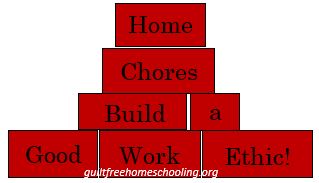
Teaching kids to help at home teaches them how to learn from others, something that will be very valuable in their future jobs. Teaching kids to do their assigned chores in a timely manner teaches them responsibility, again a valuable future skill. Teaching them to look for unassigned tasks they can do teaches them to take initiative, the most valuable skill of all. Being teachable, taking responsibility, and taking initiative combine to form an excellent work ethic, whether your child grows up to become a stay-at-home spouse or a corporate executive, and it starts with learning to pick up toys.
See also (in no particular order):
The Importance of Play in Education
Spoken Destinies & Learned Behaviors
Family Is Spelled T-E-A-M
Sorting Toys Is Algebra
I Give One Grade: 100%—But You Get to Keep Trying Until You Get It
Using Your Household Staff
Biblical Model of Discipleship
Pregnant & Homeschooling (great ideas for delegating, even if you’re not pregnant)
Full-Bodied Education: Mind, Body, & Spirit
We’re Not Raising Children – We’re Raising Adults
Respect Must Be Earned (good look at our attitudes toward each other)
Taming the Laundry Monster
For a limited time, anyone who purchases the eBook for Taking the Mystery Out of Learning Styles (only $9.99) can receive a FREE eBook copy of Diagnostic Tools to Help the Homeschooling Parent (normally $7.99), when purchased through Smashwords. When you add both eBooks to your Smashwords shopping cart, just enter the Coupon Code FQ72B, and the price of your copy of Diagnostic Tools will be reduced to $0!
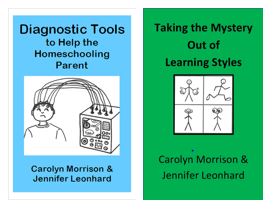
Together, these books are called the “Learning Styles Made Simple” series, with Diagnostic Tools as Book #1 (a comprehensive overview for the homeschooling family looking for direction) and Taking the Mystery Out of Learning Styles as Book #2 (“do-it-yourself educational dynamite” that shows you how to easily adapt any lesson to any learning style for any age).
This offer starts today and will run through New Year’s Day 2014, giving you a special homeschooling treat, just in time for the holidays!! Whether you currently homeschool or are just contemplating homeschooling, these two books will provide wonderful insights into how to teach your children in the ways they will learn best — without forcing you to scrap your current curricula, buy any slick, new gadgets, or waste precious time preparing complicated supplemental lessons. If you are a regular reader of Guilt-Free Homeschooling, you know that you can expect our books to deliver solid, practical wisdom, along with a healthy dose of homeschooled humor! So what are you waiting for??? Get your copies today!!! (Be sure to tell all your friends about this great offer, because we want to share it with them, too!)
[Edited to add… More complete descriptions of both books can be found here, then clicking on each book’s cover. Special coupon offer applies only to eBooks ordered through the Smashword links above.]

NOTE: Extreme sarcasm is present in these comments that have been gleaned from other homeschoolers, actually used ourselves, and/or are being held in reserve, awaiting the right moment. Our sincere thanks and admiration goes out to those intrepid souls whose remarks we have shamelessly borrowed.
So what do you do for socialization???
20. “Nothing. We just sit on the couch all day, staring at the wall.”
19. “I don’t believe in socialization.”
18. “With our large family, I usually say, ‘If you come down to breakfast in this house, you’re socializing!’”
17. “I’ve seen the village, and I don’t want it socializing my children!”
16. “Socialization? That is why I homeschool.”
15. “Socialization is the easy part. I just corner the kids in the bathroom every few days and steal their lunch money.”
14. “Oh, right, because (obviously) spending years with no one but her own family really hurt Laura Ingalls Wilder.”
13. “New studies show that, contrary to popular mythology… the average home-schooled child has no problem ‘socializing’ with other children… as long as he remembers to use smaller words and shorter sentences.” (From the Mallard Fillmore comic strip, 6/14/2005)
12. “The last thing I need is what you call socialization.”
11. “What you consider to be socialization is what Karl Marx endorsed as Communism.”
10. “We want our kids civilized, not socialized.”
9. “I’m not relying on the state to socialize my kids.”
8. “I prefer to have my kids learn to deal mostly with adults. The bullying you learn in middle school is only beneficial for bullying other middle schoolers.”
7. “What swear word do you think my kids don’t already know?”
6. “Are you worried about the quality of the education my children will get at home? Perhaps you should be more concerned about the type of education your children are getting in public school.”
5. “Well, I guess I can teach my kids how to swear, and my wife can make them wait in line for the bathroom.”
4. “You don’t go to school—how do you socialize?”
3. “You mean because we live in a cave, never go to a store, a restaurant, or a doctor’s office, never go to church, never visit friends or family, and basically avoid all contact with other human beings? How is it then that I’m talking to you?”
2. “Do you mean good socialization or bad socialization? Because it works both ways.”
1. “Do you mean, ‘Do I think my children are missing out on something by not being in public school?’ Yes, they are definitely missing out on some very important things. They are missing the explicit, X-rated vocabulary from the playground, bathrooms, school bus, and every other unsupervised moment; the sexual harassment in the lunchroom on hotdog day; and the physical, mental, and emotional abuse from the little extortionist in the next desk who used to beat my child for the correct answers whenever the teacher’s back was turned. My children do miss out on those things by not being in public school, and that is exactly why we are homeschooling!”
These responses can all be summed up by a conversation my son had with his driver’s education teacher, a high school track coach who had worked with both public-schooled and homeschooled students. The coach was concerned that homeschooled students were ahead in some areas and behind in others. Curious, my homeschooled son asked in which areas the homeschoolers were behind. “Socialization,” came the confident reply. Pressing still further, my son prompted the coach to explain exactly what the homeschoolers lacked. “My other students have been here for a long time, and they all know each other. When a homeschool student comes in for the first time, they don’t know anyone here.” My son’s emphatic response was, “When have you ever gone somewhere for the very first time and known anyone there? And how is that a lack of socialization?” He’s going to be a great homeschool Dad some day.
For more insight on the issue of Socialization, see these articles:
Socialization and Why You Don’t Need It (a.k.a. The Socialization Myth, Part 1)
The Socialization Myth, Part 2
The Myth of Age-Mates
The Socialization Code
Bullying

For further inspiration, see these articles:
What Didn’t Work for Today Can Be Changed for Tomorrow
Every Day Is a Learning Day, and Life Is Our Classroom
Tests, Book Reports, and Other Un-necessities
Becoming a Successful and Proud Quitter
How to Adapt Lessons to Fit Your Student’s Interests and Make Learning Come Alive
 Guilt-Free Homeschooling is the creation of Carolyn Morrison and her daughter, Jennifer Leonhard. After serious disappointments with public school, Carolyn spent the next 11 years homeschooling her two children, from elementary to high school graduation and college admission. Refusing to force new homeschooling families to re-invent the wheel, Carolyn and Jennifer now share their encouragement, support, tips, and tricks, filling their blog with "all the answers we were looking for as a new-to-homeschooling family" and making this website a valuable resource for parents, not just a daily journal. Guilt-Free Homeschooling -- Equipping Parents for Homeschooling Success!


Recent Comments