Archives for 0

My “Rule of 3”

There’s no denying it: Kids can be irritating—if you let them. When my kids reached that age of wanting to do things just to irritate Mom, I knew I either had to take control of the situation or lose it forever. I also knew that preventing a child from expressing himself can leave him feeling frustrated, so I wanted a solution that would satisfy both of us. The result was my “Rule of 3.”

My Rule of 3 was simply stated as “You can do that three times, but only three times, and then you’re done.” Making an irritating sound? You can do it three times, then you’re done. Running circles around the kitchen table while I’m fixing dinner? You can do it three times, then you’re done. Poking your sibling in the ribs? You can do it three times, then you’re done. The Rule applied to things done to others or around others, not to actions done alone that annoyed no one else. Practicing your piano lesson? Great! Banging on the piano keys? Three bangs and you’re done; go back to the lesson or move on to another activity. Doing karate kicks or high dance kicks in the backyard? Wonderful! Kicking the back of my car seat while we’re running errands? Three kicks and you’re done; move your feet to another position and keep them still. Somersaulting into the pool? Cool! Combining your super-acrobatic somersault with a not-really-accidental splash of water into your sibling’s face? Three splashes and you are done; the acrobatics are fine, just do them farther away from others. The same rule applies to the child who is completely capable of coherent conversation, but who decides to stop replying to Mom’s questions with the correct answers and substitutes a high-pitched EEP instead. Three EEPs and this game is over! You’re done, and the next thing out of your mouth had better be the correct answer.

Why a limit of three? The first time may be funny; the second time might be cute; the third time is merely indulgence to let you get that one last effort out of your system, but anything after three is seriously pushing beyond the limits of respect for others. Acts that were clearly a danger to others or were purposely hurtful, those I stopped immediately. The Rule of 3 was never intended to permit harmful or hurtful behavior, even temporarily. No teasing, taunting, or otherwise disrespectful behavior—if you don’t want it done to you, don’t do it to someone else. (I suppose I do need to mention that this also applies to parents, grandparents, aunts, uncles, cousins, and anyone else who feels they have the right to tease, tickle, and/or pick on my kids. Poke the Mother Bear at your own risk, but be prepared to face the inevitable consequences.) The Rule of 3 did fulfill its designed purpose of teaching my youngsters to govern their own actions, so that I wouldn’t someday find myself reminding my teenagers to show respect for others—something they should definitely know for themselves by then. The Rule of 3 was a stepping stone on the road to maturity, and each time my kids stopped themselves after the third repetition of something, I knew they were progressing well on their journey.

This Rule of 3-times-and-done gave my normal, fun-loving kids an outlet for the silly ideas and the what-if-I experiments running rampant in their heads, but at the same time, it prevented them from becoming frustrated by a sibling whose behavioral exploits never stopped. Yes, that also meant that Mom (or Dad) had to step in from time to time to stop the antics with the firm reminder, “That’s three—you’re done now.” A few times, I had to redirect my Tigger to move his antics to the backyard where no one would object, and he could repeat them as much as he himself could stand. (Although eliminating the audience was often enough to bring the activity to a quick finish.) Occasionally, I had to take possession of the ball being bounced indoors (preventing a fourth bounce) or the toy car being zoomed around the breakfast dishes (preventing a fourth zoom) to bring the Rule of 3 violation to a clear and concise end.

If I hadn’t enforced the Rule of 3-times, the rule itself would have dissolved into the mist of all other unfulfilled dreams and wishes. The method of enforcement may vary from family to family and incident to incident. Personally, I can administer a death glare that can be felt from across the room, even if it’s focused on the back of your head. Of course, the laser-stare only works if the kids already know what will happen next if they ignore the heat from my warning stare. If the rule-breaker knows what to expect as a just and fair punishment, The Look can work as well as the verbal reminder “That’s it—you’re done.” Kids usually have an innate sense of justice, so choose the punishment to fit both the individual and the infraction, then be consistently consistent. (Now to avoid further tangents, let’s return to today’s topic.)

My kids loved getting their 3-times chances. To them, it was a brief moment of indulgent freedom where they were in control of their universe. And then they knew when to stop and hand the reins back to Mom to maintain perfect order in their world. They’d had their taste of leadership, and while it was fun while it lasted, they knew it was a temporary role, a momentary glimpse of what future independence would hold. It was a lesson in cause and effect: actions have consequences, so take responsibility for them. Learn to control your behavior (or your reaction to undesirable behavior from others), because this is just a tiny sample of life in the adult world, a preview of coming attractions.

Because I began implementing this Rule of 3 when my kids were small, they learned respect for the feelings and the personal space of others, along with the self-control to be able to stop if Mom said “That’s three—you’re done.” We all learned patience and tolerance and flexibility, often with twinkles in our eyes as we watched the star-of-the-moment perform his latest trick… exactly three times. His eyes twinkled with the knowledge that he owned the moment and was in complete control for the time being. All the other eyes twinkled with the knowledge that he could only do it two more times… one more time… and then he would have to stop. There were even a few times that I remember offering, “Okay, that’s two—you can do that one more time.” And he usually did, while all eyes twinkled at the freedom contained in the Rule of 3.

Granted, the Rule of 3 was most often enforced for my always-pushing-life’s-envelope son. However, my less-boisterous daughter appreciated its effects in that she didn’t feel a need to retaliate for something that Dear Little Brother was doing just to annoy her. She knew she could allow him three chances. After three, if he didn’t limit himself, then Mom’s Voice of Authority would take over, and peace would reign once again.

The Rule of 3 is so deeply ingrained in all of us now that it can be difficult to understand why that kid in the check-out lane is still doing whatever, and it’s been 5, 11… 27 times now! Why hasn’t the kid’s parent said “That’s three—you’re done”? And then I remember that not everyone knows about my sanity-saving Rule of 3.

Over the years, there were hundreds (maybe thousands) of Rule-of-3 stunts. I remember telling my kids that I didn’t care if they wanted to bounce a beach ball off my forehead—but they’d only get to do it three times—and then they would be DONE. Try it a fourth time, and… well, they never did try a fourth time, because they had learned respect for the Mom who would let them get away with the first three times. The Rule of 3 worked both for them and against them, but it worked consistently every time. If only it worked as well on those kids in the check-out lane.
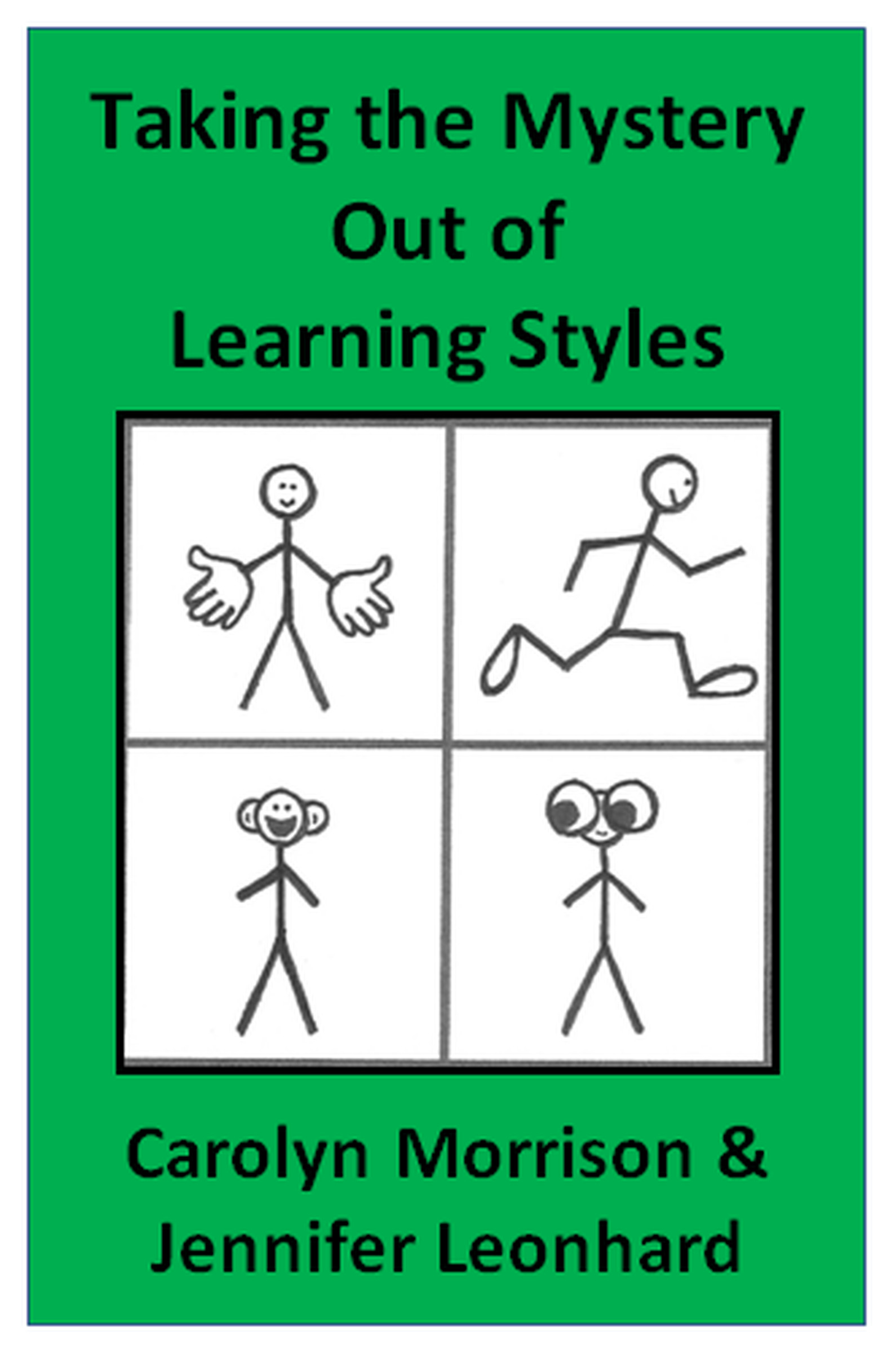
Ebook Now Available for “Taking the Mystery Out of Learning Styles”

We are excited to announce the availability of Taking the Mystery Out of Learning Styles in multiple ebook formats! Visit Smashwords.com to read all about it, view a sample, or buy a copy for your own device. We’d also love it if you’d tell all your friends!!


How to Encourage Learning

I am no one special. I am just an ordinary Mom who has learned a lot about teaching. More specifically, I have learned a lot about learning, about how to learn, and about how to help someone else learn.

I grew up in a very small community, went to the same small school from Kindergarten through twelfth grade, and graduated in a class of fifteen. I was always scolded that I was not working up to my potential, no matter how hard I tried or how much I did. My teachers discouraged anything that wasn’t already part of their tried-and-true lesson plans, and as a not-always-by-the-book learner, I did not enjoy school (in fact, I hated school) until I went to college—the second time.

I know first-hand what it is like to feel trapped in public school. I know the ridicule, the bullying, and the torturing, and I know the sinking feeling of helplessness that comes from the inability to change anything, including teachers’ preconceived notions of who you are and what you can or can’t do. Now, decades later, I also know the freedom that homeschooling brings. Through homeschooling my own children, I was able to break free from many of the stigmas that accompanied me through the first portion of my education. I say “first portion” because I now recognize education as a life-long endeavor, and the most recent portion of my education has been acquired through homeschooling my kids. Having done as little as possible through most of high school, I welcomed the chance to try again, and I learned many things right along with my students.

I enjoyed learning creation science with my kids and studying its relationship to God’s Word, something I had never thought about in my school days filled with evolution-as-scientific-fact. I learned much more about history, while helping my kids learn, and was able to connect the random facts I did know into a more accurate timeline of civilization. Reading was no longer a tedious assignment that I despised and avoided, but it became an enjoyable leisure activity for me. I grew to love reading aloud to my children as much as they enjoyed listening to the daily installments.

Back in public school, I’d had mediocre teachers, poor teachers, and absolutely horrible teachers, all of them with overwhelmingly discouraging attitudes. I’d had a few good teachers here and there, but it was not until my second try at attending college that I found some truly excellent teachers, and I attempted to recreate their methods later on when I began homeschooling. They had not rejected questions; instead, they had convinced me that the only “silly” question is the one which a student is too intimidated to ask, and they further convinced me that any intimidation at all is the teacher’s creation, not the student’s personality. These teachers did not criticize incorrect answers or solutions, but kindly and gently showed students the proper methods for proceeding. At a point when I had never even heard of homeschooling, those teachers fostered the teaching techniques that I would utilize years later.

One thing I had learned during my public school education was that students didn’t matter. Students who didn’t immediately grasp every concept as first presented were being purposely dense and stubbornly making the teacher’s job more difficult. The teachers could only be bothered to explain things once, and if you didn’t understand right away, there was something wrong with you. These were the required subjects that must be taught, and if you didn’t find them delightfully interesting, there was something wrong with you. These were the few elective courses they had the resources to offer, and if you didn’t find them endlessly fascinating, there was something wrong with you. A student who dared to object to the standard fare or dared to suggest possible alternatives or dared to desire anything more interesting was met with horrified gasps. The professional educators knew what was best, and they were in charge. End of discussion.

And then I met Mr. Benbow. Mr. Benbow taught engineering, math, and programming classes at the community college, but Mr. Benbow taught me so much more than just trigonometry. He could elicit a response from even the shyest, most introverted student, because he eagerly waited for and listened to that response. It was as if everyone else in the room disappeared when he spoke to you, and you knew he was truly, genuinely interested in your opinion on the subject at hand. He didn’t seem to want to leave the room without hearing your thoughts and having the opportunity to discuss them with you and ask another question or two for clarification. Your response, no matter how tentative, no matter how ill-prepared, was important to Mr. Benbow. And after only a few weeks in his class, you began to feel that maybe you were important to more than Mr. Benbow.

I recall a rather under-achieving student who described an incorrect method for solving a particular math problem. I was groaning inside, realizing he was wrong and feeling sorry for the humiliation I thought he was destined to endure as his error was pointed out, ridiculed, and corrected. But Mr. Benbow didn’t do that. He listened to the student’s entire explanation of how he’d arrived at his wrong answer, and then Mr. Benbow thoughtfully considered each misstep and gently replied, “Well, you could do it that way… but think about this… If we go back to this step, and instead of what you did there, we do this…” and he went on to fully detail the correct method, step-by-step, arriving at the correct solution, while keeping the errant student’s dignity intact and giving the rest of us a beautifully practical lesson in humility.

Every Wednesday, Mr. Benbow began class with a quiz—always just one question or just one problem, but it always reinforced what we’d just learned. Every Friday, he began class with a joke—it was his way of starting the weekend with a little fun. Any time someone asked him for help on an assignment, he gave that student his complete attention and always hinted at the answer just enough to help the student discover it for himself. Mr. Benbow knew that telling a student the answer outright taught nothing, but guiding the student on the path to discovering the answer taught much more than the answer to that single problem.

I eagerly signed up for Mr. Benbow’s introductory course in computer programming. It was required for my degree, but I knew that he was capable of teaching anything to anyone, even programming language to someone who had never seen a computer before, and I knew he would make it a fascinating class. When my first complex program failed to run as intended, I sought his help. He quickly read through the cryptic steps, smiled with that intriguing little twinkle in his eyes, and simply said “Computers are stupid. They are machines that can only do exactly what we tell them to do.” And there he left me, both feet firmly planted on the path to discovery. Obviously, he meant that my program was telling the computer to do the wrong thing. More precisely, as I soon discovered, my program had not told the computer to do the right thing. Mr. Benbow’s programming hint became a life-lesson for me. It’s as important not to do the wrong thing, as it is to do the right thing. When teaching and training my children, I have tried to remember to show them what not to do, as well as what to do.

All of Mr. Benbow’s excellent teaching methods influenced me heavily. When my children asked questions or gave answers to my questions or offered their opinions on random topics, I tried to give them my focused attention, as if their ideas mattered—because their ideas really did matter. When I listened to every little thing my 7-year-old son wanted to tell, he learned that Mom cared, that his thoughts were either funny or thought-provoking, that he could make people laugh, and that he was important, and he mattered. My kids learned to give answers with confidence, knowing that if they happened to be wrong, they still weren’t subjected to ridicule, taunting, or shame. Any incorrect assumptions would be gently but thoroughly straightened out, until they had a comprehensive understanding of the issue at hand.

If I expected my kids to learn, I knew they couldn’t feel intimidated. Our classroom had to be a place where they felt safe enough to ask any question and discuss any concept that they didn’t fully understand. If I wanted them to learn, I had to find an eleventh way to explain or illustrate or demonstrate what my first ten tries had failed to clarify. Their lack of understanding came from my failure to teach, not their failure to learn. In order for my kids to learn, I had to find better methods of teaching.

Because my early teachers had turned “Go look it up” into a discouraging punishment, I was determined to transform educating my children into a delightful challenge, an eager race for knowledge, a dare of discovery that they couldn’t help but pursue. Whenever we came across something of uncertain meaning, I looked my students in the eye with the most intriguing twinkle I could muster, then I dashed to the bookcase to grab the dictionary or whatever reference book might hold the answer. They enthusiastically joined me for a cheek-to-cheek search through the pages, as we found the answer together. Before long, they were the ones dashing off to find the answer, proudly beating Mom to it, but still generously sharing the moment of discovery as we read and discussed the treasured facts together.

To encourage my kids in their learning, I made up examples and story problems that were personal to them, I involved them in the illustrations and the demonstrations, and we worked together to build the models and create the learning aids that finally made the concepts clear. We converted our board games to use the facts and skills they were trying to learn and played the games over and over to practice their new knowledge. As Mr. Benbow had done, I used impromptu questions now and then to prove to them what they had just mastered (instead of shaming them for what they didn’t yet know), and I made time during our classes for an abundance of jokes and silly stories and amusing tricks, just to keep life fun.

Learning is encouraged when fear is removed and confidence takes its place. Learning is encouraged when the student sees each question as a game to be played, a challenge to be attempted, a goal to be conquered. Learning is encouraged when the student is intrigued to the point that he does not want to walk away without knowing the answer. Learning is encouraged when the examples are personal, when the problems become tantalizing puzzles to solve, when research begins an exhilarating bunny-trail adventure through a hundred twists and turns, and when every question opens another new door to wonders yet undiscovered. If learning is not fun or exciting or satisfying or rewarding, who would waste a single moment in its pursuit?

For more tips on getting your students interested and encouraging their learning:
10 Ways to Improve a Lesson
How to Adapt Lessons to Fit Your Student’s Interests and Make Learning Come Alive
Looking for the “Hard Part”
My Student Is Trying, but Just Not Learning as Expected
The Know-It-All Attitude
Learning to Walk — Seen as a New Lesson

Guilt-Free Homeschooling Summer Camp: Encouragement Around the Campfire

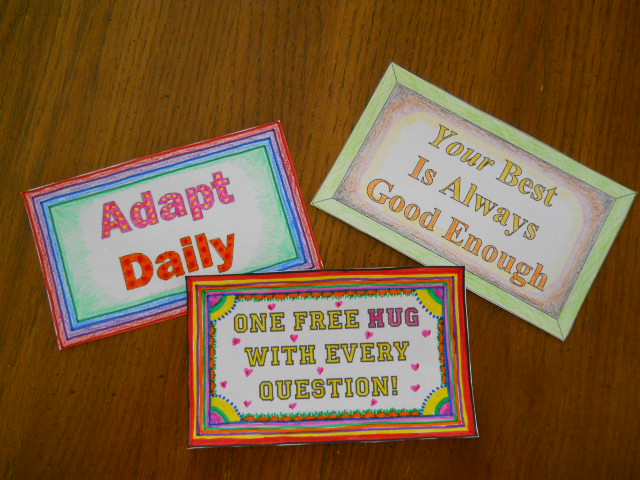
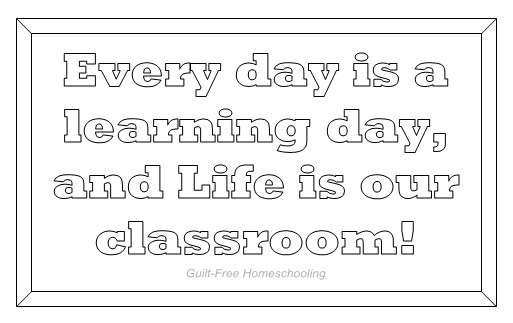
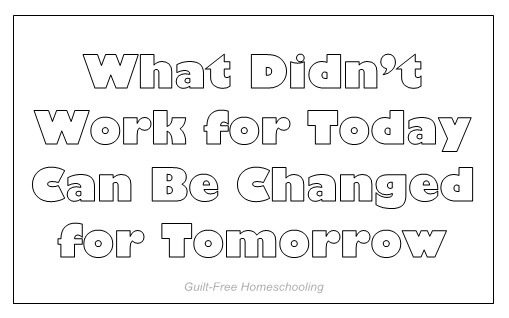
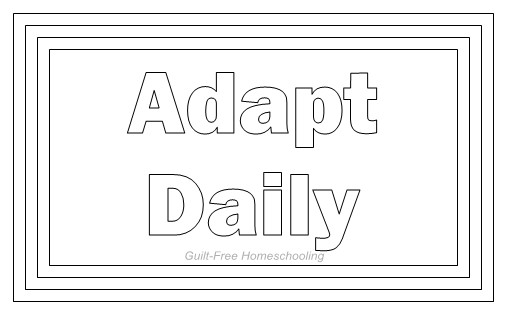
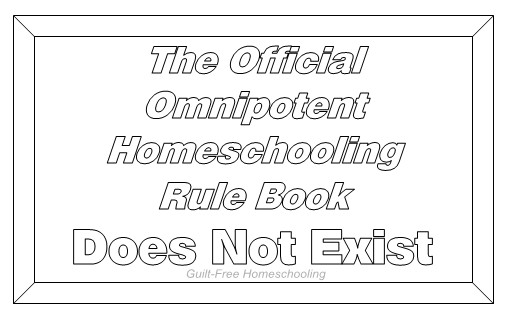
Sitting around a campfire can be a time of great encouragement as you share thoughts and stories with your friends, so we’re here to share some encouraging thoughts with you. And what Summer Camp experience would be complete without a craft or two? Don’t despair if you’re not the crafty type–we’ve done the hard part for you. All that’s left is the coloring—the fun (and therapeutic) part!

Below are some of the “mottoes” that helped us through the darker days of homeschooling, those days when books disappear, memory banks go blank, and everything you touch seems to turn to dust and fall through your fingers. Those days. These are the lines I found myself repeating over and over in those talking-to-myself “Parent/Teacher Conferences.” These are the lines that I shouted in defiance at the discouraging “voices” that were playing on repeat in my head. These are the lines that reminded me of what I was doing, why I was doing it, and what a difference I was making in my kids’ lives.

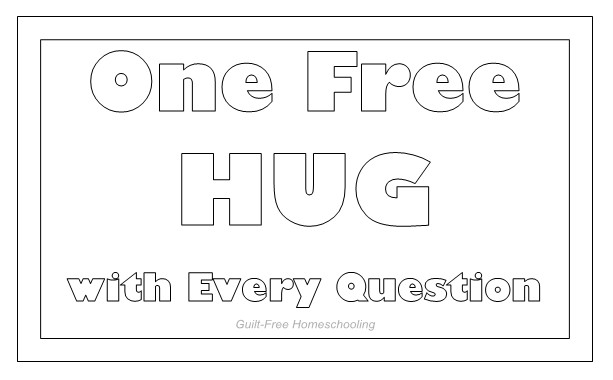
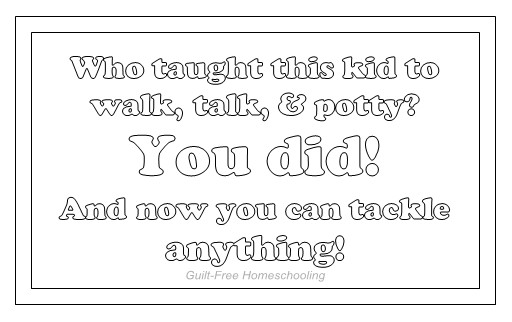
Click on any image, save it to your own computer, then print it out in whatever size you prefer. Color it yourself or invite your kids to color it or decorate it in any manner, and place the finished product in a location where you’ll see it often. Make as many as you need! Put a small one on your bathroom mirror; put a big one above the kitchen sink; keep several in your planning notebook; make individual ones for your kids (they need encouragement, too); share them with your friends around the campfire (or anywhere), and share the homeschool grace. Listed below each graphic is a link to an article pertaining to that topic, just for a little more encouragement.

Top 10 Homeschool Mommy Myths

Who Taught This Kid to Walk, Talk, and Potty?

Every Day Is a Learning Day, and Life Is Our Classroom

What Didn’t Work for Today Can Be Changed for Tomorrow

What Didn’t Work for Today Can Be Changed for Tomorrow

So You Think You’re Not Smart Enough to Homeschool?

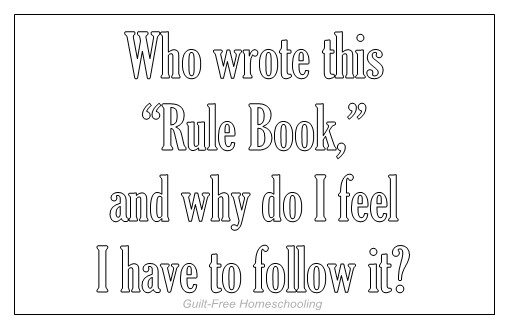
Who Wrote This “Rule Book” and Why Do I Think I Have to Follow It?

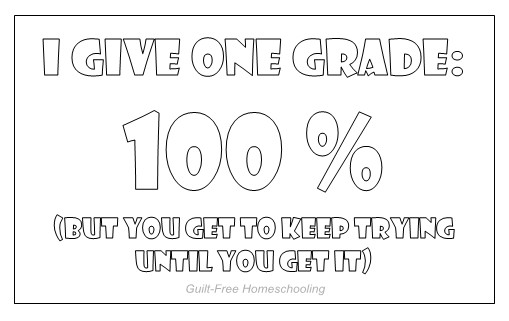
I Give One Grade: 100%—But You Get to Keep Trying Until You Get It

What Is Your “Best”?

Read the entire GFHS Summer Camp series:
Homeschool Mommy Summer Camp
Homeschool Summer Camp FUN!
Homeschool Summer Reading Activities
Homeschool Summer Scheduling
Encouragement Around the Campfire

Guilt-Free Homeschooling Summer Camp: Homeschool Summer Scheduling

Summer doesn’t have to be either a full-on homeschooling schedule or a completely idle break. Summer is a great time for Mom to do a little planning ahead for the coming school year and think about what could be tweaked to make homeschooling more interesting, more efficient, and generally better for all concerned.

Kids who need some extra time to finish out their year can work through summer while still having a break by doing only half a lesson each day. Reading and math can be practiced without being tedious: read fun stuff; play games that use money or that require score-keeping (let each player keep his own score) or that have questions to be read aloud.

Summer is also useful for the student who wants to get ahead, not just for those who are trying to catch up. When my daughter was nearing her senior year of Homeschool High, she was planning to take a class at the Community College in the Fall to supplement her homeschool classes. Not knowing how much work that course would require, she spent the summer getting other classes out of the way. She read through an entire history textbook (a big, fat one), just so she wouldn’t have to deal with that class during the coming year while doing homeschool and college at the same time.

Maybe you’d like to try adding a few more supplemental activities. Maybe you’ve been intrigued by some unschooling ideas. Maybe your kids need a break from the formal curriculum. Maybe you’d like to indulge in an activity during the summer break that deserves more time than you could spare during your regular schedule. Maybe you’ve been thinking about a specific field trip that would work better in summer weather than from Fall through Spring. Maybe you or your students have a special interest that could be explored for a day or a week during summer break.

Explore some new ideas in the articles below and brainstorm the what-if’s of how your homeschool schedule might be different. Whatever your interests, remember that summer is an opportunity for learning, not a reason to stress yourselves out by doing too much.

The Value of Supplemental Activities
The Importance of Play in Education
“Stealth Learning” Through Free Play
How to Adapt Lessons to Fit Your Student’s Interests and Make Learning Come Alive
10 Ways to Improve a Lesson
A Day Without Lessons
Homeschooling the Neighborhood

Read the entire GFHS Summer Camp series:
Homeschool Mommy Summer Camp
Homeschool Summer Camp FUN!
Homeschool Summer Reading Activities
Homeschool Summer Scheduling
Encouragement Around the Campfire

Guilt-Free Homeschooling Summer Camp: Homeschool Summer Reading Activities

How do you pack for vacation? My daughter used to pack one suitcase with her clothing and another suitcase just for her books. She would sit in the back of our van with her nose in a book, seemingly oblivious to the scenery passing by outside the windows. She might only make her way through a few of those books during a week-long trip, but her selections were varied enough to cover whatever need arose. She chose her reading material to closely coordinate with the vacation itself, and her favorite Zane Gray stories came alive as we drove through high desert country or deeply wooded forests. I’m sure that if we’d ever scheduled a boating trip, she would have brought along Moby Dick or perhaps Mutiny on the Bounty. Back at home, my kids often made use of their tree house as a reading hide-away. A blanket fort or tent might offer a different setting for “ambiance reading.”

I enjoyed reading aloud to my kids, not for the exercise of reading aloud, but because I loved to watch their faces as the story turned suspenseful or to see them puzzling over what might happen next. Sometimes I stopped reading and asked for their opinions of what a certain character had just done or where they thought the plot might lead next. And then the reading would resume, only to reveal a twist that none of us had anticipated. We laughed, we cried, we paused to look up unfamiliar words in the dictionary, but mostly we shared the stories over and over as classic lines found their way into our conversations: There’s nothing like the smell of burnt marshwiggle to bring you to your senses, or It’s just a simple matter of mathematics.

Our lists of favorite books and favorite authors grew longer every year. Whether we had read them aloud or individually, our lists included: The Chronicles of Narnia and Out of the Silent Planet by C.S. Lewis (the rest of his Space Trilogy was a bit much for my youngsters, but they absolutely hung on every word of the first volume); A.A. Milne’s poems, Longfellow’s The Village Blacksmith and other poems; the Danny Dunn books (based on a young scientist/inventor); and the Elsie Dinsmore series by Martha Finley (28 books in the original series).

We discovered that watching the video version first (whenever possible), then reading the book was a big help to a reluctant reader. That method brings a quick understanding of the plot, setting, and characters—enough to hold the attention while the book releases it all much more slowly. Sometimes my kids wanted to read the entire book to see all the scenes that had been left out of the movie; sometimes they read only a chapter or a few pages to get a sense of the author’s writing style and the mechanics of how various elements were handled. Sometimes we just stopped a movie in the middle and looked for something more interesting.

Poems, magazines, short stories, comic books and graphic novels can all be valid reading material. Shorter works instead of long chapter books can capture the attention and make reading less tedious, especially for boys and disinterested readers. Reading aloud to your child can also help build interest his interest—I did that with some shorter chapter books for early readers when my son was just becoming independent at reading. I’d read a few pages of the first chapter, then tell him he could read just a paragraph or two for himself while I went to shuffle some laundry. Then as I took my sweet time getting back, he would devour page after page, caught up in the story. Let’s just call it salting the oats to make sure the horse takes a drink.

To encourage your not-so-much readers to become I’m-running-out-of-books readers, try as many of these tips as possible. Help them choose some unforgettable lines from a few favorite books to print up, post on a wall, and quote to each other.  Pick something from the following themed lists for a new genre to expand your readers’ interests. As the great Sherlock Holmes would have said, The game’s afoot!

Summer Adventures: Jules Verne, Frank Peretti’s Cooper Kids Adventure Series; J.R.R. Tolkein’s The Hobbit and Lord of the Rings trilogy; Alexandre Dumas; Zane Gray; Robin Hood or the King Arthur stories by Howard Pyle; Treasure Island by Robert Louis Stevenson; The Chronicles of Narnia and Out of the Silent Planet by C.S. Lewis.

Summer Romances: Robin Hood by Howard Pyle; Zane Gray’s westerns (heroic cowboys who always win the girl’s heart); Grace Livingston Hill; Jane Austen’s Emma or Sense and Sensibility.

Dark Summer: the mysteries of Agatha Christie; Edgar Allan Poe; Arthur Conan Doyle; Louisa May Alcott’s The Inheritance.

Summer in the Real World: biographies of the Wright Brothers, Thomas Edison, George Washington Carver, Abraham Lincoln, Copernicus, Leonardo da Vinci; Carry On, Mr. Bowditch; The Trumpeter of Krakow.

For a few more tips on encouraging your young readers, see these articles:
How to Adapt Lessons to Fit Your Student’s Interests and Make Learning Come Alive
Classic Literature Is Not Necessarily Good Literature
Teaching Spelling (and Grammar) Through Reading and Listening
Tests, Book Reports, and Other Un-necessities

Read the entire GFHS Summer Camp series:
Homeschool Mommy Summer Camp
Homeschool Summer Camp FUN!
Homeschool Summer Reading Activities
Homeschool Summer Scheduling
Encouragement Around the Campfire

Guilt-Free Homeschooling Summer Camp: Homeschool Summer Camp FUN!

Some kids run out of ideas quickly, particularly if they’ve been used to a school schedule that has every day planned out for them. Try the articles listed below for some unique activities that your kids will love and that will also help them retain their knowledge base over the summer.

Some of these ideas were things I had intended to do with just my own kids, but their neighborhood friends begged to be included, too. Some of these ideas were things I thought would entertain my kids for an hour, but were enjoyed so immensely that they lasted all afternoon or were repeated time and time again. Some of these ideas came from trying to use old materials in new ways, such as a bucket of sidewalk chalk. Some of these ideas came from wanting my kids to practice their academic skills but needing very stealthy methods that still let them feel like they were getting a summer break. Keep some of these ideas in mind for the next time you hear “I’m bored.” If you have the supplies on hand, your kids may just come up with their own ideas, before you even have a chance to suggest anything.

Teach Your Children the Art of Amusing Themselves
“Stealth Learning” Through Free Play
Backyard Carnival
Take It Outside! 
Hopscotch—A Powerful Learning Game
It’s So HOT, You Could Fry an Egg Outside!
Jumpropes
Natural Science
Sidewalk Art

When it’s too hot to play outside or for a rainy day!
Money Land Game
Gee Whiz! Quiz
Top 10 Dress-Up Items
Beanbags (No-Sew DIY)
100-Grids and Flashcard Bingo
“Mystery Boxes” and the Scientific Method
Texture Dominoes

And many more ideas…
Topical Index: Activities

Read the entire GFHS Summer Camp series:
Homeschool Mommy Summer Camp
Homeschool Summer Camp FUN
Homeschool Summer Reading Activities
Homeschool Summer Scheduling
Encouragement Around the Campfire

Verified by MonsterInsights