Archives for 0

Guilt-Free Homeschooling Summer Camp: Homeschool Moms’ Summer Camp


As a homeschooling mom, summer break was my time to refresh my objectives and rejuvenate my motivation. I took time to indulge in a few personal luxuries, such as holding down a lawn chair in the back yard or dabbling in a nearly forgotten hobby, and I usually took a few days to sort through our collection of school supplies to get ready for the next year. I also used my summer days to re-read a favorite book by another homeschooling mom, for the encouragement to keep on keeping on in this crazy, educational journey.

Moms need to hear voices of inspiration that affirm their choices and embolden their hearts. Every homeschool mom I’ve ever met is willing to hear more ideas on how to teach, and most of them want to take notes. My Mommy Summer Camp was a time to reflect on where we wanted to go and how we needed to get there. I wasn’t always able to attend a homeschool conference, but I could read books and magazines or talk to other moms to exchange ideas, and that had nearly the same effect.

For your own Mommy Summer Camp revitalization project, review the reasons why you chose to begin homeschooling. If you haven’t written those down before, now may be a good time to do so. Then you can add any new reasons that have cropped up in the past year. If you have an accumulation of your children’s papers and notebooks to sort through, take note of how much they’ve changed in the past months. Has their handwriting improved? Has the content or structure of their writing improved? Are they mastering much more complicated work than they could have attempted just nine short months ago? Those changes and improvements are your badges of honor, the proof of the value of what you’re doing. Sit down and savor that. You deserve it.

Here are a few articles to help restore your vision and renew your vigor for next year.
Summer – A Help or a Hindrance?
Reminding Myself of My Ultimate Goal
Back to Homeschool with New Ideas
Top 10 Homeschool Mommy Myths
Homeschooling Is Hard Work
Your Children Will Not Always Be Like This
“Parent” Is a Verb
Our Reasons for Homeschooling

Read the entire GFHS Summer Camp series:
Homeschool Mommy Summer Camp
Homeschool Summer Camp FUN!
Homeschool Summer Reading Activities
Homeschool Summer Scheduling
Encouragement Around the Campfire
Top 10 Questions on Leaving Public School

These questions appear over and over in emails from parents who are considering homeschooling, regardless of the reasons. Here are the most frequent questions and our honest answers, in no specific order.

1.  How soon can I pull my child(ren) out? Now—if that’s what your gut is telling you to do. Tell the office you have a “family emergency” and take your child(ren) home. Then check Home School Legal Defense Association’s website (hslda.org) for your state’s legal requirements and get that in order. If you prefer to wait a few days, weeks, or months before removing your student(s), that’s your decision—but please understand that you can remove them immediately. After all, if you have a reason that prompts you to consider homeschooling as an option, then you do have enough reason to remove them immediately, and they will benefit more from being at home than they would benefit from a few more days to finish out a week, a month, or a semester.

2.  What curricula do I need? Start with nothing.
a) Begin by bonding with your child through shopping, movie-day, hanging out at the library, baking cookies, anything.
b) Explore an interest of your child’s through doing online research together, building a model, whatever. Follow every interesting bunny trail that comes along, because those paths are filled with great learning opportunities! (Someone decides which topics go into every textbook and how much each topic should cover—who says that your child’s bunny-trail interests are any less important or any less interconnected than the topics in a textbook? Bonus: your student will learn more and retain more from his bunny trails than from a textbook.)
c) Start slowly by using Google, Pinterest, or the library for one or two subjects and build your class load from there.
d) Allow each of these steps to progress as slowly or as quickly as needed. Your instincts will tell you when your student is ready to move on.

3.  Can I remove just one of my children from public school? You could, but what’s the point?
a) Teaching more than one child is actually less work than shuttling several students back and forth all day to various activities in multiple locations.
b) Sibling bonding is just as valuable as parent-child bonding (see #2a-b above).
c) Do your other children deserve the same learning opportunities and freedoms as the one you want to bring home?

4.  How do I teach several children at the same time? Any who can already read—can read.
a) Let older kids start the day with their favorite subjects that require the least help from you, allowing you to get a younger one started.
b) Kids don’t all have to be doing schoolwork at the same time. One can play with the toddler while another does math, then switch. For a time, my daughter got up early and did all her schoolwork from 6-10 in the morning, then worked on other projects throughout the day.
c) Let them assist each other when necessary, because Mom is not the only one capable of answering questions.
d) Problem-solving skills are developed through solving problems! I told my kids that if they got stuck they should try to figure it out themselves first, then ask their sibling for help or come find me at whatever chore I was doing. They were always proud to tell me what they had figured out on their own, and I was happy to praise them for it! Other options include phoning Grandma or asking Google—there are many ways to solve a problem.

5. How do I get the house cleaned and the laundry done?
a) Whose standards are you following? Sparkling clean houses with nothing out of place are owned by families who are never home.
b) Home Economics is a class we teach here. We used breaks between subjects as a way to get the wiggles out and get a few chores done. My kids were happy to carry their clean laundry upstairs and put it away because it meant a break from schoolwork. Unloading the dishwasher meant they could listen to the kitchen radio for the duration of that task. Taking out the trash could be followed by a few minutes on a swing. Breaks can be shortened or extended to fit the chore desired. Chores teach kids skills, responsibility, and independence—plus they break up the rest of the day while bringing real-world benefits.

6. Is it too soon/too late to pull my kids out? No.
a) Homeschooling has many more benefits than could possibly be gained from leaving them in longer. We began homeschooling when the school couldn’t cope with our child’s medical condition, but once she was home we found some serious academic deficiencies and other problems that we hadn’t realized existed. Don’t assume everything is fine at school, just because your child hasn’t complained.
b) A student at home can learn much more than a student in school, being free to move on at will instead of waiting for the entire class. A child who is motivated to learn can make incredible progress at home, making up for lost time and surging ahead in his chosen field of interest.

7. I’m thinking of homeschooling because [fill in the reason of your choice]. Is that a good enough reason? Yes, but you’ll also come up with several more good reasons as soon as you get started (see #6a above). My list of reasons for wanting to homeschool grew longer with every year that we homeschooled.

8. Can I teach my ADD/ADHD/ODD/ETC student without special training? Professional credentials don’t outweigh parental instincts. Moms and dads know their child and their child’s needs better than any professional ever will. A more accurate acronym-label for your child may actually be MIISE (More Interested In Something Else). Treat* your child for MIISE until that proves ineffective. Another syndrome common in the institutional classroom is TETL (Too Eager To Learn)—a phenomenon that classroom teachers find surprisingly difficult to manage while keeping to a schedule. Help your child follow his interests and coach him in learning to research the various aspects. Don’t be afraid to follow bunny trails and let topics run together in rapid succession. Genius flows easily across multiple ideas, and it’s the simpler mind that must limit itself to only one thought at a time. Forty-five minutes to an hour of following bunny trails will produce more significant learning than an entire day of planned lessons.

9. But what about friends? If they are a true friend, you won’t lose them. Homeschooling can be a great opportunity to ditch the troublesome relationships that needed to disappear anyway. In general, friends and acquaintances come from a variety of aspects in life: siblings, neighbors, cousins, church, clubs, sports, music lessons, friends of friends, etc. Today’s social media phenomenon provides an avenue for maintaining close contact with friends regardless of distance or schedules.

10. We can’t do sports, music, or other extra-curricular activities at home. Are those just out of the picture for homeschooling? No. There are numerous possibilities for private lessons and group participation that don’t involve public school:

  • You Tube, Netflix, Google, online instruction and/or tutorials
  • Homeschool curriculum for the desired skill
  • Private tutor or coach, who could range from an advanced student to a professional teacher for the desired skill
  • Homeschool co-op group offering team sports, band, etc.
  • Church-based or community-sponsored sports & recreational activities
  • Dual-enrollment with public or private school for specific activities

HSLDA has discouraged families from trying to “keep one foot in both worlds” through dual-enrolling for specific classes or activities. And I agree. When we left the government school system, we were ready to break all ties and not look back. Then a community-wide sports activity became available that was run through the schools but didn’t require dual-enrollment, and my kids were interested in participating. I inquired about whether this was strictly a school-sponsored group (no, it was funded by participants) and if homeschooled members of the community could be involved (they supposed so), and we went to their first session of the year and signed up. It seemed to be going well for the first few practices and even through the first public performance, but things quickly went downhill after that. We weren’t notified of subsequent exhibitions, and the group’s leader made it increasingly difficult for my kids to participate, to the point where we eventually felt it was in our best interests to withdraw from that group and focus our efforts in more homeschool-friendly areas.

Throughout our homeschooling career, we knew other homeschooling families whose students participated with private schools, public schools, community groups, church groups, or homeschool co-op groups for a variety of extra-curricular experiences. The opportunities can be found or created to suit the needs, but the bigger questions is why is it necessary? Discuss this as a family to determine your motivation, whether for music, sports, drama, foreign languages, artistic endeavors, or whatever. Are your students just looking for a place to hang out with friends, or are they genuinely interested in learning the skill? Are Mom and Dad trying to live their own lives over again through their children, or is this something the student truly desires for himself?

Yes, Harvard has been known to award scholarships to distinguished harpists, but is winning a 1-year scholarship to an Ivy League college the only reason for dedicating a minimum of ten years of one’s childhood to an instrument (especially if the child lacks the passion to maintain this as a life-long activity)? The price of the instrument(s), the cost of years of weekly lessons, and the time investment for enough daily practice to become such an accomplished player as to merit a prestigious scholarship could all have been applied toward another area that the student enjoyed and appreciated more than being able to say “But it got me into Harvard.” Were all those years of music lessons merely the foot-in-the-door for a college education leading to a non-music-related career goal? Was the motivation just to give Mom and Dad the bragging rights of “Our kid’s going to Harvard”? Could the time, energy, and resources have been better directed toward the student’s desired career path? Could the same amount of money have been invested in such a way as to return an amount equal to or greater than the scholarship itself?

The freedom and flexibility provided by homeschooling can be used to the student’s advantage in numerous, subtle ways, resulting in a focused interest, rather than a schedule filled with diverse activities that yield more social involvement than academic advancement. I would rather see a student pursue his interests as vocational preparation than devote his time to activities that merely serve to fill his calendar with a variety of time-consuming distractions.

For more info, check out these links:

Leaving Public School
*How to Adapt Lessons to Fit Your Student’s Interests and Make Learning Come Alive
Teach Your Students to Teach Themselves
Knowing How to Find the Answer Is the Same as Knowing the Answer
People LIVE in This House
Using Your Household Staff
Family Is Spelled T-E-A-M

Consider this one as the answer for the unofficial Question #11:
Homeschooling an Only Child

Encouragement Corner: Should My Child Go to Preschool?

Encouragement Corner posts are sort of a mini-seminar for the busy moms who can’t spare the time or expense to go to a major homeschooling conference, but who still need answers to their biggest questions. We’ll be grouping a few of the most-often-recommended articles around a central issue and making those articles easier to share on Pinterest by adding a photo or graphic as needed.

I’m seeing a disturbing trend. More and more families are sending their babies off to preschool at younger and younger ages—sometimes as young as two years old. Now tell me what skills a preschool teacher could possibly impart to two- or three-year-olds that Mom couldn’t do better, faster, and cheaper? Spare me the argument that Mom has to work—that’s another topic for another day (besides, that simply means that the preschool is a more expensive version of day-care, yet another topic for yet another day). I’m really confused by why any parent would think a child of 2 or 3 needs preschool, or why that parent needs to shell out their hard-earned paycheck for someone else to teach their child of 2 or 3 to identify the red ball or the blue square or to count to 10 or sing Old MacDonald Had a Farm.

Yes, my children did both attend preschool, but not at age 2 or even 3, and if I could do it over again, I wouldn’t send them anywhere. My daughter was 4, my son was 5 (late birthday), and they each went for only one year before moving on to Kindergarten. (We also weren’t planning to homeschool at that time, and homeschooling hadn’t even become legal in our state yet.) I’m not sure that my kids gained anything from their preschool experiences—my daughter’s preschool teacher remarked that she often felt that she didn’t need to show up, since my child was a suitable substitute. My son’s preschool class included our friends’ brother-sister twins, who had just turned 3, and my son could be a teensy bit resentful at times that those little kids were in his school class. It was a small class with a wide age range, but there is a huge difference between what 3-year-olds can do and understand and what 5-year-olds can do and understand.

I had sent my kids to preschool as preparation for Kindergarten, for the group experiences of sitting in circles and learning to wait for their turn. As it turned out, I shouldn’t have wasted the money—they were already much better prepared than most of their classmates. The things we had done at home as normal childhood playing were excellent preparation for preschool, for Kindergarten, and for learning in general. I had been holding them in my lap for “story time” from the moment they could focus on a picture book, and it was our daily settling-down session before naptime. I talked about the pictures and pointed out colors and shapes and girls and boys and bears and mice and bowls and hats long before my babies knew what I was talking about, but they loved the lap time, and they learned vocabulary and language, as well as colors, shapes, animals, and objects. We had played games at home, and they had learned to take turns, even when Mom was their only playmate. We had played make-believe with toy dishes and toy tools and dress-up clothes. We had played on swings and walked on a balance beam (a board lying flat on the ground) and climbed on monkey bars and jumped on hopscotch squares on the sidewalk. We had kicked balls, thrown balls, batted balls, rolled balls, and caught balls. We had drawn and colored and painted and sculpted and glued and cut with scissors. Seriously, what else could they possibly have learned at preschool that they didn’t already know? That Mom was too busy to spend time with them? That Mom’s job was more important than they were? That children are supposed to be shuttled off away from home and locked in an institutional classroom for so many hours each day to be looked after by strangers?

Here are the most important things to know about teaching your children:

  • Children can not learn more at school, even preschool, than they can learn at home, and no advanced degree is necessary for teaching a child to sing the alphabet song.
  •  The theory that “Everyone sends their kids to school” is mob mentality that deserves to be questioned. Why does everyone else send their kids to school? It certainly isn’t for the superior outcome.
  • The theory that “If you don’t send your kids to school, you’re trying to hold onto them as babies, and you’re afraid to let them grow up” is also flawed. I happen to think that 2- to 3-year-olds (for preschool) or even 5- or 6-year-olds (for Kindergarten) are much too young to take on the world. Those children need to be at home with Mom, discovering who they are and learning how to react to the world at large under Mom’s protective care. Yes, I’m saying it blatantly: children need to be kept under Mom’s wing until they are ready to be on their own. It certainly didn’t hurt George Washington or Abraham Lincoln or Thomas Edison (or countless others throughout history who didn’t go to institutional schools) to stay home with their mothers.
  • Those uncomfortable knots in your stomach do not mean that you will succumb to loneliness and despair during the 2 ½-3 hours while Little Darling is gone to Preschool each day. That anxiety is trying to tell you that sending your little one off to school is a bad idea in general. Preschool is essentially a “gateway drug” to get parents accustomed to the idea of giving up their children to the control of the institution—why else do you think it’s being pushed for younger and younger children?
  • Yet another theory says “That school has good teachers—their values are just like yours.” I had 30+ different teachers and administrators from Kindergarten through 12th grade, and very few of them portrayed the value system I have now. There may have been a small handful of them who were concerned about me personally for the brief period when I was under their authority, but the system in general defeated any efforts on their part to connect with me. My kids had more than 15 different teachers in only 6 years at church-sponsored preschools and public schools, and the values exhibited by most of those teachers were dramatically different from our family’s values.
  • Mommies are excellent teachers, primarily because they are the mommies of their students. Mommies can tell instinctively when their child is bored, tired, hungry, or jealous, and can tell which of those feelings is responsible for him acting out.
  • A child’s home usually has a ready supply of educational equipment, including building blocks, measuring cups, and empty bathroom tissue tubes.
  • Anything else you need to know can be found in the following articles.

Preschool Is Not Brain Surgery
Social Skills—What Should I Teach My Preschooler?
Preschoolers’ Educational School-Time Activities
Teaching with Preschoolers Around… and Under… and on Top… and Beside
The Importance of Play in Education
The Value of Supplemental Activities
“Stealth Learning” Through Free Play
Don’t overlook this one—even though it says Kindergarten, it is equally applicable to Preschool…
Time for Kindergarten Round-Up?
And finally…
The Myth of Age-Mates

Top 10 Homeschool Mommy Myths

Homeschool moms, especially new-to-homeschooling moms, can easily fall prey to some nasty myths. These myths, as with any myths, are simply not true. Read, learn, and be encouraged.

1) School requires 7 hours of carefully-planned-to-the-minute instruction. If your child doesn’t respond well to 7 hours in a chair at a desk, the answer isn’t how to fix him or how to fill 7 hours. The solution comes from realizing that schools spend up to 75% of each day in non-instructional activities: waiting for silence, waiting for eye contact, waiting for the slower students to catch up, counting who’s there, counting who’ll be eating lunch, counting noses again after moving from here to there, standing in line after line after line—you get the idea. Seventy-five percent! Three-quarters of their day! My kids could go off-topic eleventy-dozen times and still get all their work done in less time than they would have spent at school.

2) School requires homework beyond the lesson. Some new homeschool parents wonder how much homework should be assigned after their students complete each subject’s daily lesson. My answer is none. Schools assign homework because there isn’t enough time left in their busy day to actually complete a lesson. We did lesson work as part of each subject’s “class time,” so there was no need for further work after the class was done. (Bonus: Homeschool kids get to do the practice work immediately after learning the lesson, rather than struggling hours later to remember what to do and how to do it.) Reading was our only exception, and that was because I never held reading class once my kids were reading independently—I just let them go off and read on their own time. We called it pleasure reading, instead of considering it as another academic subject.

3) It doesn’t really count as homeschooling if:

  • We didn’t learn it during school hours. (Sometimes the best lessons happen on the weekends or in the evening or while you’re away from home.)
  • We didn’t learn it from “approved” curriculum. (Sometimes the best lessons happen out-of-the-box and away-from-the-books.)
  • We didn’t plan to learn it. (Sometimes the best lessons happen spontaneously.)
  • None of our friends are also studying it. (Sometimes the best lessons fit your personal, immediate needs, and not the needs of anyone else.)

4) All children progress according to an age-based “scope and sequence.” Pfft! Children don’t all begin crawling at the same age (some prefer scooting, and others just stand up and take off), children don’t all begin talking at the same age (or with the same vocabulary), children don’t all learn to use the potty at the same age, and children don’t all learn reading, geography, and trigonometry at the same age. Age actually has very little to do with learning ability. And while we’re on the topic, when was the last time you saw a scope-and-sequence for learning very important skills of when and how to rotate tires or change motor oil, cooking an entire meal and getting every dish done at the same time, sharpening a lawn mower blade, changing a newborn’s diaper with one hand while holding onto a toddler-Houdini with the other, or being able to tell the difference between chicken pox and a skin rash caused by an allergic reaction to medicine? Sometimes education comes on a “need to know” basis—when you need to know it, you’ll learn it. Life is its own scope and sequence, and the scope and the sequence are different for each person.

5) There’s a better teacher out there somewhere. Maybe you’ve been waiting for the ideal teacher to come along to take your kids under her wing and set afire their love of learning—the right teacher. You feel a little like the old knight in Indiana Jones and the Last Crusade, who guarded the Messiah’s chalice for 900 years, waiting for a new knight to come and relieve him of his post. However, that ideal teacher, the “new guardian” of your children’s education just might end up being you. We were fervently praying for our daughter, Jen, to get the right public school classroom and the right teacher for her 5th grade year, when God showed us Door #3: Homeschooling. He disregarded both of the options in her public school and guided us down an entirely different path to the school and the classroom and the teacher He had chosen for her needs: Mom. Our son, Nathan, needed a teacher for 1st grade with a personality that would accept and appreciate his boundless sense of humor, since his Kindergarten teacher had kept him on the Time-Out Chair for nearly the entire school year. Again, Door #3 led to Mom being selected as the ideal teacher for him. The ideal teacher you’re waiting for, the ideal teacher your kids need is in all likelihood staring back at you from the bathroom mirror.

6) Comparing ourselves to other families will show us how we’re doing. Comparing my family to other homeschooling families was not really a good thing to do. Comparing how my kids were doing in their schoolwork to how other kids were doing, again not a good thing. Comparing how my kids were doing now to how they had previously been doing was great! We could definitely see their individual progress from week to week and month to month (sometimes faster, sometimes slower, but they continually moved beyond where they had been before). When I came across a blog where another mom had posted her 12-year-old’s super-aggressive list of books that he’d read during 7th grade, I wanted to poke my eyes out with salad tongs. His unbelievably extensive list (for that one year!) could have passed as the cumulative life-time achievements of a tenured college literature professor. I decided to stop reading that blog. It was a wise choice. Instead, I paid more attention to how my child learned to read words, rather than guess at them, and reading those words led her to read a whole book, which she enjoyed enough to want to read another, which was two more than she’d ever read before.

7) I need “Me” time. When my kids were smaller and needed more attention, I used to feel like I never had any “me” time. But I wasn’t the #1 focus at that time—and I assured myself that “my time” would come later. As my children grew, I taught them skills and responsibilities, which gave me helpers to lessen my long list of to-do’s each day and gave me just enough “me time” to let me think an entire thought by myself and thereby make life bearable. As my children’s abilities increased each year, their ability to help out increased, too, and my free time grew accordingly. The bigger shock came when they had both gone off to college and left me with no more helpers!

8) “I blew it, I made a mess of things, and I can’t undo it.” If you’ve made a big mistake (like pushing your student to the point of tears over conjugating verbs), apologize. Hug each other and promise to help each other figure out the best way to learn this stuff. Your child will respect you more for your role-modeling of humility. Ask your kids for their input on different ways to learn certain subjects—they will have great suggestions for activities to try, and their ideas will help tailor activities to their specific learning style needs. When my kids weren’t sure of how to proceed, I made little reminder signs to decorate our classroom: “One free hug with every hint!” “If you’re stuck, ask Mom. If you’re confused, ask Mom. If you’re not sure, ask Mom.” (Can you tell my students had lost all their self-confidence in public school?) Holding a child on my lap and offering encouraging cuddles was extremely beneficial to both of us. Even during those occasions when you just don’t know what to do next, sharing the love through hugs and prayers will draw you and your students closer together—and that’s the biggest reason why you chose to homeschool in the first place.

9) The teacher must always be right. Wrong. We are fallible humans, and we make mistakes. Textbooks and answer keys occasionally include mistakes, too. I found several mistakes in textbooks and answer keys during our homeschooling career. Sometimes they were typos, and sometimes they were just errors, but regardless of why, the books were wrong. Parents and kids alike will learn from homeschooling, and we learn more from our mistakes than we do when everything goes smoothly and perfectly. When you mess up, admit it; apologize, ask for forgiveness, make amends, and then move on. Be a shining example of how an adult should handle personal goof-ups with grace and humility—they certainly won’t see that in many other areas of life.

10) “I can’t homeschool—I don’t know everything!” That’s the point. Homeschooling parents don’t have to know it all, but they can teach their children anyway and can learn right along with the kiddies. When my kids asked me a tough question and I didn’t know the answer, their eyes lit up when I said in all honesty, “I don’t know… but I’ll bet we can find the answer together.” Kids appreciate honesty, especially from adults, and an honest admission of “I don’t know” is a refreshing change for them from the know-it-all attitude they usually get from the adult world. My kids delighted in playing “Let’s Stump Mom,” and their desire to learn increased with every round, won or lost. No one knows everything, but everyone can learn more. Let learning become a regular habit for parents as well as for children. It’s another facet of that role-modeling thing!

Encouragement Corner: What About Writing Assignments?

Encouragement Corner is a new feature here at Guilt-Free Homeschooling, sort of a mini-seminar for the busy moms who can’t spare the time or expense to go to a major homeschooling conference, but who still need answers to their biggest questions. We’ll be grouping a few of the most-often-recommended articles around a central issue and making those articles easier to share on Pinterest by adding a photo or graphic as needed.

I don’t believe in writing assignments. There, I said it. I never liked creative writing, story writing, or other frivolous paragraphs, essays, or compositions, so I didn’t force my students to write them either. What I used instead was reading — lots of reading, and grammar lessons. I only held a formal reading class during the learning-to-read stage, and once my kids were reading fluently by themselves, I let them choose their own pleasure reading to serve as an unstructured subject. Since they each spent as much (if not more) time telling me about what they had read than it actually took them to read it, I wasn’t at all worried about their reading or comprehension skills. Relaxing with a book at bedtime was a great way to unwind from the day, and it didn’t feel to them like yet another academic endeavor.

I frequently read aloud to them, and they read to themselves from a variety of sources (fiction, non-fiction, poetry, biography; books, magazines, newspapers, web articles, etc.), giving them vast understanding of many different types of writing. Exposure to a multitude of authors showed them how any given genre could be handled in a multitude of ways. My students loved some authors’ writing styles enough to read everything they could find by those authors. Other authors’ writing styles were so cumbersome and awkward that they closed the book and moved on with no regrets for not finishing.

As my students matured and developed their own voice (meaning personal thoughts and opinions) on various topics, they were able to express them coherently, in part because they had read how others had expressed ideas through the written word. Their first serious writing assignments came from a composition class at the local college (taken during their Senior year of high school), where the teachers were impressed with their writing abilities. They could write good summations of their reading and research, because they were already accustomed to reading and evaluating, and the results were scholarly compositions.

By skipping several years of trivial paragraph-writing, my students had been able to read a wide variety of sources. They had learned how to form their opinions into logical arguments. Their minds weren’t cluttered with topic sentences and formulaic outlines. They were able to reproduce any type of composition just by reading it and analyzing the key components. They had read good writing, they had found a voice, and they had many interests which afforded them numerous topics for their composition needs. Delaying the writing assignments worked very well for us.

Linked below are our most commonly recommended articles on writing (as composition, not to be confused with handwriting), to help you decide how to tackle this topic in your homeschool.

Tests, Book Reports, and Other Un-necessities 

Teaching Spelling (and Grammar) Through Reading and Listening

Grammar with Giggles, Mad Libs Style

How Did You Learn to Write? 

How to Adapt Lessons to Fit Your Student’s Interests and Make Learning Come Alive 

Encouragement Corner: My Student Is Trying, but Just Not Learning as Expected

Encouragement Corner is a new feature here at Guilt-Free Homeschooling, sort of a mini-seminar for the busy moms who can’t spare the time or expense to go to a major homeschooling conference, but who still need answers to their biggest questions. We’ll be grouping a few of the most-often-recommended articles around a central issue and making those articles easier to share on Pinterest by adding a photo or graphic as needed.

This is a question we hear frequently. Mom is presenting the subject well, but Student just isn’t picking up on the material, no matter how hard he tries. What’s going wrong?

This problem usually can be attributed to moving ahead too quickly. The student may have been understanding everything quickly up to a certain point, but when that point was reached, he continued on at the same break-neck pace as before, not fully realizing that he had missed something important. As further lessons depended on the missing concept(s), the student became confused, began to work more slowly, and couldn’t catch on to the new material, regardless of how diligently he persevered. I call these “educational potholes,” because the missing information creates a serious bump in the road to progress.

The way to get back on track is to back up and fill in the pothole, but it’s not always obvious where that hole is or what went wrong to create it. A skill can be lacking due to a mix-up or confusion over the information, teaching materials that present the facts incorrectly or insufficiently, moving too quickly and assuming the child is ready to proceed, or from presenting the information in a learning style that is contrary to how the student learns best. The articles linked below will give you some good pointers for checking what your student knows and finding exactly where the insufficient skill is located. Once you’ve found the problem, you can focus on helping your student learn that information correctly. Some of the potholes we found could be explained away in a matter of minutes, while others took a few days or even weeks to adequately reteach (in the case of material not learned in public school that was relearned through homeschooling).

Sometimes we adults don’t remember just how difficult it was for us to learn new things, such as reading, handwriting, or arithmetic. Some of the articles below break those subjects down into smaller segments to help you teach your students one important step at a time.

The most important point to remember in this process is that finding a pothole is a good thing! Your student was obviously hampered by the missing skill, and once he has mastered it, he will be able to catch up very quickly.

For further tips, see:

Meatball Education: Filling in the Potholes of Public School

Handwriting — Beginning Techniques

Why Does Math Class Take SO LONG? 

Building Blocks for Success in Math

Building Blocks for Success in Spelling

Looking for the Hard Part

Learning Styles

Workshop Wednesday: Texture Dominoes

Textures are a wonderful way to get a touchy-feely child interested in learning. Preschoolers are especially interested in textures, so here’s a little tutorial on making a set of tactile dominoes that emphasize various textures.

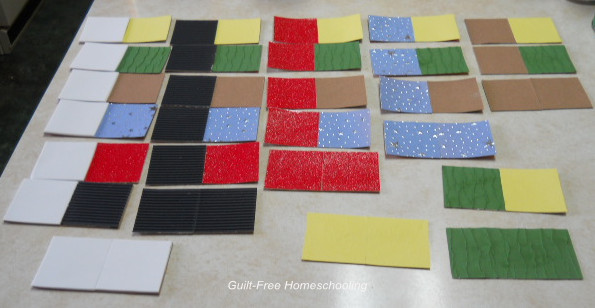
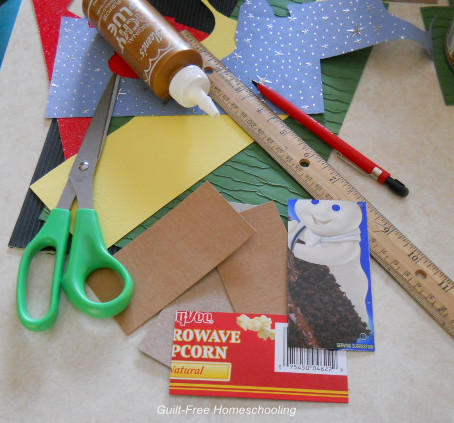
This set of dominoes used 7 different textures, mostly because that’s what I had on hand. You can make your set as large or as small as you like. I had 5 different textured papers that I’d purchased a while back from the scrapbooking section of Hobby Lobby, and I added a sheet of ordinary sandpaper (from Dollar Tree) and a sheet of craft foam to complete the set. Long-time readers will know that I love upcycling the cardboard from cereal boxes and similar packaging, and this is one more example of that. The backing of each domino is made from cereal boxes, brownie mix boxes, cracker boxes, and whatever else I had available.

Step 1: Cutting

My dominoes are 2×4”, and each textured square measures 2×2”. For this complete set of 28 dominoes, I cut 28 2×4” rectangles from an assortment of cardboard boxes and 8 2×2” squares from each of the 7 textured sheets (it takes 8 because the double uses 2 of the same texture). I used a paper cutter to make quick work of the cardboard, but only because I treated myself to one a few years ago. I have made dozens of previous projects using a ruler and scissors. Remember that this project is intended as a learning toy for your kids and doesn’t have to meet the accuracy standards of NASA. Besides that, the dog might just try to eat a couple of pieces, so you don’t want to have wasted too much of your limited time on precisely measured doggie treats.

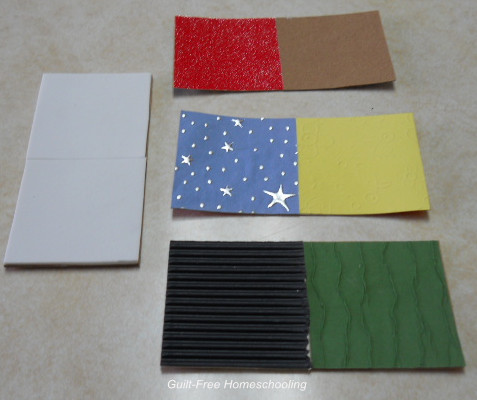
Would you like a few details on the textures I used? White is a sheet of craft foam with a smooth texture. Black is a finely corrugated paper, sort of like the inside layer of corrugated cardboard (only smaller). Green has tiny wrinkles running in rows across the paper (I glued these together so that the lines on the black squares went in the opposite direction from the wrinkle lines on the green squares). Blue has silver stars and dots that almost feel like molten metal that was poured onto the surface of the paper. Yellow has an embossed floral design. Red is a glitter paper with a very fine texture. Tan is a fine-grit sandpaper with a little more roughness than the red glitter paper. Check out the scrapbooking supply stores in your area or talk to a friend who does scrapbooking to find some great materials. The selections vary seasonally, and something I mentioned may no longer be available. Since these papers are glued onto cardboard, the durability of the paper itself isn’t important.

Step 2: Gluing

I prefer ultra-super-thick craft glue that doesn’t readily squirt or drip, and I smeared it onto the cardboard with the side of a toothpick, being careful to coat near the edges and down the middle where the paper squares would meet. Then I lined up the two texture squares, one on each end, and pressed down to be sure they were stuck without bubbles or gaps. (This is when you find out if you’ve used too much glue and get to wipe off the excess from the edges.) Repeat for each domino. It can help to stack the pieces in order before you start gluing, just so you don’t end up with any duplicated combinations.

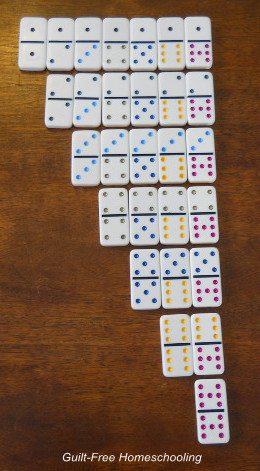
If you haven’t wasted spent countless hours of your life playing with dominoes and lining them up in patterns (as I have), this photo can help you see how to do it. I’ve used numbered dominoes (1-7) to represent the 7 textures. The top row is “texture 1” with the double-1 first, then 1-2, 1-3, 1-4, and so on to 1-7. The second row begins with the double-2 and continues through 2-7. Each subsequent row starts with its double, until row 7 contains only the double-7. Once the textured dominoes are ready for play, they can be arranged in any order. Since they don’t have numbers, any texture can be assigned the #1 position, and the remaining textures can follow in any order as positions 2 through 7. As long as the order of the first row is followed, the same type of pattern can be produced. The textures I used also just happened to be 7 different colors (making them easy to distinguish here), but a similar set could be made with 7 colors of all the same texture or 7 textures of all the same color… or any combination in any quantity that suits your children’s needs and your own creativity.

With many cereal-box projects, such as homemade flashcards, I ignore the color-printed side and write on the plain, non-printed side. For this project, I put the glue on the plain side, leaving the colored side visible on the back of each domino as sort of a bonus puzzle. The child who wants an extra challenge can sort the backsides of these dominoes by which ones came from crackers, cereal, and brownie mix boxes. Plus, I didn’t have to worry about any printing showing through a rather thin square of paper.

Step 3: Drying

As I glued the dominoes together, they began to curl — a natural effect of getting the cardboard wet, even from my not-so-runny glue. I spread the dominoes out on the table as I finished each one and held them down with cans from my pantry until they were dry. Larger cans could hold down 2 dominoes at once, which was good because my supply of heavy cans was limited!

Step 4: Playing

This set of texture dominoes is made with a double for each texture, so it will work to play a regular game of dominoes. However, I highly recommend just handing them over to the child who has been so eager to get his hands on them all the time he’s been watching or helping you make them. He probably won’t need any instructions — he will instinctively begin matching up all the pieces bearing one specific color or texture. When he’s completed that step, he will re-sort them for another color/texture. As you can see, this step could go on for quite a while, so this would be a good time for you to sneak away to shuffle the laundry or grab another cup of coffee.

This free-play session falls into what I call “stealth learning,” and your little student will be learning very important lessons. Listen closely as he tells you all the wonderful things he has learned about textures and colors and matching. He may enjoy just rubbing his fingers across the various textures over and over again, and that’s another stealth lesson. He might use each double-domino as a catalyst for finding other items in the house that are in the same color family: more stealth lessons. He might line the dominoes up end-to-end to see if they can stretch all the way across the room, or build a house shape or letter-shapes with them, or even try to build a “house of cards” with the dominoes. Even if he isn’t ready for the proper rules of the dominoes game, your child will learn plenty from color-matching, texture rubbing, and imaginative play. Playing is learning, so let learning be play.

For more ideas:

“Stealth Learning” Through Free Play

Preschoolers’ Educational School-Time Activities

Patterns

Tactile Learners

Verified by MonsterInsights